






Birsa Munda’s Ulgulan Movement and Major Contributions
Birsa Munda was a courageous tribal leader and freedom fighter who played a significant role in India’s struggle against British colonial rule in the late 19th century. He is remembered for leading the Munda rebellion, also known as the Ulgulan or The Great Tumult, against British policies and exploitation of tribal communities. Birsa Munda is regarded as a symbol of tribal pride, social reform, and resistance. His life and sacrifices are an important part of Indian history and are frequently covered in school curricula and competitive examinations.
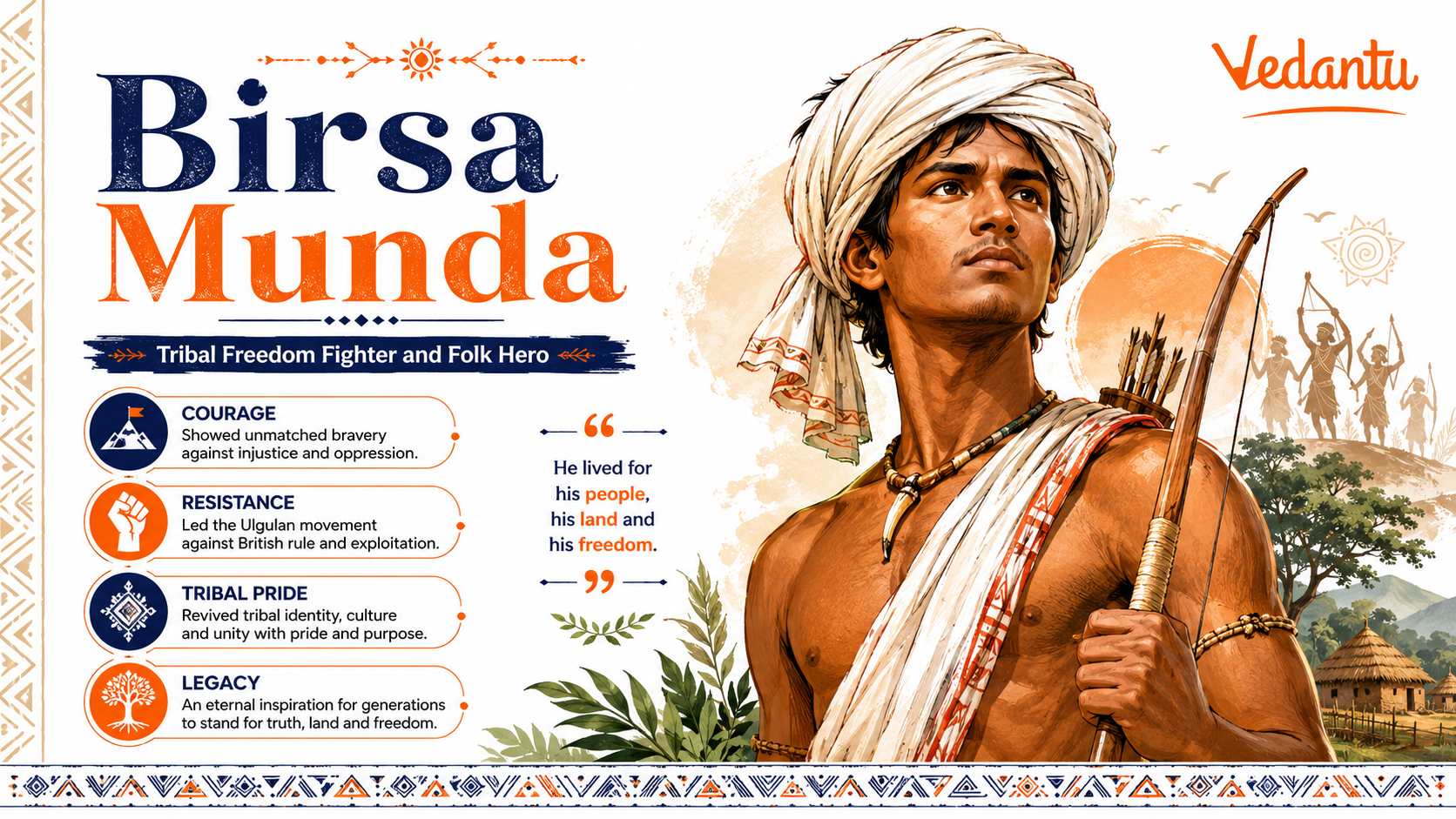
Early Life of Birsa Munda
Birsa Munda was born on 15 November 1875 in Ulihatu village, in present-day Jharkhand. He belonged to the Munda tribe, one of the prominent tribal communities of the Chotanagpur Plateau region. His parents were Sugana Munda and Karmi Hatu.
During his childhood, Birsa witnessed the exploitation of tribal people by British officials, landlords, and missionaries. He received his early education at a German Missionary School, where he was briefly influenced by Christianity. However, he later rejected missionary teachings and began promoting indigenous religious and cultural values.
Social and Religious Reforms
Birsa Munda emerged as a social and religious reformer before becoming a political leader. He aimed to reform tribal society by encouraging moral values, unity, and a return to traditional customs.
Key Reform Measures
- Opposed conversion to Christianity and promoted tribal faith.
- Encouraged people to give up superstitions and harmful practices.
- Promoted cleanliness, discipline, and moral living.
- Inspired unity among tribal communities against exploitation.
Because of his teachings and leadership, many followers regarded him as a divine figure and called him "Dharti Aba", meaning Father of the Earth.
The Munda Rebellion - Ulgulan
The Munda Rebellion, also known as Ulgulan, took place between 1899 and 1900. It was a major tribal uprising against British rule and the feudal system imposed on tribal lands. The rebellion was mainly centered in the Chotanagpur region.
Causes of the Rebellion
- Forced labor system known as beth begari.
- Land alienation due to British land revenue policies.
- Exploitation by moneylenders and landlords.
- Interference in tribal culture and traditions.
Objectives of the Rebellion
- End British rule in the tribal region.
- Restore traditional tribal land ownership system.
- Protect tribal identity and customs.
Although the British suppressed the rebellion, it had a lasting impact. As a result of the movement, the British government introduced the Chotanagpur Tenancy Act of 1908, which restricted the transfer of tribal land to non-tribals.
Key Facts About Birsa Munda
| Particular | Details | Significance |
|---|---|---|
| Date of Birth | 15 November 1875 | Observed as Janjatiya Gaurav Diwas in India |
| Major Movement | Munda Rebellion 1899-1900 | Tribal resistance against British rule |
| Title Given | Dharti Aba | Symbol of tribal pride and reform |
These key facts are frequently asked in competitive examinations and help in quick revision of important points related to Birsa Munda.
Arrest and Death
Birsa Munda was arrested by the British in February 1900. He died in Ranchi Jail on 9 June 1900 at the young age of 25. The official cause of death was declared as cholera, although his sudden death raised suspicions among his followers.
Despite his short life, Birsa Munda left a powerful legacy that continues to inspire tribal movements and social justice campaigns across India.
Legacy and Importance in Modern India
Birsa Munda is remembered as one of the earliest tribal freedom fighters who challenged colonial authority. His contributions are recognized in several ways in modern India.
- 15 November is celebrated as Janjatiya Gaurav Diwas.
- Birsa Munda Airport in Ranchi is named after him.
- Statues and institutions across India honor his memory.
- He is regarded as a symbol of tribal empowerment.
Why Birsa Munda is Important for Competitive Exams
Questions about Birsa Munda are commonly asked in General Knowledge, History, and current affairs sections of various examinations. Understanding his role helps students grasp the broader theme of tribal resistance during British rule.
Exam Preparation Tips
- Remember key dates such as his birth and death.
- Focus on the causes and impact of the Munda Rebellion.
- Understand the significance of the Chotanagpur Tenancy Act.
- Note important titles like Dharti Aba.
A clear understanding of Birsa Munda’s life, reforms, and rebellion helps in answering both objective and descriptive questions effectively. His story reflects courage, leadership, and the fight for justice, making him a key figure in Indian history and General Knowledge studies.
FAQs on Birsa Munda: Life and Tribal Freedom Movement
1. Who was Birsa Munda?
Birsa Munda was a tribal freedom fighter and social reformer who led the Munda Rebellion (Ulgulan) against British rule in India.
- Born on 15 November 1875 in present-day Jharkhand
- Belonged to the Munda tribe
- Fought against British colonial policies and zamindari system
- Known as “Dharti Aba” (Father of the Earth) by tribal communities
He is remembered as a key figure in tribal resistance movements and India’s freedom struggle.
2. What is the Ulgulan movement led by Birsa Munda?
Ulgulan means “The Great Tumult” and refers to the tribal revolt led by Birsa Munda in 1899–1900.
- Aimed to end British rule and landlord exploitation
- Opposed forced labor (beth begari)
- Demanded restoration of tribal land rights
- Focused on social and religious reforms
The movement became a significant chapter in the history of tribal uprisings in India.
3. Why is Birsa Munda called Dharti Aba?
Birsa Munda is called “Dharti Aba” because tribal people regarded him as their protector and spiritual leader.
- “Dharti Aba” means Father of the Earth
- He fought to protect jal, jangal, zameen (water, forest, land)
- Inspired social and religious awakening among tribals
This title reflects his role in defending tribal identity and land rights.
4. When and where was Birsa Munda born?
Birsa Munda was born on 15 November 1875 in Ulihatu village, in present-day Jharkhand.
- Born into a poor Munda tribal family
- Grew up during British colonial rule
- His birthplace is now a historical site
His birth anniversary is celebrated as Janjatiya Gaurav Divas in India.
5. What were the main objectives of Birsa Munda’s movement?
The main objective of Birsa Munda’s movement was to free tribal people from exploitation and British control.
- End British colonial administration
- Remove oppressive zamindars and moneylenders
- Restore traditional Khuntkatti land system
- Promote moral and social reforms
His struggle highlighted issues of tribal rights, land alienation, and self-rule.
6. How did Birsa Munda die?
Birsa Munda died on 9 June 1900 in Ranchi Jail under mysterious circumstances.
- Arrested by British authorities in 1900
- Official cause reported as cholera
- Many believe his death remains suspicious
He died at the young age of 25, becoming a martyr in India’s freedom movement.
7. What reforms did Birsa Munda introduce among tribal communities?
Birsa Munda introduced important social and religious reforms among tribal people.
- Opposed superstitions and blind faith
- Encouraged education and unity
- Promoted a new faith called Birsait
- Urged people to avoid alcohol and immoral practices
His reforms strengthened tribal identity and cultural pride.
8. What was the impact of Birsa Munda’s rebellion?
The rebellion led by Birsa Munda forced the British to introduce laws protecting tribal land rights.
- Led to the Chotanagpur Tenancy Act, 1908
- Restricted transfer of tribal land to non-tribals
- Recognized tribal land ownership systems
His movement had a lasting impact on tribal welfare laws and policies in India.
9. Why is Birsa Munda important in Indian history?
Birsa Munda is important because he symbolizes tribal resistance against British rule.
- One of the youngest tribal freedom fighters
- Leader of a major indigenous uprising
- Inspired later tribal and peasant movements
He holds a significant place in modern Indian history, freedom struggle, and tribal movements.
10. How is Birsa Munda remembered today?
Birsa Munda is remembered as a tribal hero and national icon in India.
- His birth anniversary (15 November) is celebrated as Tribal Pride Day
- Statues and institutions are named after him
- Ranchi airport is named Birsa Munda Airport
- Featured in school textbooks and competitive exams
He remains a symbol of tribal empowerment, resistance, and social reform.
