








How to draw the Lewis dot structure of PBr3 with formal charges and molecular geometry
In PBr3, phosphorus has five valence electrons in its valence shell, out of these five electrons, three form sigma bonds with three bromine atoms and two electrons remain on the phosphorus atom as a lone pair of electrons. Hence, the hybridization of PBr3 is sp3 and the geometry will be trigonal pyramidal due to the presence of a lone pair of electrons on the central atom. Since the geometry is asymmetrical, the molecule will be polar. PBr3 has 26 valence electrons of which bromine atoms can consume eight each in bonding pairs and two electrons in lone pairs on phosphorus. In the Lewis structure of PBr3, the formal charge on the terminal bromine atom is zero.
Lewis Structure of PBr3
The Lewis structure of PBr3 contains three sigma bonds between phosphorus and three bromine atoms. The phosphorus is at the centre and it is surrounded by bromine atoms. The phosphorus has one lone pair of electrons and bromine atoms have three lone pairs of electrons. The hybridization of PBr3 is sp3. Hence, the electron geometry will be tetrahedral because the phosphorus atom has one lone pair and three bonded pairs with bromine atoms. So, there are four regions of electron density around the central atom. But it has a trigonal pyramidal shape or geometry due to the presence of lone pairs on the central atom. The Lewis structure of this molecule is given below.
Lewis Structure of PBr3
The above image shows the Lewis structure of PBr3. Phosphorus is attached to three bromine atoms by sigma bonds and one lone pair can be seen on the phosphorus atom.
Phosphorus Lewis Structure
The atomic number of the phosphorus atom is 15 and the electronic configuration is as follows: 1s2 2s2 2p6 3s2 3p3
It is clear from the electronic configuration that phosphorus has five valence electrons. Hence, the Lewis dot structure of phosphorus can be drawn by showing electrons on phosphorus atoms as dots. The Lewis dot structure of phosphorus is as follows:
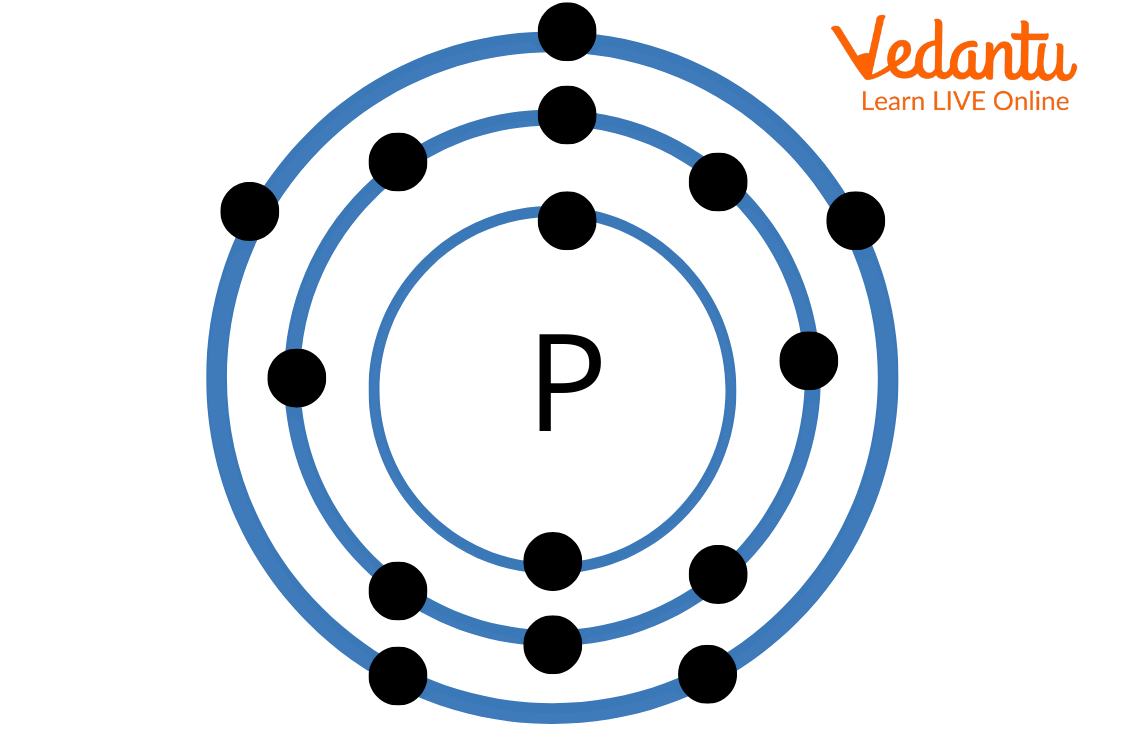
Lewis Structure of Phosphorus
Above image is the Lewis structure of phosphorus. It can be seen that there are five electrons on the Phosphorus atom.
Bond Angle of PBr3
The bond pair-bond pair repulsion increases more than the lone pair-bond pair repulsion when going down a group. So, due to bond pair-bond pair repulsion, the bromine bond angle is more than chlorine.
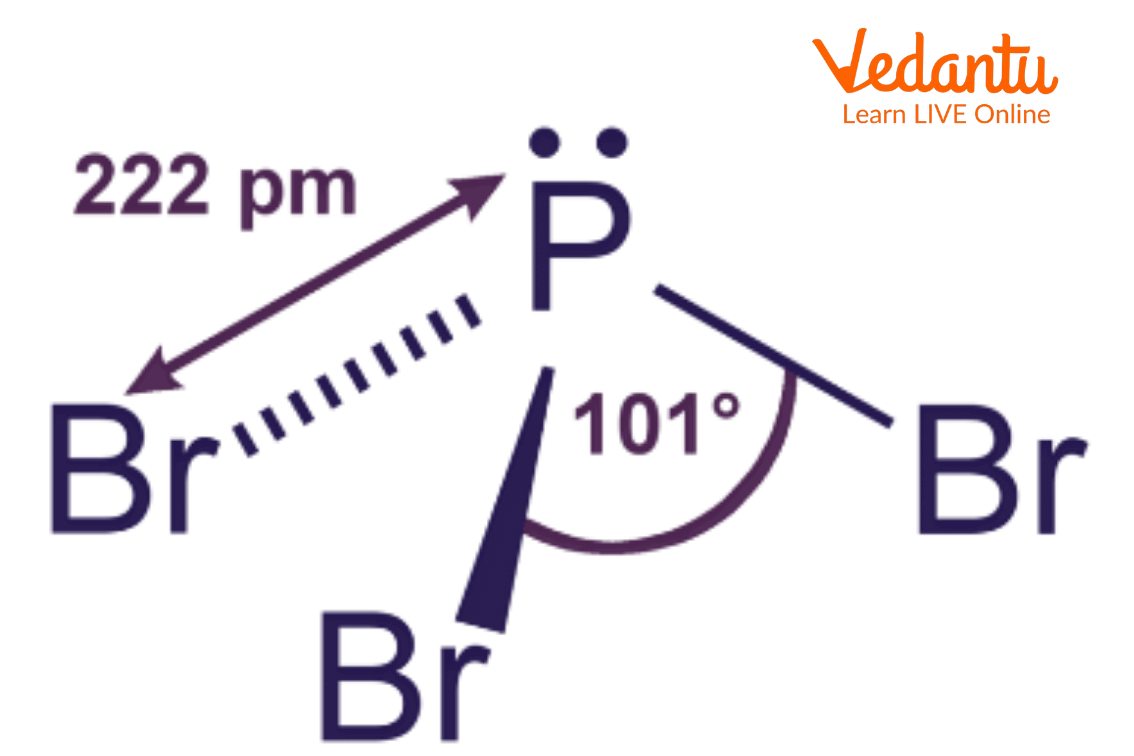
Since PBr3 is formed by a trigonal pyramidal geometry. The bond angle between Phosphorus and each bromine atom will be 101 degrees.
Bond Angle in PBr3
The above image shows the bond angle between phosphorus and bromine atoms which is 101 degrees in phosphorus and each bromine atom.
PBr3 Name
The name of PBr3 is phosphorus tribromide or tribromo phosphine.
PBr3 Lewis Structure Molecular Geometry
For PBr3, the central atom is phosphorus, three bromine atoms form bonds with it and it has one modified shape to trigonal pyramidal geometry. The molecular geometry of lone pairs of electrons give rise to an sp3 hybridization and form tetrahedral geometry.
Trigonal pyramidal geometry is also shown by molecules which have four atoms or ligands. The central atom will be the apex and three other atoms or ligands will be at one base, where they are in the three corners of the triangle. There is one lone pair of electrons on the central atom.
Lewis Dot Structure of PBr3
In the Lewis dot structure of PBr3, the phosphorus atom has a total of eight electrons. Six electrons are shared between phosphorus and each bromine atom and the remaining two electrons are present on phosphorus atoms as lone pairs of electrons. Each bromine atom has three lone pairs of electrons and two shared electrons between phosphorus and bromine.
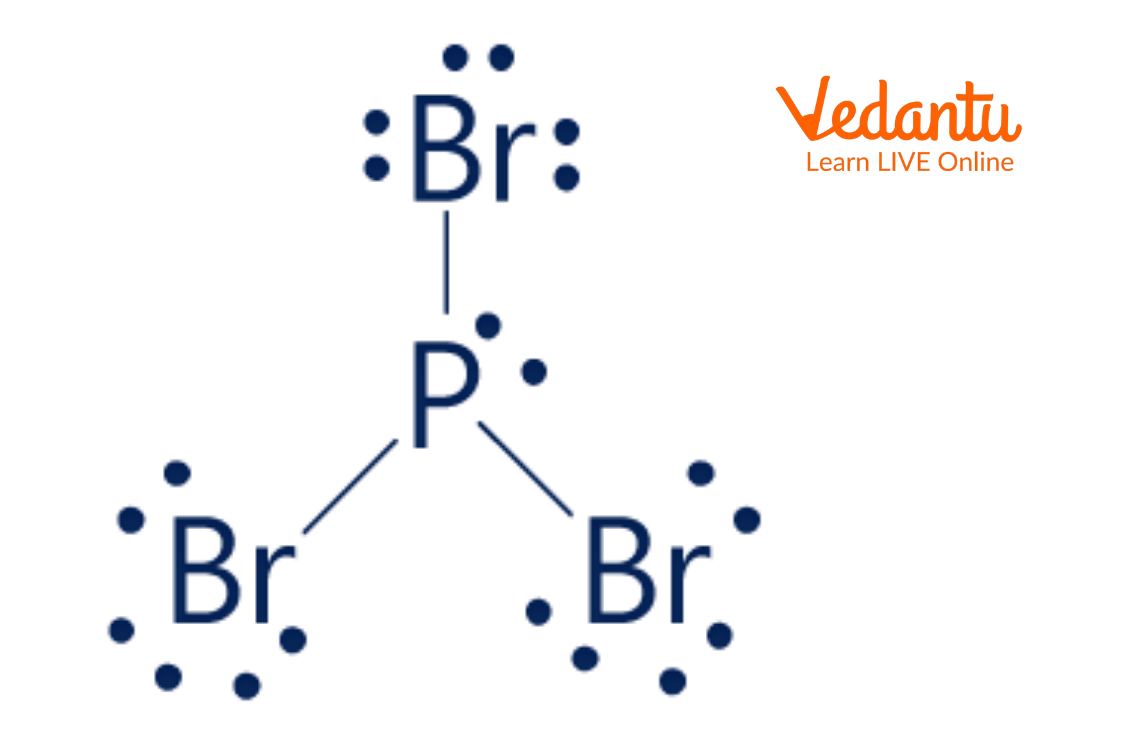
Lewis Dot Structure of PBr3
The above image is the Lewis structure of PBr3. In the structure, the phosphorus atom is bonded with three bromine atoms and has a lone pair.
Key Features of Lewis Structure of PBr3
Lewis structures extend the concept of the electron dot structure by adding lines between atoms to represent shared pairs in a chemical bond.
Trigonal pyramidal geometry results from tetrahedral electron pair geometry when a lone pair is present on the central atom.
The Lewis structure PBr3 has trigonal pyramidal shape according to its molecular geometry and tetrahedral shape according to its electron geometry.
The trigonal pyramidal molecule is symmetrical about the central atom.
For trigonal pyramidal geometry, the bond angle is slightly less than 109.5 degrees.


FAQs on Lewis Structure of PBr3 with Bonding and Geometry
1. What is the Lewis structure of PBr3?
The Lewis structure of PBr3 shows a central phosphorus atom bonded to three bromine atoms with single bonds and one lone pair on phosphorus.
- Total valence electrons = 5 (P) + 3×7 (Br) = 26 valence electrons.
- Phosphorus forms three single P–Br bonds (6 electrons).
- Each bromine has three lone pairs to complete its octet.
- One lone pair remains on phosphorus.
2. How many valence electrons are in PBr3?
PBr3 has a total of 26 valence electrons.
- Phosphorus (Group 15) contributes 5 valence electrons.
- Each bromine (Group 17) contributes 7 valence electrons.
- Calculation: 5 + (3 × 7) = 26 electrons.
3. What is the molecular geometry of PBr3?
The molecular geometry of PBr3 is trigonal pyramidal.
- There are four electron domains around phosphorus (3 bonding pairs + 1 lone pair).
- According to VSEPR theory, the electron geometry is tetrahedral.
- The lone pair causes the molecular shape to become trigonal pyramidal.
4. What is the electron geometry of PBr3?
The electron geometry of PBr3 is tetrahedral.
- Phosphorus has four regions of electron density (3 bonds + 1 lone pair).
- Electron geometry considers both bonding and lone pairs.
- According to VSEPR theory, four electron domains arrange tetrahedrally.
5. Is PBr3 polar or nonpolar?
PBr3 is a polar molecule.
- It has a trigonal pyramidal shape with one lone pair on phosphorus.
- The P–Br bonds are slightly polar due to electronegativity differences.
- The asymmetrical shape prevents dipole cancellation.
6. Does PBr3 obey the octet rule?
Yes, PBr3 obeys the octet rule for all atoms in its Lewis structure.
- Phosphorus has 3 bonding pairs (6 electrons) + 1 lone pair (2 electrons) = 8 electrons.
- Each bromine has 3 lone pairs and 1 bonding pair = 8 electrons.
7. How do you draw the Lewis structure of PBr3 step by step?
To draw the Lewis structure of PBr3, first calculate 26 valence electrons and then arrange atoms with phosphorus in the center.
- Step 1: Count valence electrons (5 + 3×7 = 26).
- Step 2: Place phosphorus in the center and form three single P–Br bonds.
- Step 3: Distribute remaining electrons to complete octets on bromine atoms.
- Step 4: Place the remaining lone pair on phosphorus.
- Step 5: Check that all atoms satisfy the octet rule.
8. What is the bond angle in PBr3?
The bond angle in PBr3 is approximately 101°.
- The ideal tetrahedral angle is 109.5°.
- The lone pair on phosphorus exerts greater repulsion than bonding pairs.
- This lone pair–bond pair repulsion reduces the bond angle.
9. What type of bonds are present in PBr3?
PBr3 contains three single covalent P–Br bonds.
- Each bond involves sharing one pair of electrons.
- The bonds are slightly polar due to electronegativity difference between P and Br.
- No double or triple bonds are present.
10. What is the hybridization of phosphorus in PBr3?
The hybridization of phosphorus in PBr3 is sp3.
- Phosphorus forms three sigma bonds with bromine.
- It has one lone pair.
- Total electron domains = 4, which corresponds to sp3 hybridization.
