


NCERT Solutions for Class 8 Social Science Chapter 5 PDF Download
Big Questions
1. What does it mean to be a citizen, not just legally, but in everyday life?
Answer:
Legally, being a citizen means being a recognised member of a country with certain rights. In everyday life, citizenship also means acting responsibly. A good citizen follows laws, respects others' rights and dignity, helps people when possible, cares for public spaces, and speaks out against unfair treatment. Citizenship therefore involves both enjoying rights and fulfilling responsibilities.
2. Why are both rights and duties essential?
Answer:
Rights allow people to live with freedom, dignity, and equality, while duties remind them to respect others' rights and freedoms. Rights without duties can lead to irresponsible behaviour, while duties without rights can limit individual freedom. Both are necessary for a peaceful, fair and democratic society.
3. How can we help build a society where everyone is treated fairly, respected, and included?
Answer:
We can help build such a society by respecting diversity, avoiding discrimination and including people from different backgrounds in activities and decisions. We should support people who face disadvantages, speak against unfair treatment and fulfil our responsibilities as citizens. Small actions based on kindness, equality and respect can make society more inclusive.
LET’S EXPLORE
What do you observe in the illustrations above? As you can see, giving the same thing to everyone does not always provide the same benefits because people are different. These differences can be due to Fig. 5.3. EQUALITY: Everyone receives the same support. EQUITY: Everyone gets the support they need, fairly. 149 Governance and Democracy 5 – Citizenship: Rights and Duties to inequality and discrimination, which may have been carried historically too. To ensure everyone gets the support they need, we look at the principle of equity (as you can see in the figure on the right). The government and civil society organisations have taken many initiatives to ensure equity in such cases. The Beti Bachao Beti Padhao campaign aimed to raise awareness in society and support girls’ education. Can you think of other such examples?
Answer:
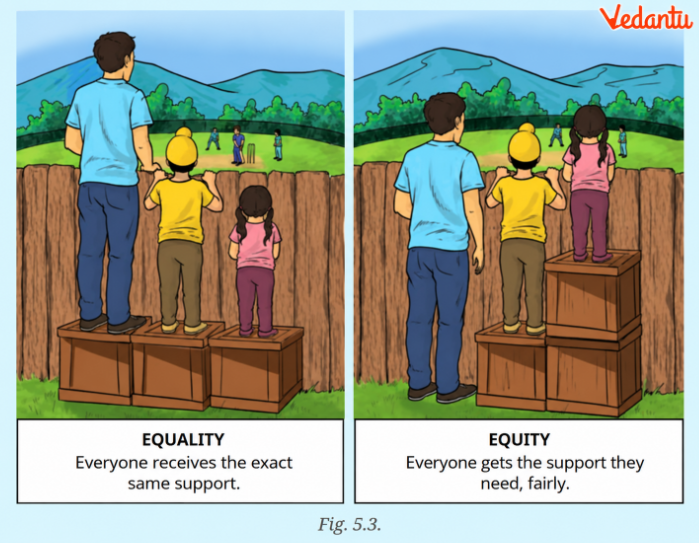
The illustrations explain the difference between equality and equity. Equality means giving everyone the same support. However, people may have different needs or may begin from different situations, so equal support may not always produce fair results. Equity means giving people the support they specifically need so that everyone has a fair opportunity.
Some individuals and communities may face disadvantages because of economic conditions, disability or discrimination. In such cases, additional support can help create greater fairness. Examples include scholarships for students from economically weaker families, accessible facilities for persons with disabilities and school meal programmes that support children’s education. Such initiatives aim to reduce disadvantages and create more equal opportunities.
THINK ABOUT IT
What would you do if you saw a child working instead of being in school? Discuss in class, then write one step you could take:
Could you talk to your teacher or principal?
Could you write to a child helpline?
Answer:
If I saw a child working instead of attending school, I would inform a trusted adult, such as my teacher or principal. They could guide me on how to report the situation safely to the appropriate authorities or child protection services. I would not confront anyone directly because the child’s safety should come first.
Taking responsible action can help protect a child’s right to education and well-being.
LET’S EXPLORE
“If I was asked to name any particular article in this Constitution as the most important — an article without which this Constitution would be a nullity— I could not refer to any other article except this one [right to constitutional remedies]. It is the very soul of the Constitution and the very heart of it…”, said Dr B.R. Ambedkar during the Constituent Assembly Debates. Why is it important to have a way to protect rights?
Answer:
Protecting rights matters because they become meaningful only when people can seek help if those rights are violated. The Right to Constitutional Remedies enables citizens to approach the courts to protect their Fundamental Rights.
This ensures that rights are not merely promises written in the Constitution but can actually be enforced. This is why Dr B.R. Ambedkar regarded the Right to Constitutional Remedies as extremely important.
THINK ABOUT IT
Can you name a duty that matches your right to education?
Answer:
A duty that goes with the right to education is to attend school regularly and learn sincerely. Students should also respect teachers and classmates, follow school rules, complete their work and participate responsibly in learning. By fulfilling these duties, students use their right to education properly.
LET’S EXPLORE
Here are some everyday situations to reflect on. Which right or duty is involved?
- Ravi decides not to join a protest march at school because he disagrees with it. Some classmates say they will exclude him from their group unless he joins.
Answer:
This situation relates to the Right to Freedom, particularly freedom of expression. Ravi should be free to express his opinion and decide whether he wants to participate. His classmates must respect his choice and should not exclude him because he holds a different opinion.
- On School Culture Day, Rukmini wants to wear her family’s traditional dress from her village. Some students laugh at her and say she should wear ‘modern’ clothes instead.
Answer:
This situation involves equality and respect for cultural diversity. Rukmini should be able to express her cultural identity without being mocked or treated unfairly. Her classmates have a duty to respect different cultures and traditions.
- During the recess, some children were throwing chocolate wrappers on the playground instead of in the dustbin. The teacher reminded them to keep the area clean.
Answer:
This situation highlights the responsibility to protect the environment and keep our surroundings clean. Students use common spaces such as playgrounds, so they also have a duty to dispose of waste properly and help maintain those spaces.
- In a mock youth parliament activity, students use a voting app to share their ideas for improving school facilities. Even students in remote areas can join the discussion online.
Answer:
This situation reflects freedom of expression and democratic participation. Technology lets students, including those in remote areas, express their views and join discussions. It also shows how technology can support inclusive participation when used responsibly.
Can we demand rights without doing our duties?
Answer:
Rights and duties go together. We can expect our rights to be respected, but we must also respect others' rights and fulfil our responsibilities. Duties encourage us to use our freedoms responsibly and contribute to a fair and peaceful society.
LET’S EXPLORE
The following are two caselets. Read them individually and discuss the questions at the end in small groups.
-A group of students makes fun of Rohan’s weight; they nickname him ‘Drummy’. They make it difficult for him to join their football game, joking that he would be competing with the football. Everyone around notices the group's behaviour.
-Mina’s school announced an overnight educational trip to a historical site. Many of her classmates were excited and enrolled immediately. Mina, however, did not; she knew her family could not afford it. When her friends found out, some started ignoring her and whispering that she “wasn’t fun”, “never joined anything”, or “was not of their status”. Mina felt hurt and left out.
What are the types of discrimination you can identify in the examples given above? What would you do if you were part of the groups? Have you faced discrimination yourself? What did you do about it?
Answer:
In Rohan’s case, the students are discriminating against him because of his physical appearance. Making insulting comments about his weight and excluding him from a game is disrespectful and can affect his dignity and confidence.
In Mina’s case, her classmates exclude her because of her family’s economic situation. Her classmates judge her because she cannot afford the trip, even though her financial circumstances aren't her fault.
If I were part of either group, I would not participate in the teasing or exclusion. I would ask the others to stop, include Rohan and Mina in activities, and, if necessary, speak to a teacher or another trusted adult.
The last part is based on personal experience, so each student’s answer may be different. If I experienced discrimination, I would speak to someone I trusted and seek help rather than remain silent.
THINK ABOUT IT
Imagine a student in your class who takes a little longer to read or write because they learn differently. Sometimes during group work, others do not wait for them or forget to include them. What would you do in this situation? Could you support them by being patient, explaining something clearly, or making sure they get a chance to speak? What steps can you take to make your classroom more inclusive?
Answer:
I would be patient and give the student enough time to read, write or express their ideas. If they needed help, I would explain things clearly without making them feel uncomfortable. During group activities, I would make sure they were included and had an equal opportunity to speak and participate.
We can make the classroom more inclusive by:
Giving everyone a chance to participate.
Helping classmates when they need support.
Avoiding teasing or laughing at mistakes.
Respecting different ways and speeds of learning.
Working in groups where students support one another.
Informing the teacher when a student needs additional help.
An inclusive classroom is one where every student feels respected, supported and valued.
Questions and activities
1. Why is it important to respect others’ religions?
Answer:
It is important to respect others’ religions because people have the freedom to follow their beliefs, and India is home to people belonging to many faiths. Respecting different religions promotes equality, harmony and peaceful coexistence and helps people live together without discrimination.
2. How would you feel if you were left out of something?
Answer:
I would feel hurt, lonely and disappointed if I were deliberately left out. Exclusion can make a person feel disrespected or undervalued. That is why we should try to include others and make sure everyone feels welcome.
3. If rights are guaranteed, why do we still see discrimination in society?
Answer:
Although rights are guaranteed, discrimination can continue because of prejudice, stereotypes, social attitudes and existing inequalities. Laws can protect people, but society also needs changes in behaviour and attitudes. People must actively oppose unfair treatment and practise equality and inclusion in everyday life.
4. Can there ever be a conflict between rights and duties? Give an example.
Answer:
Yes, rights and duties can sometimes appear to conflict. For example, a person has the right to freedom of speech, but they should exercise that freedom responsibly. A person should not use it to harm others or unlawfully disrupt public order. This shows why rights must be exercised with responsibility.
5. How does respecting diversity strengthen democracy?
Answer:
Respecting diversity helps people from different religions, languages, cultures and backgrounds feel valued and included. When different groups have an equal opportunity to participate and express their views, democracy becomes more representative and inclusive. Respect for diversity therefore promotes equality, unity and democratic participation.
6. Do you think technology (social media, online platforms) makes it easier or harder to practise citizenship? Why?
Answer:
Technology can make practising citizenship easier by letting people share ideas, access information, discuss issues, and participate in online activities. It can also connect people who live far away.
However, technology can create problems when people use it to spread false information, disrespect others, or discriminate against people. Therefore, technology supports good citizenship when used responsibly, respectfully, and carefully.
7. Imagine everyone in society enjoyed rights but ignored their duties. What would life look like?
Answer:
If everyone demanded their rights but ignored their duties, society could become disorderly and unfair. People might not respect others, care for public property, protect the environment, or follow rules meant to support everyone’s well-being.
Rights and duties therefore need to work together. Rights protect individual freedom and dignity, while duties encourage people to act responsibly towards others and society.
8. How can students your age practise inclusion in everyday school life?
Answer:
Students can practise inclusion by respecting classmates from different backgrounds, inviting everyone to participate in activities and avoiding teasing or discrimination. They can help classmates who need support, listen to different opinions and speak up when someone is being treated unfairly. These everyday actions can make school a more welcoming and respectful place.
9. What can be done in the following situations?
a) A school does not allow girls to join a mathematics or science club. b) A fellow student has dropped out of school because they are forced to work in a welding shop.
Answer:
a) Preventing girls from joining a mathematics or science club is discriminatory. Students or parents can raise the issue with teachers or school authorities and ask that girls be given the same opportunity to participate as other students.
b) If a student has left school because they are being forced to work, a trusted adult such as a teacher or principal should be informed. The school can then notify the appropriate child protection authorities so the child can receive support and return to education.
10. Make a classroom charter that outlines rights and duties, and ensures inclusion and prevents discrimination.
Answer:
Our Classroom Charter
How NCERT Solutions Help with Class 8 Social Science Chapter 5 Citizenship: Rights and Duties
Review the key ideas of citizenship, rights and duties with clear answers based on the chapter.
Check your responses to textbook questions and understand where important points need to be added.
Learn how citizens' rights are linked to responsibilities toward others and society.
Use the solutions to prepare clearer answers for conceptual, discussion-based and activity-based questions.
Keep the NCERT Class 8 Social Science Chapter 5 Solutions PDF handy for quick revision before assessments and exams.
H2: Related Study Materials for CBSE Class 8 Social Science Chapter 5: Citizenship: Rights and Duties
Explore Chapter-Wise NCERT Solutions for Class 8 Social Science Part 2
Related Study Material for Class 8 Social Science
FAQs on NCERT Solutions for Class 8 Social Science Chapter 5: Citizenship: Rights and Duties
1. What is citizenship in Class 8 Social Science?
Citizenship refers to a person's membership in a country and their relationship to the larger community. The chapter helps students understand citizenship through rights, duties, and responsible participation.
2. What is the difference between rights and duties of a citizen?
Rights are the freedoms and protections citizens are entitled to, while duties are the responsibilities they are expected to fulfil. The two are connected because exercising one's rights should also involve respecting others' rights.
3. Why are rights and duties important for citizens?
Rights protect people's freedom, dignity, and interests, while duties encourage citizens to act responsibly towards society and others. Together, they contribute to responsible citizenship.
4. What does responsible citizenship mean for Class 8 students?
Responsible citizenship means understanding one's rights while also respecting others and fulfilling responsibilities towards society. For students, it can also involve behaving responsibly, respecting rules and participating positively in their community.
5. How are rights and duties connected in everyday life?
People exercise rights in many everyday situations, but they must also respect others' rights. This creates a balance between individual freedom and responsibility towards the community.
6. What should I study in Class 8 Social Science Chapter 5: Citizenship: Rights and Duties?
Focus on the main ideas introduced in the chapter, particularly citizenship, rights, duties and responsible participation. Students should also study the examples, discussions, and activities in the NCERT textbook carefully.
7. How can I prepare Class 8 Social Science Chapter 5 for exams?
Read the chapter carefully, understand the main concepts, complete the textbook questions and activities, and practise explaining ideas in your own words. Use the NCERT solutions afterwards to check whether your answers cover the important points.
8. Where can I find answers to Class 8 Social Science Chapter 5?
Students can use Vedantu's chapter-wise NCERT solutions to check answers to the questions and activities in Citizenship: Rights and Duties. It is best to attempt each question independently before checking the solution.