



Practise Class 4 EVS Chapter 1 Important Questions on Living Together
Practise these solved questions on Chandan's village, community services, Van Mahotsav, occupations, shared responsibilities and examples of cooperation from different parts of India.
Class 4 EVS Chapter 1 Important Questions MCQ with Answers
Q1. Where do Chandan and his friends play after school?
(a) Near the river
(b) In a big playground
(c) Inside the market
(d) At the health centre
Answer: (b) In a big playground.
Explanation: Chandan plays kabaddi and other games with his friends in the playground near his house. A large banyan tree stands at one corner of the playground.
Q2. Why did John suggest cleaning the park and planting trees during Van Mahotsav?
(a) To build a shopping centre
(b) To improve the park and its surroundings
(c) To close the playground
(d) To construct a new road
Answer: (b) To improve the park and its surroundings.
Explanation: John wanted everyone to clean the park and plant trees. These activities would make the shared space cleaner, greener and more pleasant for visitors.
Q3. Who offered to bring saplings from a plant nursery for Van Mahotsav?
(a) Babita
(b) Mallika
(c) Noor
(d) Sheela
Answer: (c) Noor.
Explanation: Noor offered to bring saplings from the nursery so that the villagers could plant them along the boundary of the park.
Q4. In which state did villagers build a bridge across the Chinar River in 2024?
(a) Assam
(b) Chhattisgarh
(c) Sikkim
(d) Rajasthan
Answer: (b) Chhattisgarh.
Explanation: In Kanker, Chhattisgarh, villagers built a bridge using bamboo, stones and other materials to help people cross the Chinar River during the rainy season.
Q5. Which of the following best shows cooperation in a community?
(a) Throwing rubbish in a public park
(b) Refusing to share common facilities
(c) Working together to clean and repair a playground
(d) Damaging plants growing near a school
Answer: (c) Working together to clean and repair a playground.
Explanation: Cooperation means helping one another to complete a task. Cleaning and maintaining shared spaces benefits everyone in the community.
Class 4 EVS Chapter 1 Very Short Answer Questions
Q6. What is a community?
Answer: A community is a group of people who live, work or interact together, share common spaces and help one another.
Q7. When is Van Mahotsav celebrated in India?
Answer: Van Mahotsav, the Tree Planting Festival, is celebrated from 1 July to 7 July every year.
Q8. Who offered to repair the benches and the street light near the park?
Answer: Sameer offered to repair the benches, while Babita offered to repair the street light.
Q9. What is a sapling?
Answer: A sapling is a young tree that can be planted and cared for as it grows.
Q10. What happens when used banana leaves are buried in a pit?
Answer: The leaves gradually decompose and become manure, which helps improve soil quality.
Class 4 EVS Chapter 1 Short Answer Questions
Q11. Picture-Based Question: Observe Chandan's Village and Identify Community Activities.
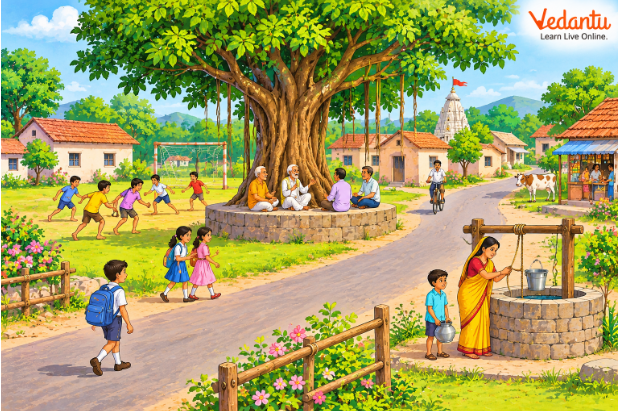
Look at the picture of a village showing houses, a playground, a banyan tree, a road, a well and people carrying out different activities.
Answer the following questions:
(a) Where do the children play?
(b) Why do elders gather under the banyan tree?
(c) Name two shared places visible in the village.
(d) How does the road help the villagers?
(e) Why should everyone take care of these places?
Answer:
(a) The children play in the village playground.
(b) Elders gather under the banyan tree to meet and talk with one another.
(c) The playground and the village road are two shared places. The well is another example.
(d) The road helps people travel and transport goods from one place to another.
(e) Everyone should help maintain these places because they are used by many people in the community.
Q12. Explain how different places and people help us in our locality.
Answer:
Different places and workers provide services that make our everyday lives easier.
Conclusion: People and places are connected because we depend on different services for our everyday needs.
Q13. How did Sameer, Babita and Noor help prepare the village park for Van Mahotsav?
Answer:
The three villagers offered different kinds of help.
Sameer: Offered wood and nails to repair the park benches.
Babita: Offered to repair the street light near the park.
Noor: Offered to bring young plants from the nursery.
Each person contributed something useful.
Their actions show that people with different skills and resources can work together to improve a public place.
Q14. Picture-Based Question: Match Community Workers with Their Tools and Work.
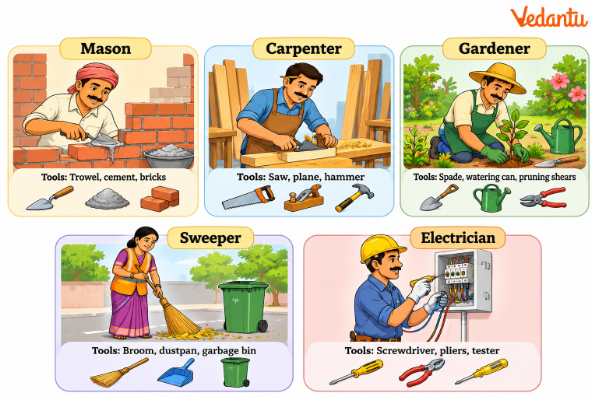
Look at the pictures showing a mason, carpenter, gardener, sweeper and electrician.
Match each worker with their main activity and tool.
Answer:
The completed table correctly matches each worker with their occupation and commonly used tools.
Explanation: Different jobs require different tools and skills. All these workers contribute to keeping public places useful, clean and safe.
Q15. What happened during the Van Mahotsav celebration in Chandan's village?
Answer:
Children and their families gathered at the village park for Van Mahotsav.
They divided themselves into groups to perform different activities.
Some people cleaned the park.
Others planted and watered saplings.
Volunteers helped prepare food.
Mallika used a microphone to make announcements.
People repaired and improved the park.
After everyone worked together, the park looked beautiful with clean paths, newly planted saplings and painted walls.
Conclusion: The celebration showed how working together can improve a shared space.
Q16. How do ants and bees show teamwork in nature?
Answer:
Ants and bees live in organised communities where different members perform different tasks.
Ants:
Some ants collect food.
Some take care of the young ones.
Others help protect their colony.
Bees:
Some bees collect food.
Some protect the young bees.
Others help build and maintain the hive.
What can we learn?
Just as ants and bees share work, people can cooperate to meet the needs of their community.
Q17. Why did villagers share a meal after the tree plantation? How did they manage the used banana leaves?
Answer:
The villagers shared a meal to celebrate their hard work during Van Mahotsav.
Families contributed vegetables and cereals, while volunteers prepared and served food.
Children helped distribute banana leaves for serving the meal.
Everyone sat together, talked and enjoyed the celebration.
After eating, the used banana leaves were placed in a pit.
They could gradually decompose into manure and improve the soil.
Conclusion: Sharing the meal brought the villagers closer, while using leaves for manure helped reduce waste.
Q18. Match the community traditions with their descriptions.
Answer:
Explanation: These traditions show how communities in different parts of India come together to celebrate, share work and support one another.
Class 4 EVS Chapter 1 Long Answer and Application-Based Questions
Q19. Explain how the villagers of Kanker built a bridge and why it was important for their community.
Answer:
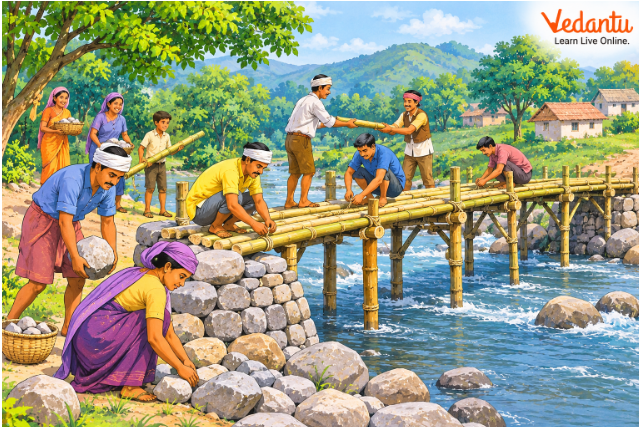
The chapter describes an example of community cooperation in Kanker, Chhattisgarh.
1. The Problem
The Chinar River often overflowed during the rainy season.
This made it difficult for villagers to cross the river, transport goods and reach schools and hospitals.
2. Working Together
During the rainy season in 2024, the villagers decided to solve the problem.
They worked together and built a simple but strong bridge in just two days.
3. Materials Used
They used bamboo, stones and other locally available materials.
4. Benefits of the Bridge
The bridge helped:
Students reach school.
Villagers cross the river more easily.
People access important services.
Goods move between places.
5. Lesson Learned
The villagers showed that a community can solve difficult problems when people cooperate and share their efforts.
Conclusion: The bridge became an example of teamwork and helping others during a time of need.
Q20. How can students and school workers make their school a better place? Explain their responsibilities.
Answer:
A school is also a community because many people work together to help students learn and stay safe.
Different Responsibilities:
How Can Students Help?
Students can:
Keep classrooms and playgrounds clean.
Avoid damaging school property.
Help classmates when needed.
Take care of trees and plants.
Participate in group activities.
Conclusion: When students and school workers work together, the school becomes a cleaner, safer and friendlier place.
Q21. Case-Based Question: Your Neighbourhood Park Needs Improvement
A neighbourhood park has broken benches, dry plants and rubbish scattered along the walking paths. Children cannot play comfortably, and older people find it difficult to sit and relax.
A group of students decides to organise a cleanliness and tree-planting activity with help from their families and neighbours.
Answer the following questions:
(a) What are the main problems in the park?
(b) Which community workers could help repair the park?
(c) Suggest three activities the students can organise.
(d) Why should family members and neighbours participate?
(e) How can the community keep the park clean after the activity?
Answer:
(a) Main Problems
The park has broken benches, dry plants and rubbish on the paths.
(b) Community Workers
A carpenter can repair the benches, while a gardener can care for the plants. Cleaning workers can help remove the waste.
(c) Three Activities
Organise a cleanliness drive.
Plant suitable saplings and water them.
Arrange repairs for damaged benches and facilities.
(d) Need for Participation
Different people can contribute time, materials, skills and effort. This makes it easier to complete the work.
(e) Keeping the Park Clean
The community can place rubbish in bins, water the plants regularly, avoid damaging property and report maintenance problems.
Conclusion: Taking responsibility for shared spaces helps everyone enjoy a better neighbourhood.
Q22. Picture-Based Question: Identify Community Places Using Clues.
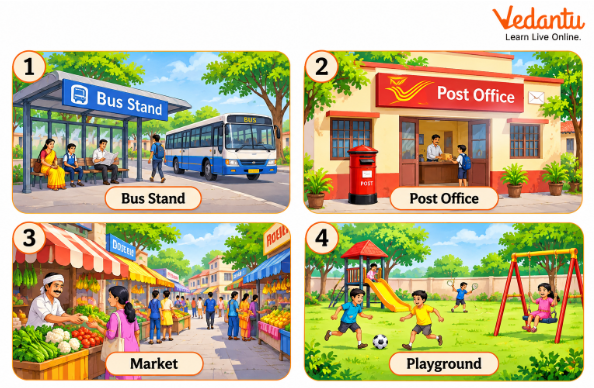
Look at four pictures showing a bus stand, post office, market and playground.
Identify the correct place from each description.
(a) People wait here to travel by bus.
(b) People send letters and parcels from this place.
(c) People buy fruits, vegetables and other daily goods here.
(d) Children run, play and enjoy swings and slides here.
Answer:
Learning: Different public places meet different needs of the community.
Q23. Imagine your school is organising Van Mahotsav. Prepare a short activity plan showing how students can work together.
Answer:
Activity Name: Green School, Happy School
Purpose: To make our school cleaner and greener.
Activity Plan:
My Role:
I will help plant saplings and water them. I will also remind my classmates to keep the school garden clean.
What Will We Learn?
We will learn the value of teamwork, sharing responsibilities and protecting nature.
Conclusion: Van Mahotsav is an opportunity for students to improve their surroundings by working together.
Key Topics and Revision Guide for Class 4 EVS Chapter 1 – Living Together
Before solving Class 4 EVS Chapter 1 important questions, go through these topics to recall how people help each other and take care of their community.
Quick Preparation Tips for Class 4 EVS Chapter 1
Recall how Chandan and his friends celebrated Van Mahotsav.
Practise matching community workers with their tools.
Identify public places and activities from pictures.
Write short answers using examples from daily life.
Exam Tip: For questions about teamwork, mention what people did together and how it helped their community.
Class 4 EVS Chapter 1 Important Questions PDF Download
Download Vedantu's Class 4 EVS Chapter 1 Important Questions PDF to practise solved MCQs, short answers, picture-based questions and real-life situations from Living Together. The PDF includes answers to help students understand community life, teamwork, Van Mahotsav and shared responsibilities. Students can use it for offline practice and exam preparation.
CBSE Class 4 EVS Chapter 1 Study Materials
Use these resources to develop a clearer understanding of Living Together.
CBSE Class 4 EVS Chapter-wise Important Questions
Explore important questions from other chapters of Our Wondrous World to practise different EVS concepts.
Important Study Materials for CBSE Class 4 EVS
FAQs on Important Questions and Answers for Class 4 EVS (Our Wondrous World) Chapter 1 – Living Together | 2026–27
1. What is Class 4 EVS Chapter 1 Living Together about?
Living Together explains how people in a community share places, services and responsibilities. Through Chandan's village and the Van Mahotsav celebration, students learn about cooperation, community helpers, public places and protecting nature.
2. What is a community in Class 4 EVS Chapter 1?
A community is a group of people who live or work together, share common spaces and help one another. A village, neighbourhood or school can be a community.
3. Why are public places important in our community?
Public places such as parks, schools, roads, markets and health centres provide services and spaces that many people use. They support education, healthcare, transport, recreation and daily needs.
4. What are the most important MCQs in Class 4 EVS Chapter 1?
Class 4 EVS Chapter 1 important questions MCQ practice should cover Chandan's village, Van Mahotsav, community helpers, public places, the Kanker bridge and different community traditions. Picture-based MCQs are also useful.
5. What is Van Mahotsav, and when is it celebrated?
Van Mahotsav is India's Tree Planting Festival, celebrated from 1 July to 7 July. People plant trees and take part in activities that help protect the environment.
6. Who helped prepare the park for Van Mahotsav in Living Together?
John suggested cleaning and planting trees. Sameer offered to repair the benches, Babita offered to repair the street light, and Noor offered to bring saplings. Mallika helped with announcements during the celebration.
7. Which community workers and tools are important in Chapter 1?
Students should learn about masons and trowels, carpenters and hammers, gardeners and watering cans, sweepers and brooms, and electricians and electrical tools. Each worker performs an important task.
8. What happened in the Kanker bridge story?
In 2024, villagers in Kanker, Chhattisgarh, built a bridge across the Chinar River using bamboo, stones and other materials. They completed it in two days, making it easier for people to travel and reach important services.
9. How do ants and bees live together in communities?
Ants and bees live in organised groups where different members perform different tasks. Some collect food, others care for young ones, and some protect their homes. They show the importance of cooperation.
10. What is Uruka in Assam?
Uruka is the first day of Magh Bihu, described in the textbook as occurring on 14 January. People come together to build a Bhela Ghar using bamboo and hay and celebrate with a feast.
11. Who are Khetala in Sikkim?
Khetala are people described in the chapter as skilled in agriculture who come together to help during harvesting. Their work shows how sharing responsibilities strengthens community bonds.
12. Why were banana leaves buried after the community feast?
The villagers placed the used banana leaves in a pit so they could decompose and become manure. This helps improve soil quality and reduces waste.
13. How can children help keep their neighbourhood clean?
Children can use waste bins, avoid littering, take care of plants, participate in supervised cleanliness activities and encourage others to protect public places.
14. What picture-based questions should students practise from Living Together?
Important pictures include Chandan's village, community workers and their tools, people planting saplings, the bridge across the Chinar River and public places such as a bus stand, market, post office and playground.
15. How can I prepare for Class 4 EVS Chapter 1 important questions and answers for exams?
Read the chapter carefully and revise the key events. Learn the roles of community helpers and practise MCQs, short answers, picture identification and situation-based questions. Try explaining your answers using examples from your own neighbourhood.
16. Where can I get Class 4 EVS Chapter 1 important questions PDF?
Download the Class 4 EVS Chapter 1 Important Questions PDF from Vedantu to practise solved MCQs, short answers and picture-based questions from Living Together offline.
17. Which textbook contains Class 4 EVS Chapter 1 Living Together?
Living Together is Chapter 1 of Our Wondrous World, under Unit 1, Our Community. It covers community life, cooperation, festivals, public spaces and shared responsibilities.
