



Practise Class 4 EVS Chapter 4 Important Questions on Growing up with Nature
Practise these solved questions on Reena and Amit's village visit, Palash flowers, natural colours, traditional storage, useful plants, solar energy, festivals and caring for the environment.
Class 4 EVS Chapter 4 Important Questions MCQ with Answers
Q1. Why were Reena and Amit excited about visiting their village?
(a) They were going to a sports competition.
(b) Their village was celebrating a harvest festival and becoming fully solar-powered.
(c) They were visiting a new shopping mall.
(d) Their village was building a railway station.
Answer: (b) Their village was celebrating a harvest festival and becoming fully solar-powered.
Explanation: Reena and Amit were visiting their village near a forest. They were excited about the harvest festival and the special occasion of their village becoming fully solar-powered.
Q2. Why is the Palash tree called the "flame of the forest"?
(a) Its leaves turn blue during summer.
(b) It produces heat like fire.
(c) Its bright orange-red flowers make the forest look reddish-orange.
(d) Its fruits glow at night.
Answer: (c) Its bright orange-red flowers make the forest look reddish-orange.
Explanation: During flowering, Palash trees are covered with orange-red flowers. From a distance, the trees look like flames. Palash is also called Kesuda in Gujarat.
Q3. What did Reena and Amit's grandmother use to make paint for the walls?
(a) Plastic colours
(b) Rice flour and water
(c) Petrol and oil
(d) Synthetic spray paint
Answer: (b) Rice flour and water.
Explanation: Their grandmother used a dye prepared by mixing rice flour and water to decorate the walls.
Q4. Why were neem leaves placed inside earthen pots used for storing grains?
(a) To change the colour of the grains.
(b) To protect the stored grains from insects and pests.
(c) To make the pots heavier.
(d) To add water to the grains.
Answer: (b) To protect the stored grains from insects and pests.
Explanation: The chapter describes a traditional storage method in which neem leaves were used inside earthen pots, while bamboo baskets were coated with cow dung on the outside.
Q5. Which of the following best explains a sacred grove?
(a) A forest cleared to build houses.
(b) A small area of forest protected by a local community.
(c) A place used only for parking vehicles.
(d) A garden without any trees or animals.
Answer: (b) A small area of forest protected by a local community.
Explanation: Sacred groves are small patches of forests where communities protect trees and wildlife. They may also be places for gathering, worship and celebrating nature.
Class 4 EVS Chapter 4 Very Short Answer Questions
Q6. What is solar energy?
Answer: Solar energy is energy received from the Sun. Solar panels can convert sunlight into electricity to run appliances such as lights and fans.
Q7. Name four natural materials used to build traditional village houses.
Answer: Clay, hay, cow dung and wood are natural materials that can be used to build traditional village houses.
Q8. What is Gond art?
Answer: Gond art is a traditional painting style that includes pictures of trees, animals, birds and people. The chapter describes wall paintings made using natural colours.
Q9. Who are the Jenu Kurubas?
Answer: The Jenu Kurubas are a tribal community from Karnataka. The word Jenu means honey, and the chapter describes their tradition of singing songs while collecting honey to show respect for bees.
Q10. What is a Tumri?
Answer: A Tumri is a traditional container made from a dried bottle gourd. The textbook gives Uttarakhand as an example of a place where it is used.
Class 4 EVS Chapter 4 Short Answer Questions
Q11. Picture-Based Question: Identify the Natural Materials and Features of a Village House.
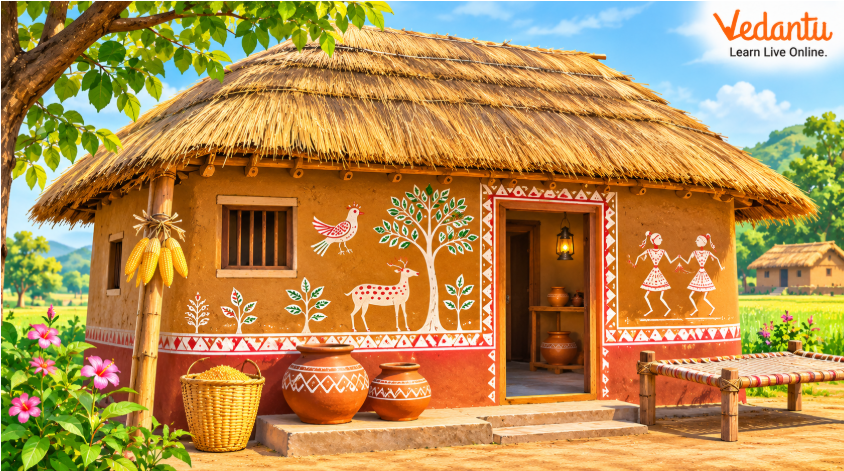
Look at the village house shown in the picture and answer the questions.
(a) What is the house made of?
(b) What natural material is used on the roof?
(c) What can you see painted on the walls?
(d) Which two natural materials can be used to make colours?
(e) Why should we learn about traditional houses?
Answer:
(a) The house is made using materials such as clay, hay and cow dung.
(b) Hay or dried grass can be used for the roof.
(c) The walls have traditional paintings showing natural designs, people or animals.
(d) Flowers and leaves can be used to make natural colours.
(e) Traditional houses teach us how people use locally available materials and knowledge.
Q12. Name five colourful flowers and mention their colours and local names.
Answer:
The chapter encourages students to observe colourful flowers growing in their area.
Explanation: A flower may have different names in different languages. Learning these names helps us understand the plants around us.
Q13. How can natural dyes be prepared from plants? Explain the steps.
Answer:
Natural dyes can be prepared using plant parts that contain colouring substances.
Steps:
Collect suitable materials such as beetroot, hibiscus flowers or marigold flowers.
Ask an adult to boil the plant materials in water.
Strain the liquid to separate the plant pieces.
Allow the coloured liquid to cool.
Use the prepared dye on a suitable piece of cloth.
Follow the instructions for soaking and drying the cloth.
Safety: Heating and boiling must be done by a teacher or responsible adult.
Conclusion: Natural dyes show how people can obtain colours from plants instead of relying only on manufactured colours.
Q14. Picture-Based Question: How Did Villagers Store Grains Using Natural Materials?
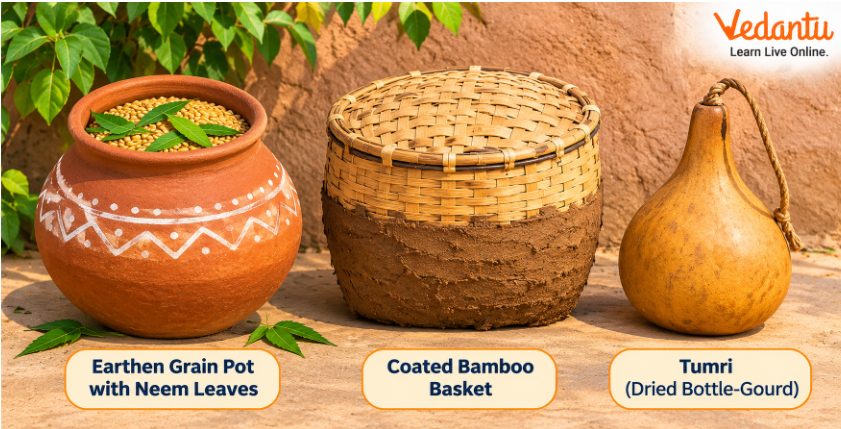
Observe the picture showing earthen pots, bamboo baskets, grains and neem leaves.
Answer the following questions:
(a) Name two traditional containers used to store grains.
(b) What was placed inside earthen pots?
(c) What was applied to the outside of bamboo baskets?
(d) Why did villagers use these methods?
Answer:
(a) Earthen pots and bamboo baskets.
(b) Neem leaves were placed inside earthen pots.
(c) Cow dung was applied to the outside of bamboo baskets.
(d) These methods helped protect stored grains from insects and pests.
Traditional Storage Table
Q15. Why is first aid important? What should we keep in a first-aid box?
Answer:
First aid is the immediate help given to a person who is injured or suddenly becomes unwell before further medical care is available.
A basic first-aid box may contain:
Clean bandages and sterile gauze
Adhesive bandages
Antiseptic wipes
Medical tape
Disposable gloves
Other supplies recommended by a responsible adult or healthcare professional
Importance of First Aid:
It helps provide quick care for minor injuries.
It can help prevent an injury from becoming worse.
It allows adults to respond while arranging further medical help.
Example from the Chapter:
Reena tells her grandfather that she has prepared a first-aid box containing medicines and mosquito repellent cream bought from the market.
Remember: Children should inform an adult about injuries and should not use medicines without adult guidance.
Q16. What are medicinal plants? Give examples of plants and their traditional uses.
Answer:
Medicinal plants are plants whose parts have been used in traditional health practices.
Explanation: Plants have different uses, but natural substances are not automatically safe as medicines. We should ask a healthcare professional or responsible adult before using plant-based remedies for treatment.
Q17. How did Reena and Amit celebrate the harvest festival in their village?
Answer:
Reena and Amit enjoyed the festival with their family and villagers.
The main celebrations included:
Houses and the village were decorated.
People wore traditional clothes and ornaments.
Prayers were offered to God and Mother Nature.
The dhol and nagada were played.
Villagers performed traditional dances.
Reena and Amit joined the celebrations.
Conclusion: The harvest festival brought the community together and showed their respect for nature and traditions.
Q18. Match the festivals with the plants or animals associated with them.
Question:
Answer:
Explanation: These examples from the textbook show how Indian festivals and community traditions are connected with plants, animals and nature.
Class 4 EVS Chapter 4 Long Answer and Application-Based Questions
Q19. Explain how the village in Growing up with Nature uses both traditional knowledge and modern technology.
Answer:
Reena and Amit's village shows how traditional practices and modern technology can be used together.
1. Natural Houses
Villagers use materials such as clay, hay and cow dung to build their houses.
These are examples of traditional construction methods.
2. Natural Paintings
People decorate walls and cloth using colours obtained from plants and other natural materials.
3. Traditional Grain Storage
Earthen pots and bamboo baskets are used to store grains.
Neem leaves and cow dung coatings are part of the traditional methods described in the chapter.
4. Solar Electricity
The village is becoming fully solar-powered.
Solar panels convert sunlight into electricity for appliances such as fans and bulbs.
5. Cultural Celebrations
The villagers continue to enjoy traditional songs, dances and harvest festivals.
Conclusion: The village shows how people can preserve useful traditions while adopting modern technology that supports everyday life.
Q20. Picture-Based Question: Identify Natural and Modern Features in a Village.
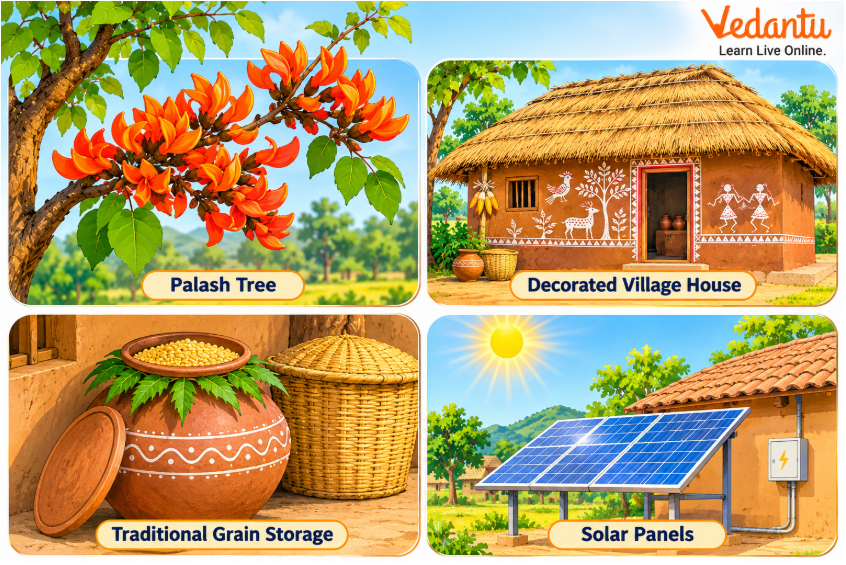
Observe the four pictures below and answer the questions.
Picture 1: A Palash tree covered with orange-red flowers.
Picture 2: A traditional house decorated with natural colours.
Picture 3: An earthen pot containing grains.
Picture 4: Solar panels providing electricity to a house.
Questions:
(a) Which picture shows the "flame of the forest"?
(b) Which picture shows traditional wall art?
(c) Which picture represents grain storage?
(d) Which picture shows the use of renewable energy?
(e) What common lesson do these pictures teach us?
Answer:
(e) Common Lesson:
The pictures show how people depend on nature for materials, food and energy. They also show how traditional knowledge and modern technology can support village life.
Q21. How does the overuse of natural resources affect the environment? Explain with examples.
Answer:
Natural resources are materials we obtain from nature, such as water, soil, wood and food from seas and rivers.
Using too much of these resources can harm the environment.
How Can We Protect Natural Resources?
Save water and electricity.
Avoid unnecessary cutting of trees.
Reduce paper and plastic waste.
Protect soil and water bodies.
Use resources carefully and avoid wastage.
Conclusion: Natural resources are valuable, so we must use them responsibly to protect the environment.
Q22. Case-Based Question: Why Should a Community Protect Its Sacred Grove?
A village has a small forest where people gather during festivals. Many birds, insects and other animals live there.
Some villagers suggest cutting down the trees to create more open space.
Others want to protect the forest because it is an important part of their village tradition.
Answer the following questions:
(a) What is this protected forest area called?
(b) Why is it important for birds and animals?
(c) How is the forest connected with the village's traditions?
(d) What could happen if the trees were removed?
(e) Suggest three ways the villagers can protect the area.
Answer:
(a) Name of the Area
The protected forest area is called a sacred grove.
(b) Importance for Wildlife
It provides food, shelter and living spaces for birds, insects and other animals.
(c) Cultural Importance
People may gather in sacred groves to worship, celebrate festivals and show respect for nature.
(d) Effects of Cutting Trees
Removing trees could destroy animal habitats, reduce greenery and disturb the natural environment.
(e) Three Ways to Protect It
Avoid cutting trees unnecessarily.
Keep the area clean and free of waste.
Encourage people to protect the plants and animals living there.
Conclusion: Sacred groves help protect nature while preserving local traditions.
Q23. Activity-Based Question: Design a Herbal Garden for Your School
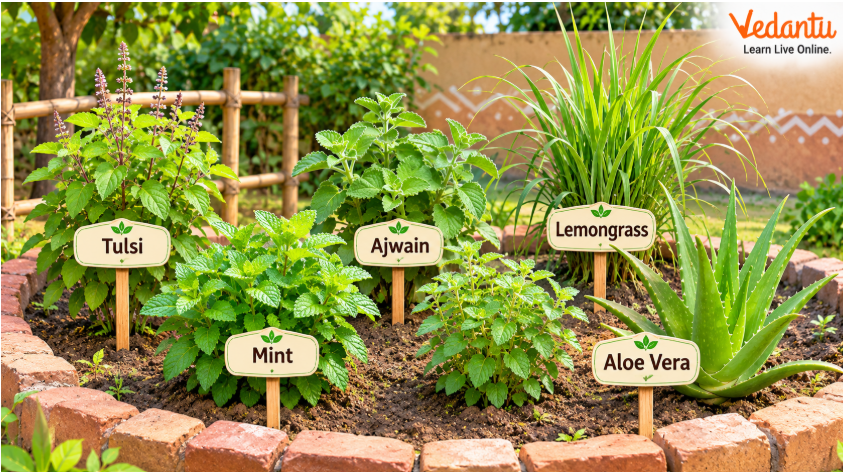
Your teacher asks you to create a small herbal garden in the school.
Select suitable plants and explain how you will care for them.
Answer:
My Herbal Garden Plan
Steps to Prepare the Garden:
Choose a suitable area with enough space.
Ask a teacher to help select plants suited to the local climate.
Prepare the soil and plant the saplings.
Place name labels near each plant.
Water and care for the plants according to their needs.
Observe their growth and record changes.
Key Topics and Revision Guide for Class 4 EVS Chapter 4 – Growing up with Nature
Revise these important concepts from Growing up with Nature before practising the chapter questions.
Quick Preparation Tips for Class 4 EVS Chapter 4
Revise Reena and Amit's village visit and the Palash tree.
Practise identifying natural materials, storage containers and plants from pictures.
Understand how solar energy and traditional practices help village life.
Learn how festivals and sacred groves are connected to nature.
Practise questions about saving resources and protecting the environment.
Exam Tip: For application-based questions, give a clear example from the chapter and explain how it helps people or nature.
Class 4 EVS Chapter 4 Important Questions PDF Download
Students can use Vedantu's Class 4 EVS Chapter 4 important questions and answers to practise solved MCQs, short answers and picture-based activities. The Class 4 EVS Chapter 4 important questions and answers PDF will help students revise Palash flowers, natural dyes, solar energy, traditional village life and environmental protection offline.
CBSE Class 4 EVS Chapter 4 Study Materials
Use these chapter-specific study materials to understand Growing up with Nature.
CBSE Class 4 EVS Chapter-wise Important Questions
Practise important questions from the other chapters of Our Wondrous World to learn more about community life, plants, health, science and the environment.
Important Study Materials for CBSE Class 4 EVS
FAQs on Important Questions and Answers for Class 4 EVS (Our Wondrous World) Chapter 4 – Growing up with Nature | 2026–27
1. How did Reena and Amit learn about the connection between nature and village life?
Reena and Amit observed houses made from natural materials, colourful Palash flowers, traditional wall paintings and grain storage methods. They also learned how solar energy provides electricity and how villagers protect plants and forests.
2. Why is Palash called the flame of the forest in Class 4 EVS Chapter 4?
Palash has bright orange-red flowers. When many Palash trees bloom, the forest looks reddish-orange from a distance, making it look as if it is covered with flames.
3. What types of MCQs are important for Class 4 EVS Chapter 4?
Class 4 EVS Chapter 4 important questions MCQ practice should cover Palash flowers, solar energy, traditional houses, natural dyes, grain storage and sacred groves. Students should also practise MCQs based on pictures and real-life examples.
4. How did Reena and Amit's village become fully solar-powered?
The chapter describes how the village became fully solar-powered. Solar panels use sunlight to generate electricity, which can be used for lighting and running appliances such as fans.
5. What natural materials were used to build houses in the village?
The village houses were built using clay, hay, cow dung and other natural materials. These materials show how people use locally available resources in traditional construction.
6. What is Gond art in Growing up with Nature?
Gond art is a traditional painting style that includes pictures of nature, such as trees, birds, animals and people. The chapter describes paintings made using natural colours.
7. How are natural dyes prepared from flowers and plants?
Natural dyes can be made by extracting colour from suitable flowers, leaves, bark or roots. The plant materials are boiled in water with adult supervision, and the coloured liquid is strained for use.
8. Why did villagers keep neem leaves in earthen pots?
Villagers lined earthen pots with neem leaves to protect stored grains from insects and pests. They also coated bamboo baskets with cow dung as part of their traditional storage methods.
9. Who are the Jenu Kurubas mentioned in Class 4 EVS Chapter 4?
The Jenu Kurubas are a tribal community from Karnataka. The word Jenu means honey. The chapter describes their practice of singing songs while collecting honey to show respect towards bees.
10. What is a Tumri, and where is it used?
A Tumri is a traditional container made from a dried bottle gourd. The chapter gives Uttarakhand as an example of a state where this container is used.
11. Which useful plants are mentioned in Class 4 EVS Chapter 4?
The chapter mentions plants such as Tulsi, ajwain and neem. Students learn about plant parts and their traditional uses through observation and discussions with elders.
12. Why are sacred groves important?
Sacred groves are small forest areas protected by local communities. They help preserve trees, wildlife and local traditions. People may gather there for worship and community celebrations.
13. Which festivals are connected with plants and animals in Growing up with Nature?
The chapter mentions Vat Purnima, associated with the banyan tree; Hari Jiroti, associated with planting fruit-bearing trees; and the Kaziranga Elephant Festival, associated with elephants and awareness activities.
14. How can students protect natural resources in everyday life?
Students can save water, reduce paper waste, avoid unnecessary plastic, plant trees, keep public spaces clean and protect birds and animals. These actions help conserve resources.
15. How can I prepare Class 4 EVS Chapter 4 important questions and answers for exams?
Read Reena and Amit's village journey carefully. Revise the important plants, natural materials, festivals, solar energy and traditional practices. Practise MCQs, picture identification, matching questions and short answers using simple examples from the chapter.
16. Where can I download Class 4 EVS Chapter 4 important questions PDF?
Students can download the Class 4 EVS Chapter 4 Important Questions PDF from Vedantu. It includes solved questions and answers on Growing up with Nature, covering Palash flowers, natural dyes, solar energy and traditional village life for offline practice.
17. Which textbook contains Class 4 EVS Chapter 4 Growing up with Nature?
Growing up with Nature is Chapter 4 of Our Wondrous World, under Unit 2, Life Around Us. It covers natural materials, traditional practices, useful plants, solar energy, festivals and caring for the environment.
