



Practise Class 4 EVS Chapter 3 Important Questions on Nature Trail
Practise these solved questions on the nature trail at Pachmarhi, animal features, forest safety, bird beaks, insects, leaves and the connections between living things.
Class 4 EVS Chapter 3 Important Questions MCQ with Answers
Q1. Where did the students go for their nature trail?
(a) Kaziranga, Assam
(b) Pachmarhi, Madhya Pradesh
(c) Gir Forest, Gujarat
(d) Jim Corbett, Uttarakhand
Answer: (b) Pachmarhi, Madhya Pradesh
Explanation: The students visited Pachmarhi in Madhya Pradesh with their teacher to observe different plants, birds and animals.
Q2. Who was Abha Didi in the Nature Trail chapter?
(a) A forest photographer
(b) A school bus driver
(c) A nature scientist
(d) A gardener
Answer: (c) A nature scientist
Explanation: Abha Didi studies plants and animals. She guided the students during their forest visit and helped them understand nature.
Q3. Which special feature helps an eagle catch its prey?
(a) A flat beak and webbed feet
(b) A sharp, curved beak and strong claws
(c) A long trunk and large ears
(d) A short beak and soft feet
Answer: (b) A sharp, curved beak and strong claws
Explanation: Eagles use their sharp claws to catch prey and their curved beaks to tear food.
Q4. How many legs does a grasshopper have?
(a) Four
(b) Six
(c) Eight
(d) Ten
Answer: (b) Six
Explanation: A grasshopper is an insect. Insects have three pairs of legs, making a total of six legs.
Q5. What does the Web of Life activity teach us?
(a) Animals can live without plants.
(b) Only large animals are important in forests.
(c) Plants, animals and natural elements depend on one another.
(d) Every animal eats the same kind of food.
Answer: (c) Plants, animals and natural elements depend on one another.
Explanation: The Web of Life shows how living things are connected. When one part is removed, other parts of nature can also be affected.
Class 4 EVS Chapter 3 Very Short Answer Questions
Q6. What is a nature trail?
Answer: A nature trail is a walk through a natural area, such as a forest or park, to observe plants, animals and their surroundings.
Q7. What is special about the Indian Giant Squirrel?
Answer: The Indian Giant Squirrel is a large, reddish-coloured squirrel found in Pachmarhi and some other places in India.
Q8. Why is the Spectacled Monkey given this name?
Answer: The Spectacled Monkey has white patches around its eyes that make it look as if it is wearing spectacles.
Q9. What are antennae in insects?
Answer: Antennae are feelers on an insect's head that help it sense its surroundings.
Q10. What are veins in leaves?
Answer: Veins are the lines visible on leaves. They help transport water and other materials through the leaf.
Class 4 EVS Chapter 3 Short Answer Questions
Q11. Why should visitors follow safety rules while exploring a forest? Mention four rules.
Answer:
Forest safety rules protect visitors, animals, plants and their natural surroundings.
Four important rules are:
Do not feed or tease wild animals.
Do not damage trees, flowers or other plants.
Do not throw rubbish or polythene bags in the forest.
Follow the guide's instructions and remain with the group.
These rules help keep the forest clean and prevent harm to living things.
Q12. Picture-Based Question: Identify Animals and Birds Seen During the Nature Trail.
Look at the forest picture showing gaur, deer, monkeys and birds.
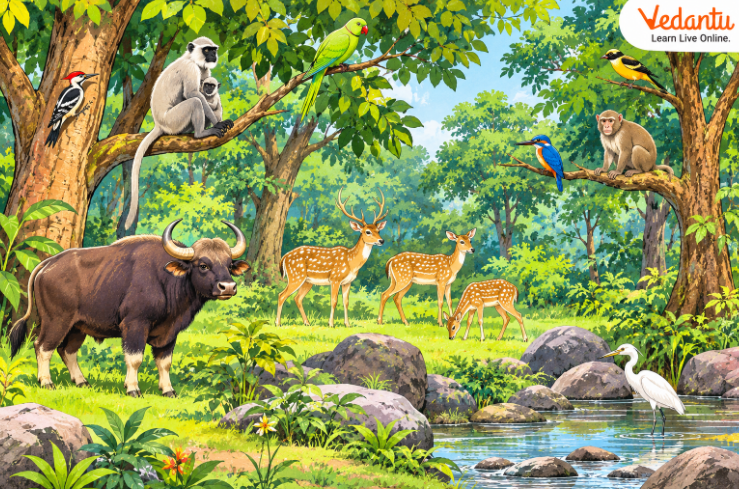
Answer the following questions:
(a) Name two land animals shown in the picture.
(b) Name two birds visible in the forest.
(c) Which animals are shown moving together as a group?
(d) Why do birds need trees?
(e) Why should visitors observe wild animals from a safe distance?
Answer:
(a) Gaur and deer are two land animals.
(b) Students can identify the birds visible in the picture, such as parrots and other forest birds.
(c) The deer are shown moving together in a group.
(d) Trees shelter birds, providing resting places and food.
(e) Observing animals from a safe distance protects both visitors and wildlife.
Q13. How is the Indian Giant Squirrel different from a common squirrel?
Answer:
The Indian Giant Squirrel and common squirrels have some similar features, but they differ in size and appearance.
Conclusion: Both are squirrels, but the Indian Giant Squirrel is larger and has a more striking appearance.
Q14. How can animal footprints help us learn about wildlife?
Answer:
Animal footprints are marks left by animals when they walk on mud, sand or soft ground.
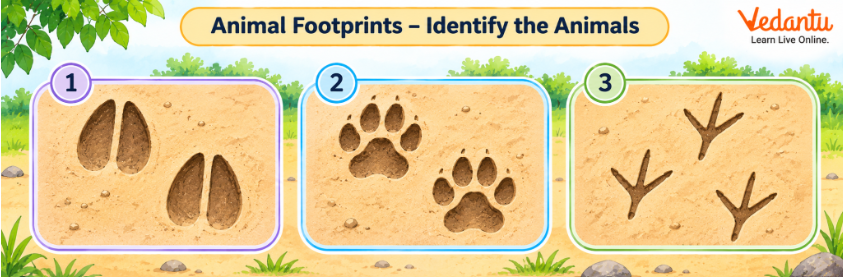
They can help us understand:
Which animals may have visited an area.
The direction in which an animal moved.
Whether the animal has paws, hooves or clawed feet.
How animals move around water sources.
Example: During the nature trail, Arya and Sarthak noticed footprints near a pond and wondered which animals had visited it.
Q15. Compare the beaks and food habits of a sparrow, eagle, sunbird and parrot.
Answer:
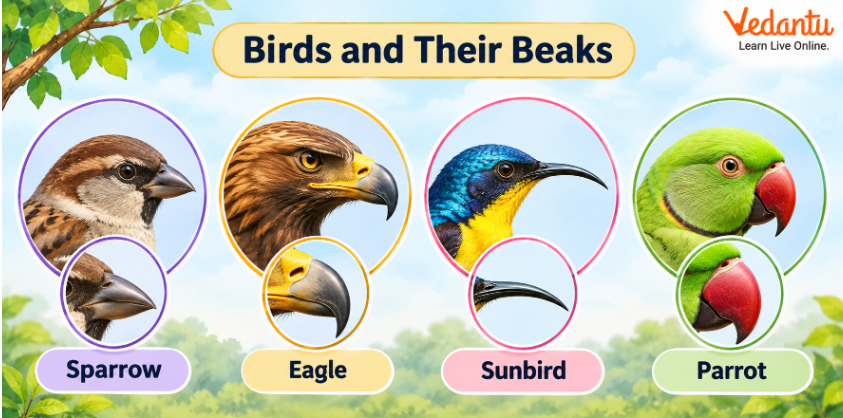
Different birds have different beaks that help them eat different kinds of food.
Explanation: The shape of a bird's beak gives us clues about what it eats.
Q16. How do fish, turtles, frogs and gharials survive in or around water?
Answer:
Animals living in or near water have different body features that help them survive.
Frogs can live both on land and in water.
Conclusion: These animals have different body features that suit their surroundings.
Q17. What are the main characteristics of insects? Give four examples.
Answer:
Insects are small animals with special body features.
Main characteristics:
They have six legs arranged in three pairs.
They have one pair of antennae.
Their bodies have three main sections.
Many insects have wings.
Examples:
Grasshopper
Butterfly
Ant
Beetle
Bees, flies and praying mantises are other examples mentioned in the chapter.
Q18. Picture-Based Question: Identify the Insects
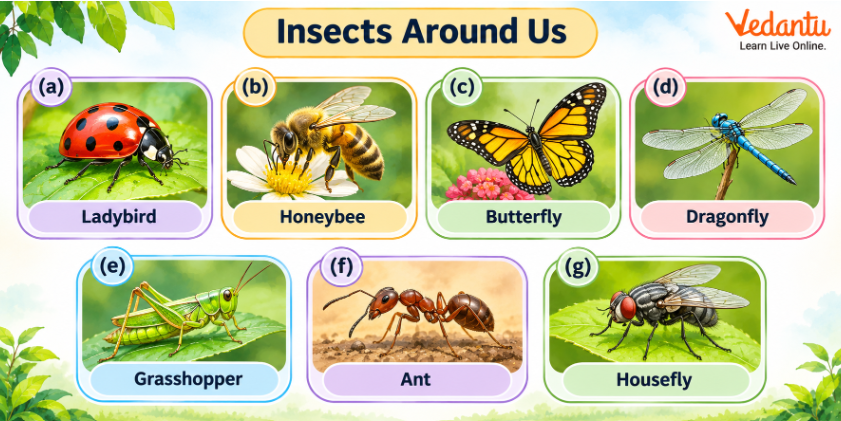
Observe the seven insect pictures from the textbook.
Identify each insect using its appearance.
Answer:
How to identify them:
Butterflies have broad, often colourful wings.
Cockroaches have long antennae and flattened bodies.
Beetles often have hard wing covers.
Dragonflies have long bodies and two pairs of wings.
Ants have six legs and bent antennae.
Praying mantises have folded front legs used to catch prey.
Grasshoppers have strong hind legs for jumping.
Q19. How can we identify different plants by observing their leaves?
Answer:
Leaves have different shapes, colours, textures and vein patterns.
We can identify and compare plants by looking at these features.
Example: A lemon leaf is generally green, oval-shaped and smooth, with a noticeable smell when crushed.
Conclusion: Leaf observations help us recognise different plants and appreciate their variety.
Class 4 EVS Chapter 3 Long Answer and Application-Based Questions
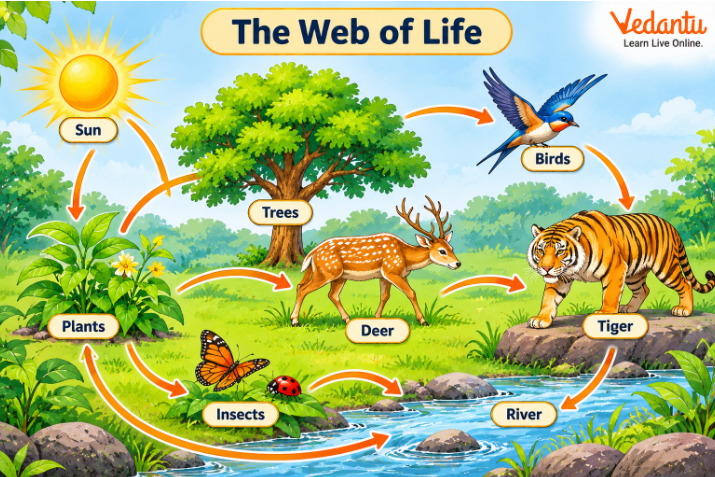
Q20. Explain how the Web of Life game shows the connection between plants, animals and their surroundings.
Answer:
The Web of Life is a group activity that helps students understand how different parts of nature depend on one another.
How the game is played:
Each student receives a card representing a plant, animal or natural element.
One student holds a ball of yarn.
The student identifies another part of nature connected to their card.
The yarn is passed to the next student while keeping hold of the thread.
More connections are made until a web forms.
One player then leaves the web to show what happens when a part of nature disappears.
Examples of Connections:
The Sun provides energy for plants to grow.
Trees provide food and shelter to birds.
Rivers provide water and habitats for fish.
Deer eat plants.
Tigers depend on animals such as deer for food.
What happens if one part disappears?
Removing one part can affect the others.
For example, if many plants disappear, plant-eating animals may lose their food. Animals that depend on them may also be affected.
Conclusion: The Web of Life teaches us that plants, animals and natural elements are connected, so protecting one part of nature also helps protect others.
Q21. Picture-Based Question: Identify Different Leaf Patterns and Explain Leaf Venation.
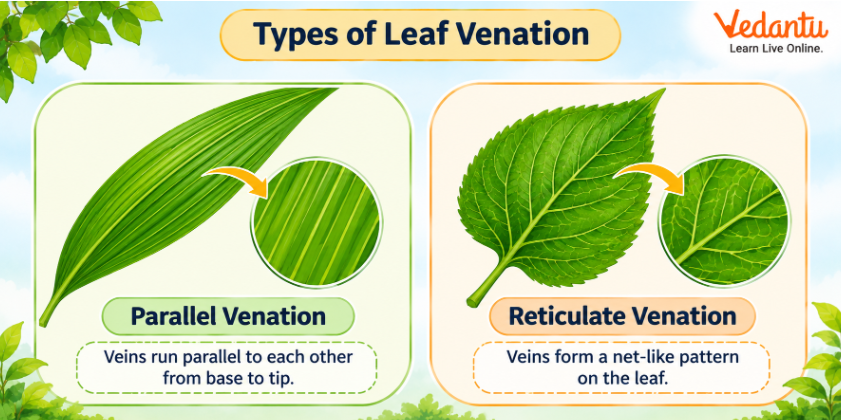
Look at two leaves. Leaf A has many veins running almost parallel to each other. Leaf B has a main vein with smaller veins branching out like a network.
Answer the following questions:
(a) What are the lines on a leaf called?
(b) Which leaf has parallel venation?
(c) Which leaf has reticulate venation?
(d) Why should students observe leaf patterns?
(e) How can a leaf rubbing help us see its veins?
Answer:
(a) The lines are called veins.
(b) Leaf A has parallel venation.
(c) Leaf B has reticulate, or net-like, venation.
(d) Observing vein patterns helps us compare and identify different leaves.
(e) Placing a leaf under paper and rubbing a crayon over it reveals the shape and raised vein pattern.
Leaf Pattern Comparison
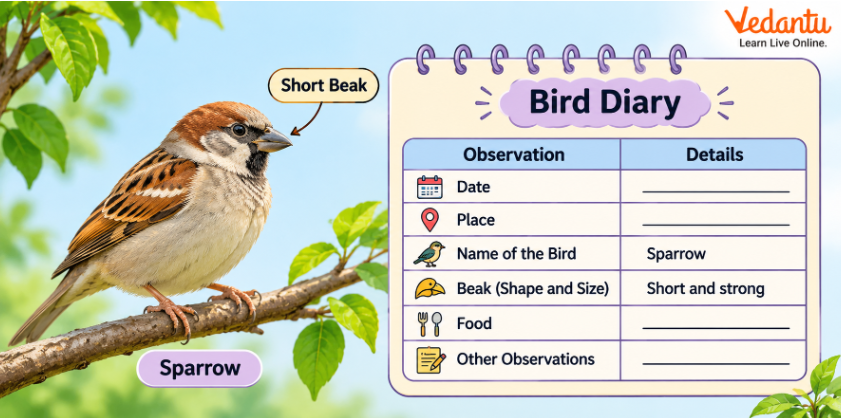
Q22. Activity-Based Question: Prepare a Bird Diary for a Sparrow
During a nature walk, you see a sparrow sitting on a tree. Prepare a short bird diary using its appearance and food habits.
Answer:
My Bird Diary
Bird Name: Sparrow
Interesting Facts:
Sparrows have short beaks suited to eating seeds.
They are commonly seen around homes and gardens.
They often make nests in sheltered spaces.
They feed on seeds and small insects.
What did I learn?
Observing a bird's colours, beak, movements and food habits helps us understand how it lives.
Note: This is a sample observation. Students can record a different bird they see in their surroundings.
Q23. Case-Based Question: What Happens When a Forest Loses Its Trees?
A forest has many trees, birds, insects, deer and other animals. Some trees are cut down to make space for buildings.
After some time, birds begin losing nesting places, and fewer insects and animals are seen in the area.
Answer the following questions:
(a) Why are trees important to birds?
(b) How might removing trees affect insects?
(c) What could happen to animals that depend on plants for food?
(d) How can the loss of trees affect the Web of Life?
(e) Suggest three ways to protect the forest.
Answer:
(a) Importance of Trees
Trees provide birds with food, resting places and nesting spaces.
(b) Effect on Insects
Some insects depend on trees for food, shelter and breeding places. Cutting down trees can reduce these resources.
(c) Effect on Plant-Eating Animals
Animals such as deer may lose important food sources when vegetation is removed.
(d) Effect on the Web of Life
The loss of trees can disturb many connections between plants, insects, birds and other animals.
(e) Three Ways to Protect Forests
Avoid unnecessary cutting of trees.
Protect plants and wildlife habitats.
Keep forests clean and follow conservation rules.
Conclusion: Protecting trees helps maintain the connections between living things in a forest.
Q24. Imagine You Are Leading a Nature Trail. Prepare a Plan for Your Classmates
Your teacher asks you to guide a small group of students during a nature walk in a park.
Prepare a simple plan explaining what your group will observe and how everyone will stay safe.
Answer:
Activity Name: Discover Nature Around Us
Place: A nearby park or nature area
Purpose: To observe plants, birds, insects and their surroundings.
Nature Trail Plan
Safety Rules:
Stay with the teacher or supervising adult.
Do not feed, tease or approach wild animals.
Do not damage plants or nests.
Do not throw rubbish.
Observe insects and other animals without touching them.
What Will We Learn?
We will learn that nature contains many different living things, each with special features and an important role.
Conclusion: A nature trail helps us observe living things and understand why we should protect our natural surroundings.
Key Topics and Revision Guide for Class 4 EVS Chapter 3 – Nature Trail
Revise these important concepts before practising the Class 4 EVS Chapter 3 important questions and answers.
Quick Preparation Tips for Class 4 EVS Chapter 3
Revise the animals and birds observed during the Pachmarhi visit.
Practise identifying bird beaks, insects, footprints and leaf patterns.
Learn the special features of animals living in and around water.
Understand how plants and animals depend on one another.
Exam Tip: For picture-based questions, identify the animal or plant first, then explain the special feature that helps it survive.
Class 4 EVS Chapter 3 Important Questions PDF Download
Download Vedantu's Class 4 EVS Chapter 3 Important Questions PDF to practise solved MCQs, short answers, picture-based questions and application-based activities from Nature Trail. The PDF includes answers on forest animals, birds, insects, leaf patterns and the Web of Life, helping students prepare for exams and revise offline.
CBSE Class 4 EVS Chapter 3 Study Materials
Use these resources to strengthen your understanding of Nature Trail.
CBSE Class 4 EVS Chapter-wise Important Questions
Practise important questions from the remaining chapters of Our Wondrous World to learn more about communities, plants, animals, health and the environment.
Important Study Materials for CBSE Class 4 EVS
FAQs on Important Questions and Answers for Class 4 EVS (Our Wondrous World) Chapter 3 – Nature Trail | 2026–27
1. What did students learn from Abha Didi during the Nature Trail?
Abha Didi guided the students through the forest at Pachmarhi, Madhya Pradesh. She helped them observe plants, birds and animals, understand their special features and learn why protecting nature is important.
2. Why is the Indian Giant Squirrel special in Class 4 EVS Chapter 3 Nature Trail?
The Indian Giant Squirrel is a large, red-coloured squirrel found in Pachmarhi and other parts of India. It is much bigger than common squirrels and has a long, bushy tail.
3. Why is the Spectacled Monkey called by this name?
The Spectacled Monkey has white patches around its eyes that make it look as if it is wearing spectacles. The Nature Trail textbook identifies it as the state animal of Tripura.
4. How do different bird beaks help birds eat their food in Nature Trail?
Different birds have beaks suited to their food habits. Eagles have sharp, curved beaks for tearing prey, sunbirds have long beaks for drinking nectar, and sparrows have short, strong beaks for eating seeds.
5. What special features help animals survive in water in Class 4 EVS Chapter 3?
Fish use fins to swim, turtles have protective shells and webbed feet, and gharials have long, narrow snouts to catch fish. Frogs can live both on land and in water.
6. How can students identify insects and leaves in Nature Trail?
Students can identify insects by observing their six legs, antennae, wings and body shapes. They can compare leaves by looking at their colour, shape, texture and vein patterns.
7. What does the Web of Life activity teach us in Class 4 EVS Chapter 3?
The Web of Life activity shows how plants, animals and natural elements depend on one another. For example, deer depend on plants for food, while tigers depend on animals such as deer. Removing one part can affect the others.
8. Which topics are important for Class 4 EVS Chapter 3 Nature Trail questions and answers?
Important topics include forest safety rules, Indian Giant Squirrel, Spectacled Monkey, bird beaks, animal footprints, water animals, insects, leaf patterns and the Web of Life. Students should also practise picture-based questions.
9. Where can I download Class 4 EVS Chapter 3 Nature Trail Important Questions PDF?
Students can download the Class 4 EVS Chapter 3 Nature Trail Important Questions PDF from Vedantu. It includes solved MCQs, short-answer questions, picture-based questions and activities for offline practice.
