






What Is the Venus Flower Basket? Habitat, Structure, and Unique Facts
The Venus’s Flower Basket is one of the most beautiful and unusual sea creatures found deep in the ocean. It is not a plant but a special type of sponge made of glass-like fibers. Known for its delicate, lace-like skeleton, this marine animal lives in deep waters and often shelters tiny shrimp inside its body. Let’s explore the amazing Venus’s Flower Basket facts, habitat, diet, life cycle, characteristics, and importance in nature.
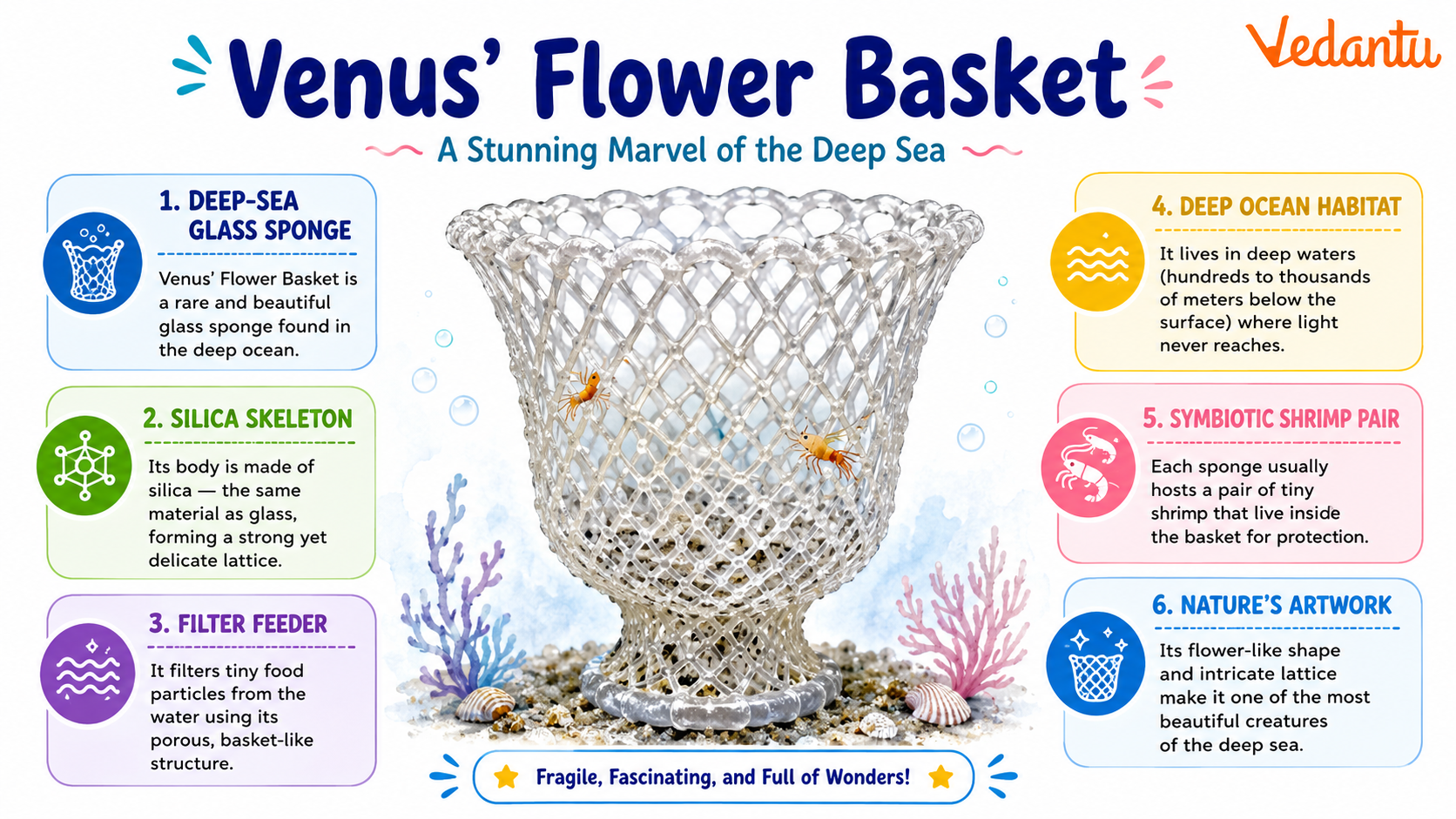
Quick Facts and Statistics
| Feature | Details |
|---|---|
| Common Name | Venus’s Flower Basket |
| Scientific Name | Euplectella aspergillum |
| Animal Group | Glass Sponge (Phylum Porifera) |
| Habitat | Deep ocean floor |
| Depth Range | About 100–1,000 meters below sea level |
| Diet | Microscopic plankton and organic particles |
| Body Structure | Tubular, lattice-like glass skeleton |
| Special Feature | Made of silica (glass-like material) |
Appearance and Physical Characteristics
- Body Shape: Tall, tube-shaped body with a rounded base.
- Skeleton: Made of silica, forming a glass-like lattice.
- Texture: Hard outer skeleton but soft inner tissues.
- Colour: Usually white or pale.
- Size: Can grow up to 20–30 cm long.
- Opening: A large opening at the top for water flow.
Habitat and Distribution
- Found in the deep sea, especially near the Philippines.
- Lives on the ocean floor, attached to soft sediments.
- Prefers cold, dark, high-pressure environments.
- Cannot survive in shallow or warm waters.
Diet and Feeding Habits
The Venus’s Flower Basket diet mainly consists of tiny floating organisms.
- It is a filter feeder.
- Water enters through small pores in its body.
- It traps plankton and organic particles.
- Clean water exits through the top opening.
Behaviour and Lifestyle
- It is sessile – meaning it stays fixed in one place.
- Does not move around like fish or crabs.
- Often houses a pair of small shrimp inside its body.
- Works silently as part of the deep-sea ecosystem.
Life Cycle and Reproduction
- Spawning: Releases eggs and sperm into the water.
- Fertilisation: Occurs in the surrounding seawater.
- Larva Stage: Free-swimming larva moves briefly in water.
- Attachment: Settles on the ocean floor.
- Growth: Develops into a tube-shaped adult sponge.
The Venus’s Flower Basket life cycle begins as a tiny swimming larva but ends as a fixed adult attached to the seabed.
What Makes Venus’s Flower Basket Special?
Importance and Role in Nature
Amazing Facts About Venus’s Flower Basket
- It is called a “flower basket” because it looks like a delicate vase.
- Its skeleton is made of pure silica, like glass.
- It can survive under very high ocean pressure.
- It has been given as a wedding gift in some cultures.
- It belongs to one of the oldest animal groups on Earth.
- Despite its beauty, it is a simple animal without organs.
Fun Facts for Kids
FAQs on Venus Flower Basket: The Glass Sponge of the Deep Sea
1. What is Venus’ Flower Basket?
Venus’ Flower Basket is a type of deep-sea sponge known for its beautiful, glass-like skeleton.
- Its scientific name is Euplectella aspergillum
- It lives in the deep ocean, mostly in the Pacific Ocean
- It has a delicate, lattice-like structure made of silica (glass)
- It is often called a glass sponge
- It looks like a woven basket, which is how it got its name
2. Where does Venus’ Flower Basket live?
Venus’ Flower Basket lives deep under the sea on the ocean floor.
- Found mainly in the Pacific Ocean near the Philippines and Japan
- Lives at depths of about 100 to 1,000 meters
- Attaches itself to the seafloor using root-like fibers
- Thrives in cold, dark deep-sea habitats
3. Why is Venus’ Flower Basket called a glass sponge?
Venus’ Flower Basket is called a glass sponge because its skeleton is made of silica, the same material found in glass.
- Its body contains tiny glass-like needles called spicules
- These spicules form a strong, see-through lattice structure
- It belongs to the class Hexactinellida (glass sponges)
- The structure shines and looks delicate like crystal
4. What does Venus’ Flower Basket eat?
Venus’ Flower Basket feeds on tiny particles floating in the water.
- Eats plankton and microscopic organisms
- Filters food through small holes in its body
- Uses a filter-feeding system
- Helps keep ocean water clean by filtering it
5. What animals live inside Venus’ Flower Basket?
Small shrimp often live inside Venus’ Flower Basket in a special symbiotic relationship.
- A male and female spongicola shrimp enter when young
- They grow inside and cannot leave
- The shrimp clean the sponge and eat leftovers
- This relationship is an example of symbiosis
6. How does Venus’ Flower Basket reproduce?
Venus’ Flower Basket reproduces by releasing eggs and sperm into the water.
- Uses sexual reproduction
- Fertilization happens in the ocean water
- Larvae swim freely before settling on the seafloor
- Grows slowly in deep-sea environments
7. Why is Venus’ Flower Basket important?
Venus’ Flower Basket is important for marine ecosystems and science.
- Provides shelter for marine animals
- Helps scientists study biomimicry and natural engineering
- Its structure inspires strong building designs
- Supports deep-sea biodiversity
8. Is Venus’ Flower Basket a plant or an animal?
Venus’ Flower Basket is an animal, not a plant.
- Belongs to the kingdom Animalia
- It is a type of marine sponge
- Does not make its own food like plants
- Feeds by filtering water
9. How big can Venus’ Flower Basket grow?
Venus’ Flower Basket can grow up to about 30 centimeters (12 inches) tall.
- Has a long, tube-shaped body
- Attached to the seabed with silica fibers
- Its size helps protect shrimp living inside
- Grows slowly in deep-sea conditions
10. Why is Venus’ Flower Basket given as a gift in some cultures?
In Japan, Venus’ Flower Basket is a symbol of eternal love and marriage.
- The trapped shrimp pair represents lifelong partnership
- Often given as a wedding gift
- Symbolizes love, harmony, and commitment
- Connected to cultural beliefs about good luck
