






Velociraptor Facts: Size, Diet, Habitat, and Hunting Behavior Explained
The Velociraptor was one of the most famous small dinosaurs that lived millions of years ago. Known for its speed, sharp claws, and hunting skills, it belonged to the group of meat-eating dinosaurs. Even though movies show it as very large, real Velociraptors were much smaller. Studying Velociraptor facts helps us understand dinosaur behaviour, evolution, and life during the age of reptiles.
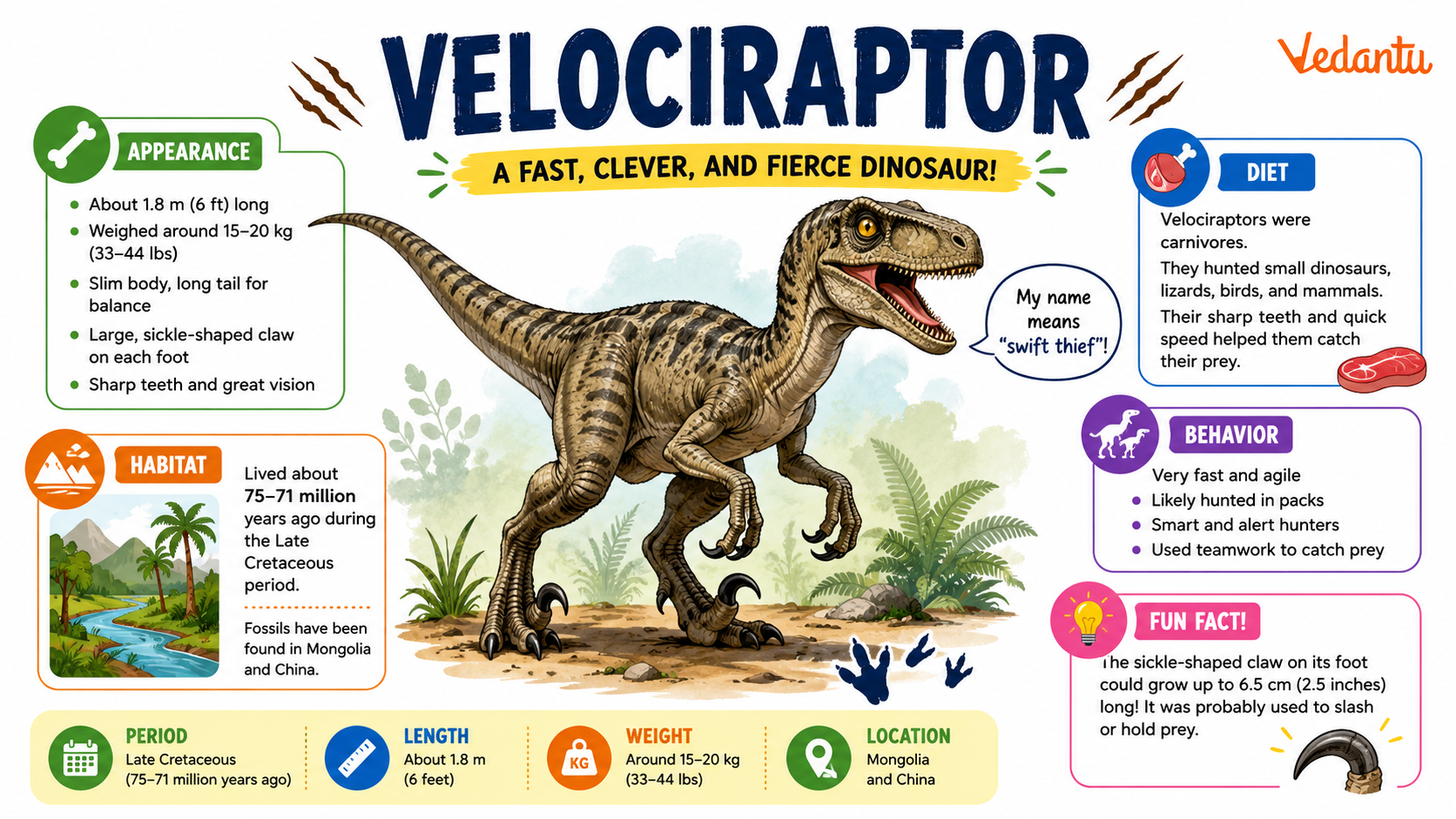
Quick Facts About Velociraptor
| Feature | Details |
|---|---|
| Common Name | Velociraptor |
| Scientific Name | Velociraptor mongoliensis |
| Animal Group | Theropod Dinosaur |
| Period | Late Cretaceous (about 75–71 million years ago) |
| Length | About 2 meters (6.5 feet) |
| Weight | Around 15 kilograms |
| Diet | Carnivore (meat-eater) |
| Habitat | Deserts and dry plains of Central Asia |
| Movement | Walked and ran on two legs |
| Status | Extinct |
Appearance and Physical Characteristics
- Long, stiff tail for balance while running.
- Sharp, curved sickle-shaped claw on each hind foot.
- Lightweight body built for speed.
- Sharp teeth for tearing meat.
- Likely covered in feathers.
- Long arms with three clawed fingers.
Velociraptor Habitat and Distribution
The Velociraptor habitat was mainly dry and sandy regions of what is now Mongolia and China.
- Lived in desert-like environments.
- Fossils found in the Gobi Desert.
- Adapted to hot days and cooler nights.
- Likely sheltered near rocks or low vegetation.
Diet and Feeding Habits
- Pure carnivore (meat-eater).
- Hunted small reptiles and mammals.
- Used its sharp sickle claw to attack prey.
- Teeth designed for cutting and tearing flesh.
In the food chain, Velociraptor was a predator but may also have been hunted by larger dinosaurs.
Behaviour and Lifestyle
Velociraptor Life Cycle
- Egg Stage: Velociraptors hatched from eggs laid in nests.
- Hatchling: Baby Velociraptors were small and likely depended on parents for protection.
- Juvenile: Grew quickly and learned hunting skills.
- Adult: Fully grown, active predator in its habitat.
Like many dinosaurs, their exact lifespan is unknown, but they likely lived for several years if they survived predators and harsh conditions.
What Makes Velociraptor Special?
Importance of Velociraptor in Science
- Shows the link between dinosaurs and birds.
- Provides clues about feather evolution.
- Helps scientists understand predator behaviour.
- Important for studying Late Cretaceous ecosystems.
Amazing Velociraptor Facts
Interesting Facts About Velociraptor
- It had a long tail to help it balance while running.
- Its bones were hollow, like modern birds.
- It likely had a warm-blooded metabolism.
- It is one of the most studied small theropods.
Fun Facts for Kids
FAQs on Velociraptor: Fast, Feathered Hunter of the Cretaceous
1. What is a Velociraptor?
A Velociraptor was a small, fast, meat-eating dinosaur that lived millions of years ago.
- It was a type of theropod dinosaur.
- Lived during the Late Cretaceous Period.
- Its name means "swift thief".
- It is one of the most famous raptor dinosaurs in history.
2. When did Velociraptors live?
Velociraptors lived about 75 to 71 million years ago during the Late Cretaceous Period.
- Time period: Late Cretaceous
- Era: Mesozoic Era (Age of Dinosaurs)
- Lived before the mass extinction that ended the dinosaurs
3. Where did Velociraptors live?
Velociraptors lived in areas that are now part of Mongolia and China in Central Asia.
- Fossils found in the Gobi Desert
- Lived in dry, desert-like environments
- Shared habitat with dinosaurs like Protoceratops
4. What did Velociraptors eat?
Velociraptors were carnivores, meaning they ate meat.
- Hunted small dinosaurs
- Ate reptiles and small animals
- Used sharp teeth and claws to catch prey
- Famous fossil shows a fight with Protoceratops
5. How big was a Velociraptor?
A Velociraptor was about the size of a large turkey, much smaller than in movies.
- Length: about 6–7 feet (2 meters)
- Height: around 1.5–2 feet tall
- Weight: about 30 pounds (15 kg)
6. Did Velociraptors have feathers?
Yes, scientists believe Velociraptors had feathers like modern birds.
- Fossils show evidence of quill knobs on arms
- They are closely related to birds
- Feathers may have helped with warmth or display
7. How fast was a Velociraptor?
Velociraptors were very fast runners and agile hunters.
- Estimated speed: up to 25–40 miles per hour
- Lightweight body helped them move quickly
- Long legs built for speed
8. What made Velociraptors dangerous?
Velociraptors were dangerous because of their sharp claws and hunting skills.
- Had a large sickle-shaped claw on each foot
- Sharp teeth for tearing meat
- Strong, grasping hands
- Smart predator compared to many dinosaurs
9. Did Velociraptors hunt in packs?
Scientists are not sure if Velociraptors hunted in packs, but it is possible.
- Some fossils found near each other
- Movies like Jurassic Park show pack hunting
- No clear proof, but they may have hunted alone or in small groups
10. How is Velociraptor different from the Jurassic Park raptors?
The Velociraptors in Jurassic Park are much bigger than real ones.
- Movie raptors are closer in size to Deinonychus
- Real Velociraptors were smaller and feathered
- Films made them larger and scarier for entertainment
