






Where Do Tasmanian Devils Live, What Do They Eat, and Why Are They Endangered?
The Tasmanian Devil is a powerful carnivorous marsupial found only in Tasmania, Australia. Known for its loud screeches, strong jaws, and fiery temper, this animal may look small but has an incredibly fierce reputation. Tasmanian Devil facts show that it is the largest living carnivorous marsupial in the world today. Let’s explore its habitat, diet, characteristics, life cycle, and why it plays an important role in nature.
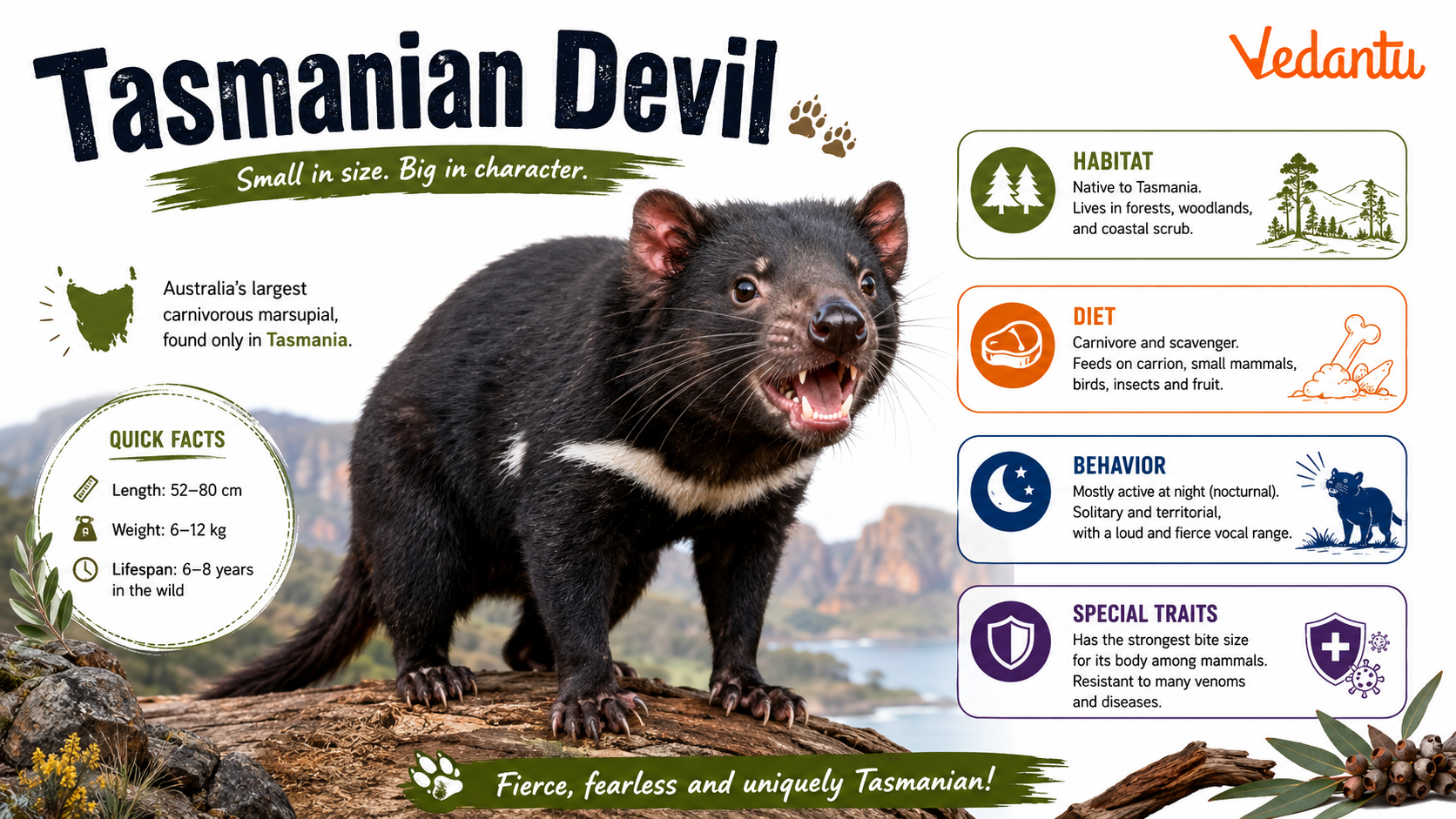
Quick Facts About Tasmanian Devil
| Feature | Details |
|---|---|
| Common Name | Tasmanian Devil |
| Scientific Name | Sarcophilus harrisii |
| Animal Group | Mammal (Marsupial) |
| Size | 50–80 cm (body length) |
| Weight | 6–8 kg (males heavier than females) |
| Lifespan | 5–8 years (in the wild) |
| Habitat | Forests, grasslands, coastal scrub in Tasmania |
| Diet | Carnivore (meat eater & scavenger) |
| Conservation Status | Endangered |
Appearance and Physical Characteristics
- Small, stocky body with short legs.
- Black fur with white patches on chest or rump.
- Large head and powerful jaw muscles.
- Sharp teeth designed to crush bones.
- Strong claws for tearing meat.
Tasmanian Devil Habitat and Distribution
- Found only in the island state of Tasmania, Australia.
- Lives in forests, coastal scrublands, and grasslands.
- Prefers areas with thick bushes for shelter.
- Rests in burrows, hollow logs, or caves during the day.
Tasmanian Devil Diet and Feeding Habits
- Strict carnivore.
- Eats small mammals, birds, reptiles, and insects.
- Often feeds on dead animals (scavenger).
- Uses strong smell to locate food.
- Can eat up to 40% of its body weight in one meal!
Behaviour and Lifestyle
- Nocturnal – active mainly at night.
- Usually solitary but gather when feeding.
- Famous for loud screeches, growls, and snarls.
- Shows aggressive displays to scare rivals.
Sound or Call
Tasmanian Devil Life Cycle
Babies are born tiny, about the size of a jellybean.
They crawl into the mother’s pouch and stay for about 4 months.
After leaving the pouch, they stay in a den and depend on the mother.
Become independent and start hunting alone.
What Makes Tasmanian Devil Special?
Importance and Role in Nature
Amazing Tasmanian Devil Facts
- It is the symbol animal of Tasmania.
- Despite its name, it is shy around humans.
- It can run up to 24 km/h.
- Has a powerful immune system.
- Uses scent glands to mark territory.
- Its population has declined due to a contagious facial tumor disease.
Fun Facts for Kids
FAQs on Tasmanian Devil: Fascinating Facts About Australia’s Fierce Marsupial
1. What is a Tasmanian Devil?
The Tasmanian Devil is a small, powerful marsupial found only in Tasmania, Australia.
- It is the largest carnivorous marsupial in the world.
- It belongs to the Dasyuridae family.
- It is known for its loud screeches and strong bite.
- It became famous from the cartoon character Taz.
2. Why is it called a Tasmanian Devil?
The Tasmanian Devil got its name because of its scary sounds and fierce behavior.
- Early European settlers heard its loud growls and screams at night.
- They thought it sounded like a "devil."
- It is called "Tasmanian" because it lives in Tasmania.
3. Where do Tasmanian Devils live?
Tasmanian Devils live in the wild landscapes of Tasmania.
- They prefer forests, woodlands, and coastal scrublands.
- They hide in burrows, hollow logs, or caves.
- They are mostly active at night (nocturnal animals).
4. What do Tasmanian Devils eat?
Tasmanian Devils are carnivores that eat meat.
- They feed on small mammals, birds, insects, and reptiles.
- They are famous for eating dead animals (scavengers).
- Their powerful jaws can crush bones and skulls.
5. How big is a Tasmanian Devil?
A Tasmanian Devil is about the size of a small dog.
- Length: around 20–30 inches (50–80 cm).
- Weight: between 13–26 pounds (6–12 kg).
- Males are usually bigger than females.
6. Are Tasmanian Devils endangered?
Yes, the Tasmanian Devil is listed as endangered due to disease and habitat threats.
- A serious illness called Devil Facial Tumour Disease (DFTD) has reduced their population.
- Road accidents and habitat loss also harm them.
- Conservation programs are helping protect this unique species.
7. How strong is a Tasmanian Devil's bite?
The Tasmanian Devil has one of the strongest bites for its size in the animal kingdom.
- It has a very high bite force quotient (BFQ).
- Its jaws can easily crush bones and tough meat.
- This helps it eat almost every part of its prey.
8. Are Tasmanian Devils dangerous to humans?
Tasmanian Devils are not usually dangerous to humans.
- They are shy and avoid people.
- They may growl or show teeth if scared.
- They are wild animals and should not be touched.
9. How do Tasmanian Devils reproduce?
Tasmanian Devils are marsupials, which means their babies grow in a pouch.
- Females give birth to tiny babies called joeys.
- The joeys stay in the mother's pouch for several months.
- Usually only a few survive because the pouch has limited space.
10. Why are Tasmanian Devils important to the ecosystem?
Tasmanian Devils play a key role in keeping their environment clean and balanced.
- They act as scavengers, eating dead animals.
- This helps stop the spread of disease.
- They maintain a healthy Tasmanian ecosystem by controlling animal populations.
