






Where Do Shoebill Birds Live and What Do They Eat?
The Shoebill is one of the most unusual birds in the world. Famous for its huge shoe-shaped beak and tall body, this bird lives in African wetlands. It stands very still while hunting and looks almost like a statue. Because of its ancient appearance and powerful hunting skills, the Shoebill fascinates bird lovers and students alike. Let’s explore amazing Shoebill facts, habitat, diet, characteristics, and more in a simple and fun way.
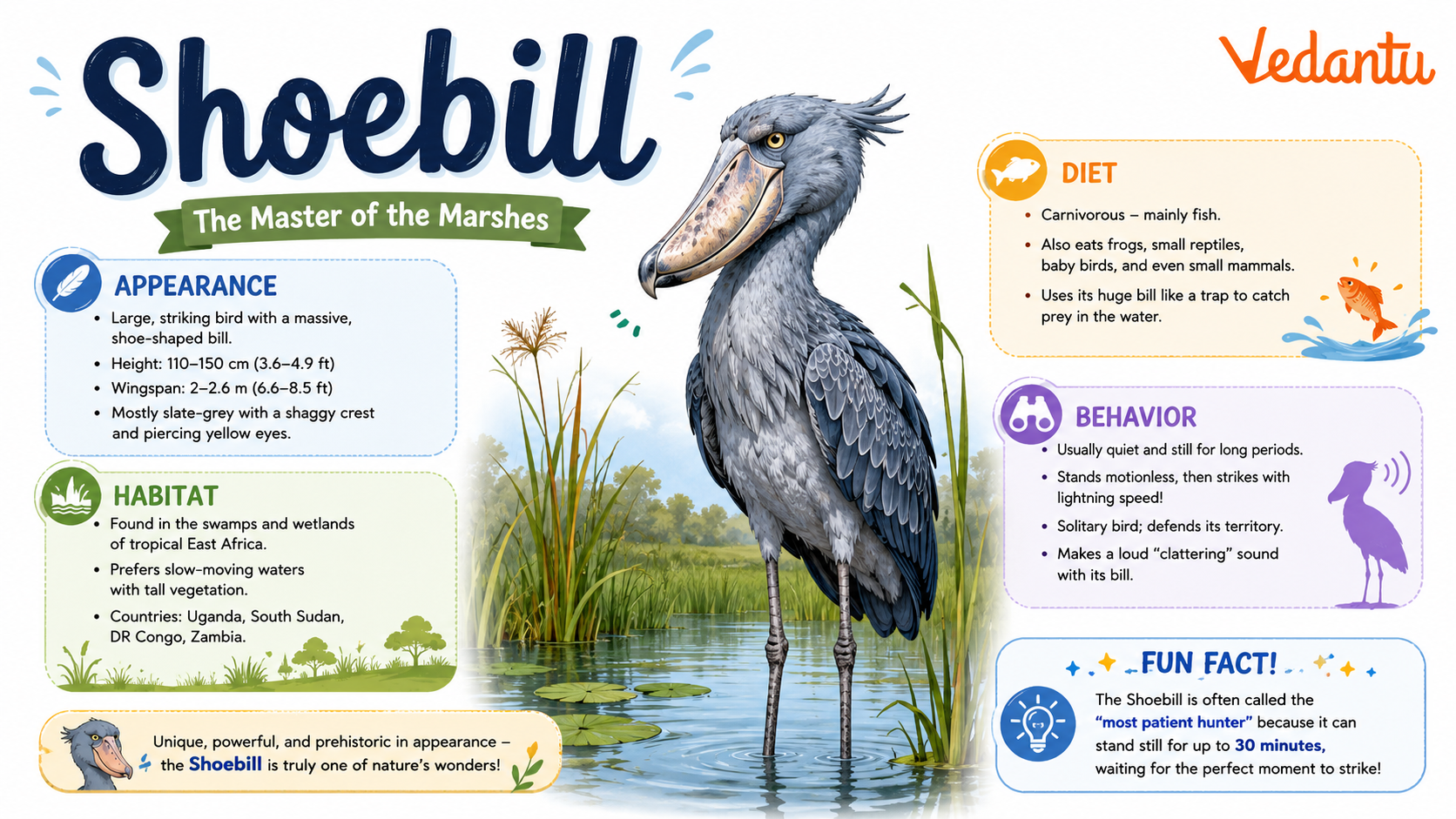
Quick Facts About Shoebill
| Feature | Details |
|---|---|
| Common Name | Shoebill |
| Scientific Name | Balaeniceps rex |
| Animal Group | Bird |
| Height | 110–140 cm (about 4–5 feet tall) |
| Weight | 4–7 kg |
| Habitat | Swamps and wetlands of East Africa |
| Diet | Fish, frogs, snakes, baby crocodiles |
| Lifespan | Up to 35 years |
| Conservation Status | Vulnerable |
Appearance and Physical Characteristics
- Massive Beak: Large, shoe-shaped beak with a sharp hook at the tip.
- Colour: Grey-blue feathers with lighter belly.
- Long Legs: Perfect for walking in shallow water.
- Broad Wings: Wingspan can reach about 2.5 meters.
- Serious Expression: Looks calm and powerful.
Shoebill Habitat and Distribution
The Shoebill habitat includes tropical wetlands and swamps in East Africa. These birds prefer quiet, shallow waters filled with plants.
- Found in countries like Uganda, South Sudan, Zambia, and Tanzania.
- Lives in papyrus swamps and marshes.
- Needs freshwater wetlands to survive.
- Avoids busy or crowded areas.
Shoebill Diet and Feeding Habits
Behaviour and Lifestyle
- Mostly solitary birds.
- Very patient and can stand still for hours.
- Fly slowly but strongly.
- Bow their heads to greet humans in zoos.
- Active mainly during the day.
Shoebill Life Cycle
- Nesting: Builds large nests on floating vegetation.
- Eggs: Usually lays 1–3 eggs.
- Chicks: Parents feed chicks with regurgitated food.
- Survival: Often only one chick survives.
- Adult Stage: Fully grown in about 3–4 years.
Flight Adaptations
- Large, broad wings help in steady flight.
- Strong chest muscles power their heavy body.
- Long wings allow gliding over wetlands.
- Lightweight hollow bones reduce body weight.
Sound or Call
Shoebills are usually quiet. Instead of singing like other birds, they make:
- Loud bill-clattering sounds (like machine gun noise).
- Hissing sounds when threatened.
- Soft whining sounds near nests.
What Makes the Shoebill Special?
Importance and Role in Nature
- Keeps fish and reptile populations balanced.
- Helps maintain healthy wetland ecosystems.
- Attracts eco-tourism in African countries.
- Indicator of healthy freshwater habitats.
Amazing Shoebill Facts
Fun Facts for Kids
- The Shoebill looks like a cartoon dinosaur.
- It can stare without blinking for a long time.
- Its beak works like a strong fishing tool.
- It loves quiet swampy places.
- It is one of the tallest birds in Africa.
FAQs on Shoebill (Balaeniceps rex): The Mysterious Stork-Like Giant
1. What is a Shoebill?
The Shoebill is a large, rare African bird known for its huge shoe-shaped bill.
- The Shoebill stork is also called the whale-headed stork.
- It lives in East African wetlands and swamps.
- It is famous for its big beak that looks like a wooden shoe.
- The scientific name is Balaeniceps rex.
2. Where do Shoebills live?
Shoebills live in tropical swamps and wetlands of central Africa.
- They are found in countries like Uganda, South Sudan, and Zambia.
- They prefer marshes, papyrus swamps, and freshwater wetlands.
- These habitats provide plenty of fish and space to hunt.
3. Why is the Shoebill’s beak so big?
The Shoebill’s large bill helps it catch and hold slippery prey easily.
- The strong beak can grab large fish like lungfish.
- It helps crush and slice prey quickly.
- The hook at the tip makes catching food easier.
4. What do Shoebills eat?
Shoebills are carnivorous birds that mainly eat fish and small animals.
- Their favorite food is lungfish.
- They also eat tilapia, frogs, snakes, and baby crocodiles.
- They hunt by standing still and waiting quietly.
5. How big is a Shoebill?
Shoebills are very tall birds, almost as tall as a grown-up human’s chest.
- They can grow up to 5 feet (1.5 meters) tall.
- Their wingspan can reach 8 feet.
- They weigh around 12 to 15 pounds.
6. Are Shoebills dangerous?
Shoebills are not dangerous to humans but can look scary because of their size.
- They are usually calm and quiet.
- They may defend themselves if threatened.
- They are wild animals and should not be disturbed.
7. Why do Shoebills stand so still?
Shoebills stand still to surprise and catch their prey more easily.
- This hunting style is called “stand-and-wait” hunting.
- It helps them blend into swamp plants.
- Suddenly, they strike very fast with their powerful beak.
8. Are Shoebills endangered?
Shoebills are considered a vulnerable species due to habitat loss and human activity.
- Their population is decreasing in the wild.
- Wetland destruction threatens their homes.
- Conservation efforts help protect these rare birds.
9. How long do Shoebills live?
Shoebills can live for many years, especially in safe environments.
- In the wild, they may live around 35 years.
- They may live longer in protected areas or zoos.
- They grow slowly and take years to mature.
10. Why is the Shoebill called the “whale-headed stork”?
The Shoebill is nicknamed the “whale-headed stork” because of its huge head shape.
- The word Balaeniceps means “whale head.”
- Its large head and bill look massive compared to its body.
- It is not a true stork but closely related to pelicans and herons.
