






Why Horseshoe Crabs Are Called Living Fossils and How They Help Modern Medicine
The Horseshoe Crab is one of the most fascinating sea creatures on Earth. Even though its name includes “crab,” it is not a true crab at all. These amazing animals have existed for more than 450 million years, surviving even the age of dinosaurs. With a hard shell, blue blood, and a long tail spine, horseshoe crabs are full of surprising features. Let’s explore Horseshoe Crab facts, habitat, diet, life cycle, characteristics, and importance in nature.
Quick Facts and Statistics
| Feature | Details |
|---|---|
| Common Name | Horseshoe Crab |
| Scientific Group | Xiphosura |
| Animal Group | Arthropod (related to spiders & scorpions) |
| Size | Up to 60 cm long (including tail) |
| Weight | Up to 4 kg |
| Lifespan | 20 years or more |
| Habitat | Shallow coastal waters |
| Diet | Worms, clams, small marine animals |
| Blood Colour | Blue |
| Conservation Status | Vulnerable (in some regions) |
Appearance and Physical Characteristics
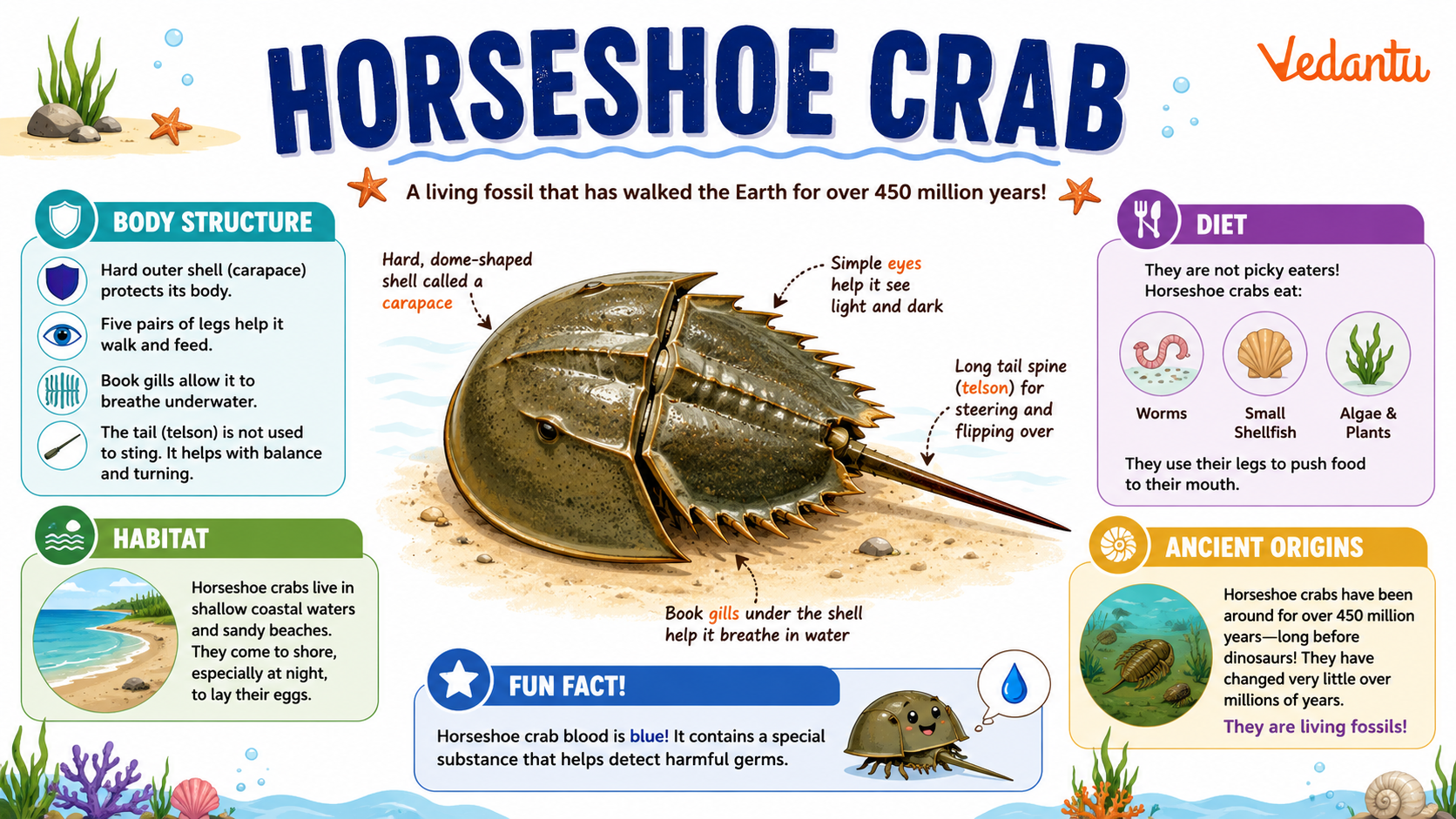
- Hard, dome-shaped shell that looks like a horseshoe.
- Long pointed tail spine called a telson.
- Brown or grey-green colour.
- Five pairs of walking legs.
- Multiple eyes (up to 10 eyes!).
Habitat and Distribution
The Horseshoe Crab habitat includes shallow coastal waters, sandy beaches, and muddy sea floors.
- Found along the east coasts of North America.
- Also found in parts of Asia.
- Prefer warm, shallow ocean waters.
- Come to sandy shores during breeding season.
Diet and Feeding Habits
The Horseshoe Crab diet mainly includes small marine organisms.
- Marine worms
- Clams and mollusks
- Small crustaceans
- Algae
Behaviour and Lifestyle
- Mostly active at night.
- Slow-moving sea bottom walkers.
- Use their tail to flip themselves over if turned upside down.
- Generally peaceful and non-aggressive.
Life Cycle and Reproduction
- Egg Stage: Females lay thousands of eggs in sandy beaches.
- Larva Stage: Tiny larvae hatch and swim briefly.
- Juvenile Stage: Young crabs grow and shed their shells many times.
- Adult Stage: Reach maturity after 9–12 years.
What Makes Horseshoe Crab Special?
Importance and Role in Nature
Amazing Horseshoe Crab Facts
- They existed before dinosaurs.
- They have survived five mass extinctions.
- They can regenerate lost limbs.
- Females are larger than males.
- They molt many times as they grow.
- Their tail is not poisonous.
Fun Facts for Kids
FAQs on Horseshoe Crab: Life, Anatomy, and Unique Blue Blood Explained
1. What is a horseshoe crab?
A horseshoe crab is an ancient marine animal that looks like a crab but is actually more closely related to spiders and scorpions.
- It belongs to the group arthropods.
- It has a hard, horseshoe-shaped shell.
- It has existed for over 450 million years, making it a “living fossil.”
- It lives in shallow ocean waters and sandy beaches.
2. Where do horseshoe crabs live?
Horseshoe crabs live in shallow coastal waters around the world.
- They are commonly found along the Atlantic coast of North America.
- They also live in parts of Asia.
- They prefer sandy or muddy sea floors.
- During breeding season, they come onto beaches to lay eggs.
3. Why are horseshoe crabs called living fossils?
Horseshoe crabs are called living fossils because they have changed very little over millions of years.
- They appeared before the dinosaurs.
- Fossils from 450 million years ago look similar to today’s species.
- Their body structure has stayed almost the same.
4. Are horseshoe crabs really crabs?
No, horseshoe crabs are not true crabs despite their name.
- They are more closely related to spiders and scorpions.
- True crabs are crustaceans, but horseshoe crabs are chelicerates.
- They do not have antennae like real crabs.
5. What do horseshoe crabs eat?
Horseshoe crabs are bottom feeders that eat small marine animals.
- They feed on worms, clams, and small shellfish.
- They use their legs to push food into their mouth.
- They help keep ocean floors clean.
6. Why is horseshoe crab blood important?
Horseshoe crab blood is important because it helps keep medicines safe for humans.
- Their blood is bright blue due to copper-based hemocyanin.
- It contains Limulus Amebocyte Lysate (LAL).
- LAL is used to test vaccines and medical equipment for harmful bacteria.
7. How do horseshoe crabs reproduce?
Horseshoe crabs reproduce by laying eggs on sandy beaches.
- Females lay thousands of eggs in the sand.
- Males attach to females during spawning.
- Spawning often happens during high tide and full moons.
- Many shorebirds feed on their eggs.
8. Are horseshoe crabs dangerous to humans?
Horseshoe crabs are harmless and not dangerous to people.
- They do not bite or sting.
- Their long tail, called a telson, is used for flipping over, not for attacking.
- They are generally calm and slow-moving animals.
9. What are the body parts of a horseshoe crab?
A horseshoe crab has three main body parts protected by a hard shell.
- Prosoma (front section with eyes and legs)
- Opisthosoma (middle section with spines)
- Telson (long tail spine)
- They also have multiple compound eyes.
10. Are horseshoe crabs endangered?
Some species of horseshoe crabs are threatened due to human activities.
- They are collected for medical research and bait.
- Habitat loss affects their breeding beaches.
- Conservation efforts help protect their populations.
- Protecting horseshoe crabs also supports migratory birds.
