






Where Do Grouper Live and What Do They Eat?
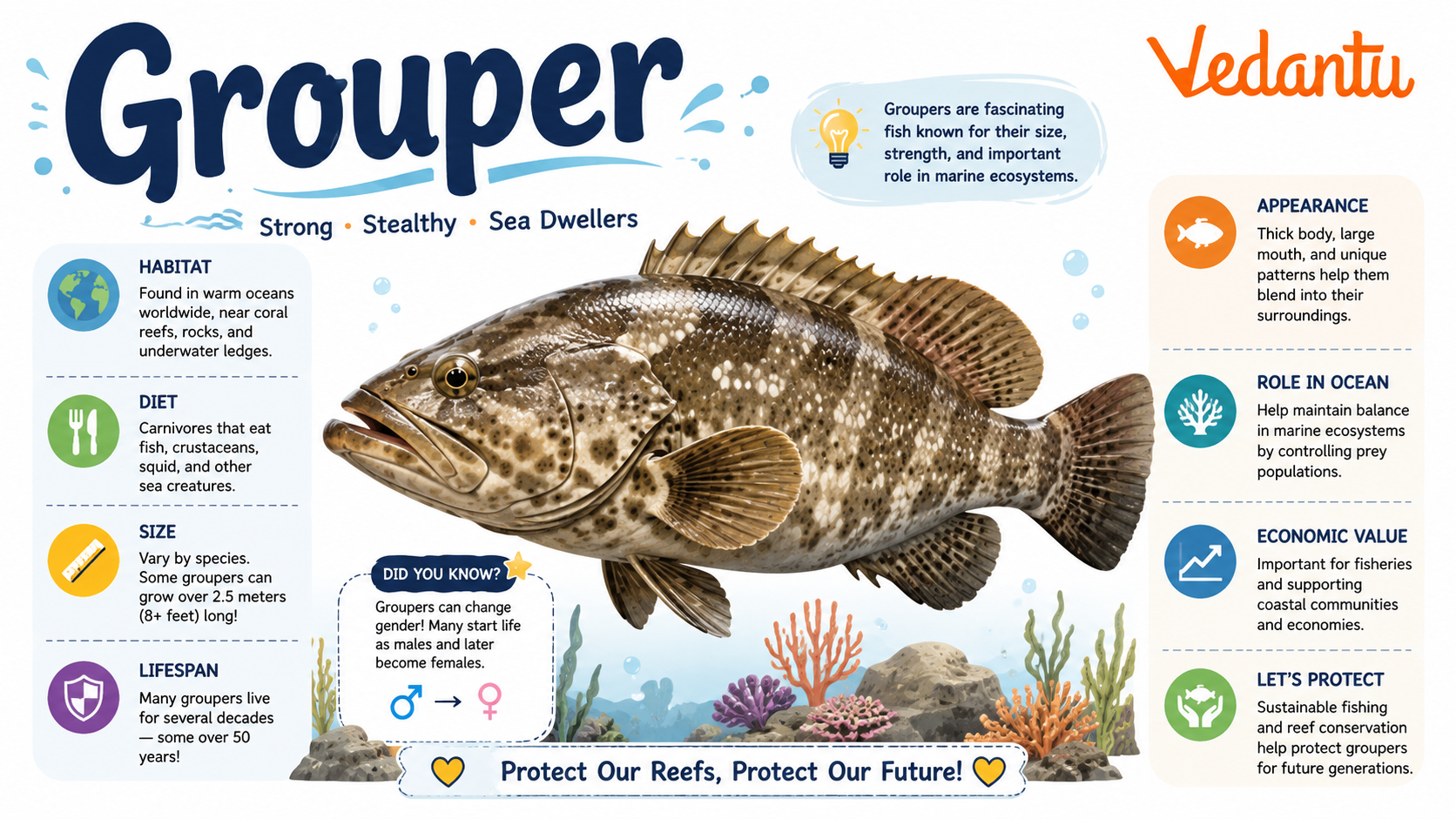
Quick Facts About Grouper
| Feature | Details |
|---|---|
| Common Name | Grouper |
| Scientific Family | Serranidae |
| Animal Group | Fish |
| Size | Up to 8 feet (in giant species) |
| Weight | Up to 400 kg (Goliath grouper) |
| Habitat | Coral reefs, rocky seabeds, coastal waters |
| Diet | Fish, crabs, lobsters |
| Lifespan | Up to 30–50 years (varies by species) |
| Conservation Status | Some species are Vulnerable or Endangered |
Appearance and Physical Characteristics
- Thick, muscular body
- Very large mouth with strong jaws
- Small sharp teeth for gripping prey
- Rounded tail and broad fins
- Spotted, striped, or camouflaged skin patterns
Grouper Habitat and Distribution
The Grouper habitat mainly includes warm ocean waters around the world. They are especially common in tropical and subtropical seas.
- Coral reefs
- Rocky underwater caves
- Coastal waters
- Deep sea areas (some species)
Diet and Feeding Habits
Groupers are carnivores.
Smaller fish, crabs, shrimp, and lobsters.
Ambush predator – waits quietly and attacks suddenly.
Top predator in reef ecosystems.
Grouper diet plays an important role in controlling populations of smaller fish and crustaceans in coral reefs.
Behaviour and Lifestyle
- Mostly solitary (live alone)
- Slow swimmers but powerful attackers
- Hide in rocks and coral crevices
- Territorial – protect their area
- Some species gather in groups during breeding
Grouper Life Cycle
- Egg Stage: Females release thousands to millions of eggs into the water.
- Larva Stage: Tiny larvae float with ocean currents.
- Juvenile Stage: Young groupers settle near reefs.
- Adult Stage: They grow large and become powerful reef predators.
An interesting fact about the Grouper life cycle is that many species can change their gender as they grow older. This helps maintain balance in their population.
What Makes Grouper Special?
Importance and Role in Nature
- Control populations of smaller fish
- Maintain reef biodiversity
- Provide food for humans in many coastal regions
- Support fishing and eco-tourism industries
Amazing Grouper Facts
Interesting Facts About Grouper
- There are more than 150 species of groupers.
- They are popular in seafood markets around the world.
- Overfishing has reduced the population of some species.
- Young groupers often have brighter colours than adults.
Fun Facts for Kids
FAQs on Grouper Fish: Amazing Facts About This Reef Predator
1. What is a grouper?
A grouper is a large, strong marine fish that lives in warm ocean waters around coral reefs.
- Belongs to the Serranidae family
- Found in tropical and subtropical oceans
- Known for its big mouth and heavy body
- Often hides in coral reefs and rocky caves
2. Where do groupers live?
Groupers live mainly in warm ocean habitats near reefs and rocky sea floors.
- Common in the Atlantic Ocean, Pacific Ocean, and Indian Ocean
- Prefer coral reefs, underwater caves, and ledges
- Some species live in shallow coastal waters
- Others can be found in deeper offshore areas
3. What do groupers eat?
Groupers are carnivorous fish that eat smaller sea animals.
- Feed on fish, crabs, and shrimp
- Use their large mouths to swallow prey whole
- Are known as ambush predators
- Hide and quickly surprise their food
4. How big can a grouper grow?
Some grouper species can grow very large and heavy compared to other reef fish.
- The Goliath grouper can reach over 8 feet (2.5 meters)
- Can weigh up to 800 pounds (360 kg)
- Other species are much smaller
- Size depends on the species and habitat
5. Why are groupers important to the ocean?
Groupers play an important role in keeping the marine ecosystem balanced.
- Control populations of smaller fish
- Help maintain healthy coral reef systems
- Are part of the ocean food chain
- Support local fishing communities
6. Are groupers endangered?
Some grouper species are considered threatened or endangered due to human activities.
- Overfishing is a major threat
- Loss of coral reef habitats
- Slow growth makes recovery difficult
- Protected in certain areas to help populations grow
7. How do groupers reproduce?
Groupers have a unique way of reproducing that helps their survival in the wild.
- Many are protogynous hermaphrodites
- Start life as females and may change into males
- Gather in large groups to spawn
- Release eggs and sperm into the water
8. What is the Goliath grouper?
The Goliath grouper is one of the largest and most famous grouper species in the world.
- Lives in the Atlantic Ocean
- Can grow extremely large and heavy
- Has a thick body and small eyes
- Protected in parts of the United States
9. How long do groupers live?
Groupers can live for many years in the ocean if they are not disturbed.
- Some species live over 30 to 50 years
- Grow slowly compared to other fish
- Long lifespan makes them vulnerable to overfishing
- Healthy reefs support longer lives
10. Are groupers dangerous to humans?
Groupers are generally not dangerous and are usually calm around humans.
- Not aggressive toward divers
- May defend themselves if threatened
- Have strong jaws but rarely attack people
- Popular in marine tourism and diving
