






Gaboon Viper Habitat, Venom Strength, Diet, and Unique Adaptations
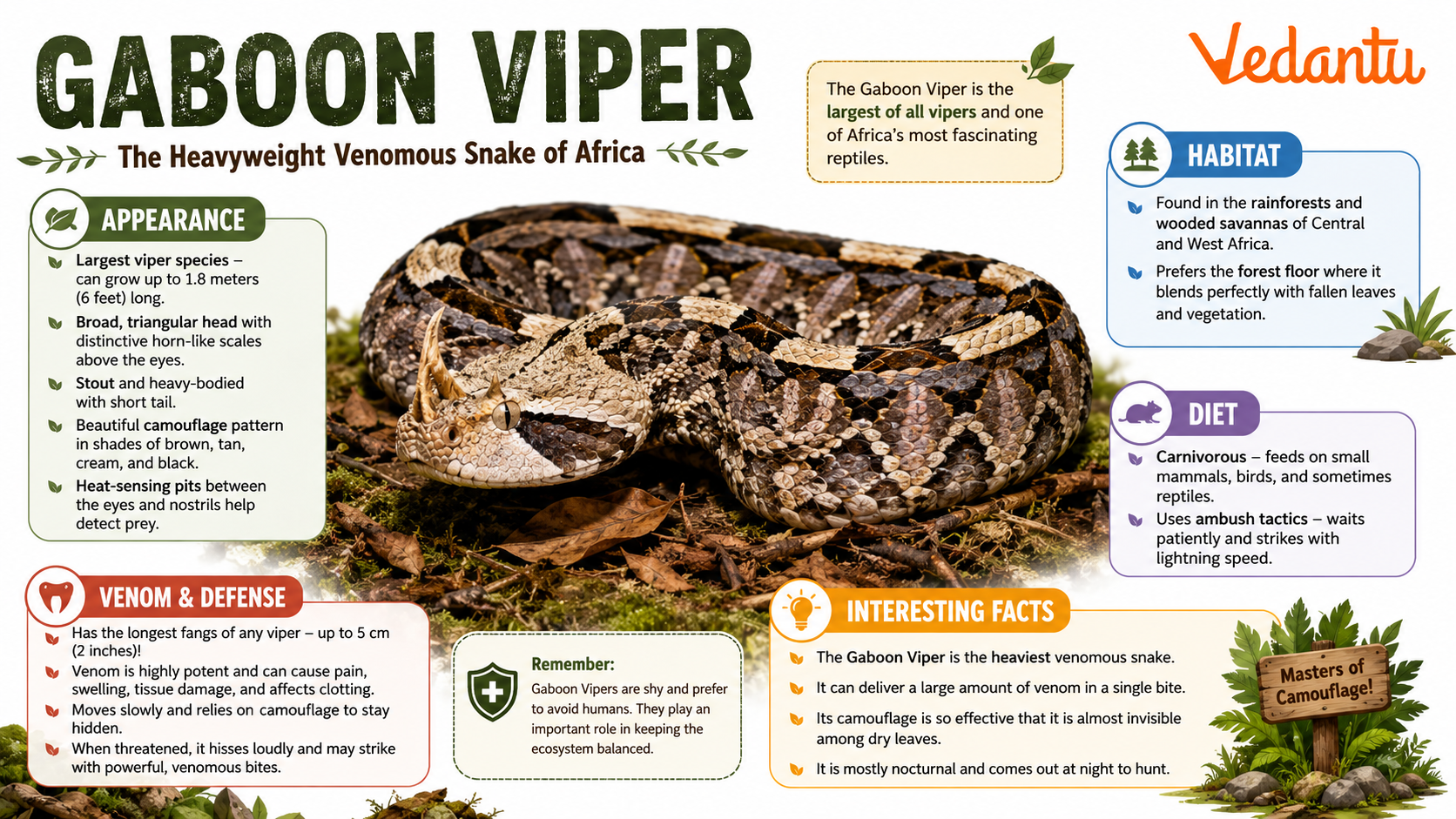
Quick Facts About Gaboon Viper
| Feature | Details |
|---|---|
| Common Name | Gaboon Viper |
| Scientific Name | Bitis gabonica |
| Animal Group | Reptile |
| Length | 4–6 feet (can grow longer) |
| Weight | Up to 20 kg (very heavy for a snake) |
| Habitat | Rainforests and savannas of Africa |
| Diet | Small mammals, birds |
| Special Feature | Fangs up to 2 inches long |
| Conservation Status | Least Concern |
Appearance and Physical Characteristics
- Large, thick, and heavy body.
- Triangular-shaped head with small horn-like scales on the nose.
- Complex pattern of brown, purple, yellow, and black shapes.
- Scales help it blend perfectly with dry leaves.
- Longest fangs of any venomous snake in the world.
Gaboon Viper Habitat and Distribution
- Found in Central and West Africa.
- Lives in tropical rainforests.
- Also found in savannas and woodland areas.
- Prefers forest floors covered with leaves.
- Usually stays hidden under fallen leaves.
Gaboon Viper Diet and Feeding Habits
- Eats rodents like rats and mice.
- Also hunts birds and small mammals.
- Uses “sit-and-wait” hunting method.
- Strikes quickly and injects strong venom.
- Swallows prey whole after it dies.
Behaviour and Lifestyle
Gaboon Viper Life Cycle
- Mating: Usually during the rainy season.
- Birth: Female gives birth to live young (not eggs).
- Baby Snakes: 20–40 babies can be born at once.
- Growth: Young vipers grow independently.
- Lifespan: Can live 15–20 years in the wild.
What Makes the Gaboon Viper Special?
Importance and Role in Nature
- Controls rodent populations.
- Keeps forest ecosystems balanced.
- Part of the food chain (prey for larger animals).
- Venom is studied for medical research.
Amazing Gaboon Viper Facts
Fun Facts for Kids
- It looks like a pile of colorful leaves!
- It has tiny “horns” on its nose.
- Baby vipers are venomous from birth.
- It swallows its food whole.
- It is slow-moving but super fast when attacking.
FAQs on Gaboon Viper: Fascinating Facts About Africa’s Heaviest Venomous Snake
1. What is a Gaboon Viper?
The Gaboon Viper is a large, venomous snake found in the rainforests and savannas of Africa.
- Scientific name: Bitis gabonica
- One of the largest vipers in the world
- Known for its long fangs and powerful venom
- Famous for its beautiful camouflage patterns
- Belongs to the viper family (Viperidae)
2. Where does the Gaboon Viper live?
The Gaboon Viper habitat includes tropical regions of central and western Africa.
- Found in rainforests and woodlands
- Lives in savannas and forest edges
- Common in countries like Nigeria, Cameroon, and Congo
- Prefers areas with thick leaf litter for hiding
3. How big can a Gaboon Viper grow?
The Gaboon Viper size can reach up to 6 feet (1.8 meters) long.
- Average length: 4 to 5 feet
- One of the heaviest venomous snakes
- Can weigh over 20 pounds (9 kg)
- Has a thick, heavy body
4. Is the Gaboon Viper dangerous to humans?
Yes, the Gaboon Viper venom is very strong and can be dangerous if untreated.
- Has the longest fangs of any snake (up to 2 inches)
- Venom can cause serious injury
- Usually calm and bites only if threatened
- Antivenom is available in hospitals
5. What does a Gaboon Viper eat?
The Gaboon Viper diet mainly includes small animals it can ambush.
- Eats rodents like rats and mice
- Also hunts birds
- Sometimes eats frogs and small mammals
- Swallows prey whole after injecting venom
6. How does the Gaboon Viper hunt its prey?
The Gaboon Viper hunting method is called ambush predation.
- Lies still and blends into leaves using camouflage
- Waits patiently for prey to come close
- Strikes quickly with long venomous fangs
- Tracks prey using its heat-sensing pits
7. What makes the Gaboon Viper unique?
The Gaboon Viper is unique because of its size, fangs, and beautiful patterns.
- Has the longest snake fangs in the world
- Produces a large amount of venom
- Features striking geometric markings
- Has a wide, triangle-shaped head
8. Are Gaboon Vipers aggressive?
No, the Gaboon Viper behavior is usually calm and not aggressive.
- Prefers to stay still instead of attacking
- Bites mainly when stepped on or disturbed
- Relies on camouflage for protection
- Slow-moving but strikes very fast
9. How do Gaboon Vipers reproduce?
The Gaboon Viper reproduction process involves giving birth to live young.
- They are ovoviviparous (eggs hatch inside the mother)
- Can give birth to 20–40 baby snakes
- Babies are born fully formed
- Young vipers are venomous at birth
10. How long does a Gaboon Viper live?
The Gaboon Viper lifespan can reach up to 20 years in the wild.
- May live longer in captivity
- Life depends on habitat and predators
- Faces threats from habitat loss and humans
- Considered important for ecosystem balance
