






What Did Compsognathus Eat and How Did It Live?
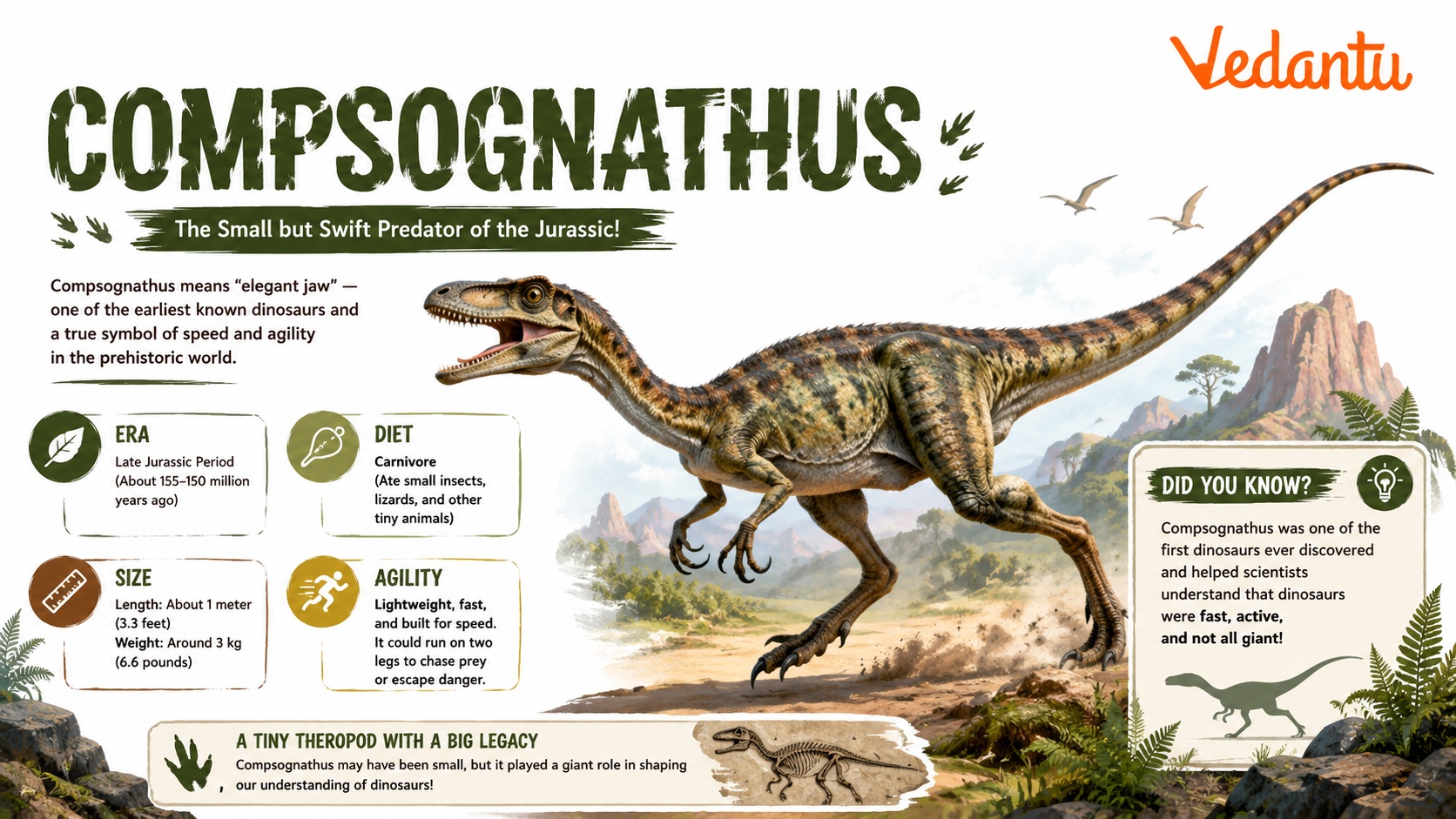
Quick Facts About Compsognathus
| Feature | Details |
|---|---|
| Common Name | Compsognathus |
| Scientific Meaning | "Elegant Jaw" |
| Animal Group | Dinosaur (Theropod) |
| Period | Late Jurassic (about 150 million years ago) |
| Size | Around 1 meter long |
| Weight | About 2–3 kg |
| Diet | Carnivore |
| Found In | Germany and France |
| Conservation Status | Extinct |
Appearance and Physical Characteristics
- Very small and lightweight body.
- Long, slender tail for balance.
- Sharp, narrow teeth for catching prey.
- Long hind legs built for running fast.
- Short forearms with small claws.
- Large eyes and a lightweight skull.
Compsognathus Habitat and Distribution
The Compsognathus habitat included warm, coastal areas with forests and lagoons during the Jurassic period.
- Lived in parts of Europe.
- Fossils found mainly in Germany and France.
- Preferred dry land near water sources.
- Thrived in warm and tropical climates.
Compsognathus Diet and Feeding Habits
Compsognathus was a strict carnivore. Its small body required frequent hunting of tiny prey.
- Ate small lizards and reptiles.
- Possibly hunted insects.
- Used sharp teeth to grip slippery prey.
- Relied on speed to chase and capture food.
Behaviour and Lifestyle
Compsognathus Life Cycle
- Egg Stage: Like most dinosaurs, it likely hatched from eggs laid in nests.
- Young Dinosaur: Baby Compsognathus would grow quickly to avoid predators.
- Adult Stage: Reached full size at about 1 meter long.
- Lifespan: Exact lifespan is unknown but probably similar to small reptiles.
What Makes Compsognathus Special?
Importance of Compsognathus in Science
- Provides clues about early theropod dinosaurs.
- Helps scientists understand dinosaur-to-bird evolution.
- Shows how even small dinosaurs played an important role in ecosystems.
- Adds valuable information about Jurassic biodiversity.
Amazing Compsognathus Facts
Interesting Facts About Compsognathus
- It may have had feathers, though this is not confirmed.
- Its skeleton is very delicate and thin.
- Only a few well-preserved fossils have been found.
- It lived alongside much larger dinosaurs.
Fun Facts for Kids
FAQs on Compsognathus Dinosaur: Fast, Small, and Fascinating
1. What is Compsognathus?
Compsognathus was a small, fast-running dinosaur that lived during the Late Jurassic period.
- Its name means "elegant jaw"
- It was a small theropod dinosaur
- Lived about 150 million years ago
- Fossils were found in Germany and France
- Often compared to a small chicken in size
2. How big was Compsognathus?
Compsognathus was one of the smallest known dinosaurs, about the size of a turkey.
- Length: about 3–4 feet (1 meter)
- Weight: around 5–7 pounds (2–3 kg)
- Lightweight and slender body
- Long tail for balance
3. What did Compsognathus eat?
Compsognathus was a carnivorous dinosaur that ate small animals.
- Hunted lizards
- Ate small insects and tiny vertebrates
- Sharp teeth helped it catch prey
- Fast runner to chase food
4. Where did Compsognathus live?
Compsognathus lived in warm, tropical environments in prehistoric Europe.
- Fossils found in Bavaria, Germany
- Also discovered in France
- Lived in island lagoons and coastal areas
- Shared habitat with other Jurassic dinosaurs
5. When did Compsognathus live?
Compsognathus lived during the Late Jurassic period about 150 million years ago.
- Time period: Jurassic Era
- Before the Tyrannosaurus rex
- Shared Earth with large dinosaurs like Allosaurus
6. Was Compsognathus faster than other dinosaurs?
Compsognathus was likely very fast because of its small size and long legs.
- Lightweight body helped it run quickly
- Long hind legs built for speed
- Used speed to escape predators
- Could quickly chase small prey
7. Did Compsognathus have feathers?
Scientists are not completely sure if Compsognathus had feathers, but it may have had simple feather-like coverings.
- It was a theropod, related to birds
- Some related dinosaurs had proto-feathers
- No clear feather fossils found yet
- Possibly had light body covering for warmth
8. How was Compsognathus discovered?
Compsognathus was first discovered in Germany in the 19th century.
- First fossil found in 1859
- Discovered in Bavaria
- Well-preserved skeleton helped scientists study it
- One fossil even showed remains of a small lizard inside its stomach
9. Is Compsognathus related to birds?
Compsognathus is closely related to modern birds because it belongs to the theropod group.
- Part of the theropod dinosaur family
- Theropods later evolved into birds
- Shared features like hollow bones
- Walked on two legs like birds
10. Why is Compsognathus important to scientists?
Compsognathus is important because it helps scientists understand small dinosaurs and bird evolution.
- One of the smallest known dinosaurs
- Provides clues about Jurassic ecosystems
- Helps study the link between dinosaurs and birds
- Well-preserved fossils give detailed scientific evidence
