






Where Do Cat Snakes Live and Are They Venomous to Humans?
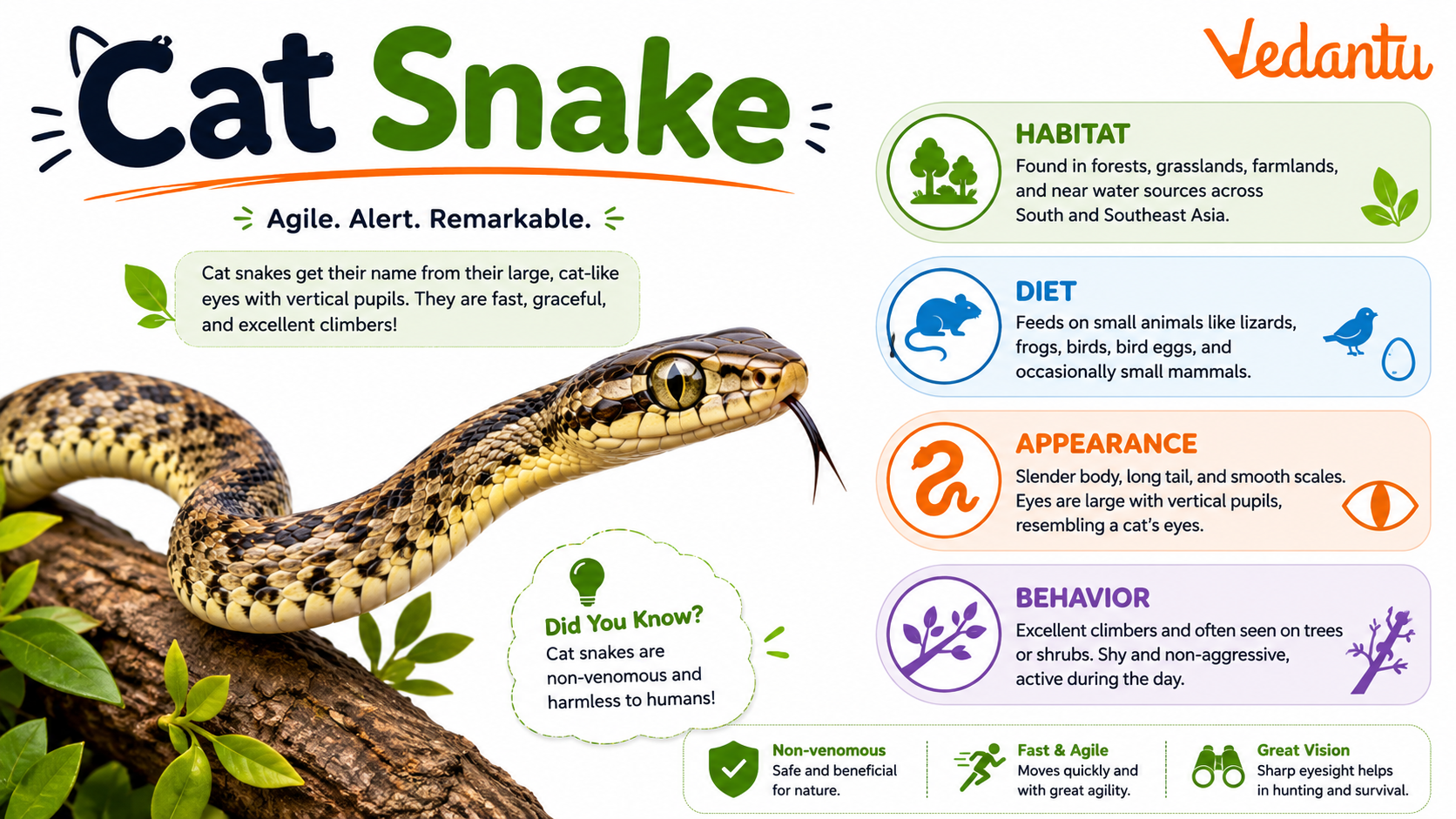
Quick Facts About Cat Snake
| Feature | Details |
|---|---|
| Common Name | Cat Snake |
| Scientific Genus | Boiga |
| Animal Group | Reptile |
| Type | Mildly venomous, rear-fanged snake |
| Size | 1 to 2 metres (varies by species) |
| Habitat | Forests, gardens, plantations, shrubs |
| Diet | Lizards, frogs, birds, eggs, small mammals |
| Activity | Mostly nocturnal |
| Found In | Asia, Africa, Australia |
Appearance and Physical Characteristics
- Long, slender and flexible body.
- Large eyes with vertical pupils like a cat.
- Smooth scales that shine slightly.
- Colours vary: brown, green, grey or patterned with spots or bands.
- Head is slightly wider than the neck.
Habitat and Distribution
- Lives mainly in forests and wooded areas.
- Often found in bushes, trees and shrubs.
- Can also live near human settlements and gardens.
- Prefers warm and tropical climates.
Diet and Feeding Habits
- Carnivorous reptile.
- Eats lizards, frogs, small birds and bird eggs.
- Some species eat small rodents.
- Uses mild venom to control prey.
Behaviour and Lifestyle
- Mostly active at night (nocturnal).
- Excellent tree climber.
- Moves slowly and silently.
- Usually shy and avoids humans.
- May bite if handled or disturbed.
Cat Snake Life Cycle
- Egg Laying: Female lays eggs in hidden places like under leaves or inside tree holes.
- Incubation: Eggs hatch after several weeks depending on temperature.
- Hatchlings: Baby snakes are independent from birth.
- Growth: They grow by shedding their skin regularly.
- Adult Stage: Become mature in a few years and start reproducing.
What Makes the Cat Snake Special?
Vertical pupils help in night hunting.
Can climb branches easily and balance well.
Uses venom mainly for catching prey.
Slender body helps move through tight spaces.
Types and Diversity
- Common Cat Snake (Boiga trigonata)
- Mangrove Cat Snake (Boiga dendrophila)
- Brown Tree Snake (Boiga irregularis)
Importance and Role in Nature
Controls lizard and rodent populations.
Acts as both predator and prey.
Helps maintain balance in forest ecosystems.
Shows health of forest habitats.
Amazing Facts About Cat Snake
- They have eyes that look very similar to a cat’s eyes.
- Some species can grow over 2 metres long.
- They are mostly active during the night.
- Their venom is mild compared to many other snakes.
- They are excellent at hiding in trees.
- They swallow prey whole.
- They shed their skin several times a year.
Interesting Facts About Cat Snake
Fun Facts for Kids
FAQs on Cat Snake: Fascinating Facts, Identification, and Natural History
1. What is a Cat Snake?
A Cat Snake is a slender, tree-living snake known for its large, cat-like eyes and mild venom.
- Belongs to the genus Boiga
- Has vertical pupils similar to a cat
- Mostly active at night (nocturnal snake)
- Common in Asia, Australia, and Africa
- Usually not dangerous to humans
2. Why is it called a Cat Snake?
The Cat Snake gets its name from its eyes, which look like a cat’s eyes.
- Has vertical slit pupils
- Eyes help it see well in the dark
- Gives it a sharp and alert appearance
- Helps it hunt at night
3. Are Cat Snakes venomous?
Yes, Cat Snakes are mildly venomous, but they are not dangerous to most humans.
- They have rear fangs
- Venom helps them catch small prey
- Bites may cause mild swelling or pain
- Rarely cause serious harm to people
4. Where do Cat Snakes live?
Cat Snakes live mainly in warm tropical and subtropical regions.
- Found in forests, jungles, and woodlands
- Common in India, Southeast Asia, Australia, and Africa
- Prefer trees and shrubs (arboreal habitat)
- Sometimes seen near villages
5. What do Cat Snakes eat?
Cat Snakes are carnivores that eat small animals.
- Feed on lizards
- Eat frogs
- Hunt small birds
- Sometimes eat rodents
6. Are Cat Snakes dangerous to kids or pets?
Cat Snakes are generally not dangerous, but they should not be touched.
- Usually shy and avoid humans
- Bite only if threatened
- Mild venom may cause irritation
- Keep pets away from wild snakes
7. How big does a Cat Snake grow?
Most Cat Snakes grow to a medium length compared to other snakes.
- Average size: 2 to 6 feet long
- Slender and lightweight body
- Long tail helps with climbing
- Size varies by Boiga species
8. Are Cat Snakes active during the day or night?
Cat Snakes are mostly active at night.
- They are nocturnal reptiles
- Sleep or hide during the day
- Use strong night vision to hunt
- Rest in trees or bushes
9. How do Cat Snakes move and climb?
Cat Snakes are excellent climbers that move smoothly through trees.
- Have flexible, slender bodies
- Use strong muscles to grip branches
- Balance with their long tails
- Can move quickly and quietly
10. What are some common types of Cat Snakes?
There are many species of Cat Snakes in the Boiga group.
- Common Cat Snake (Boiga trigonata)
- Mangrove Cat Snake (Boiga dendrophila)
- Brown Tree Snake (Boiga irregularis)
- Green Cat Snake
