






How to Identify Aedes Mosquitoes and Prevent Dengue, Zika, and Chikungunya
Aedes is a group of mosquitoes known for spreading serious viral diseases like dengue, Zika, chikungunya, and yellow fever. These small but powerful insects are easily recognised by their black bodies with white stripes. Aedes mosquitoes are active during the daytime and are commonly found in tropical and subtropical regions. Learning about Aedes facts, Aedes habitat, Aedes diet, and Aedes life cycle helps us understand how to prevent the diseases they spread.
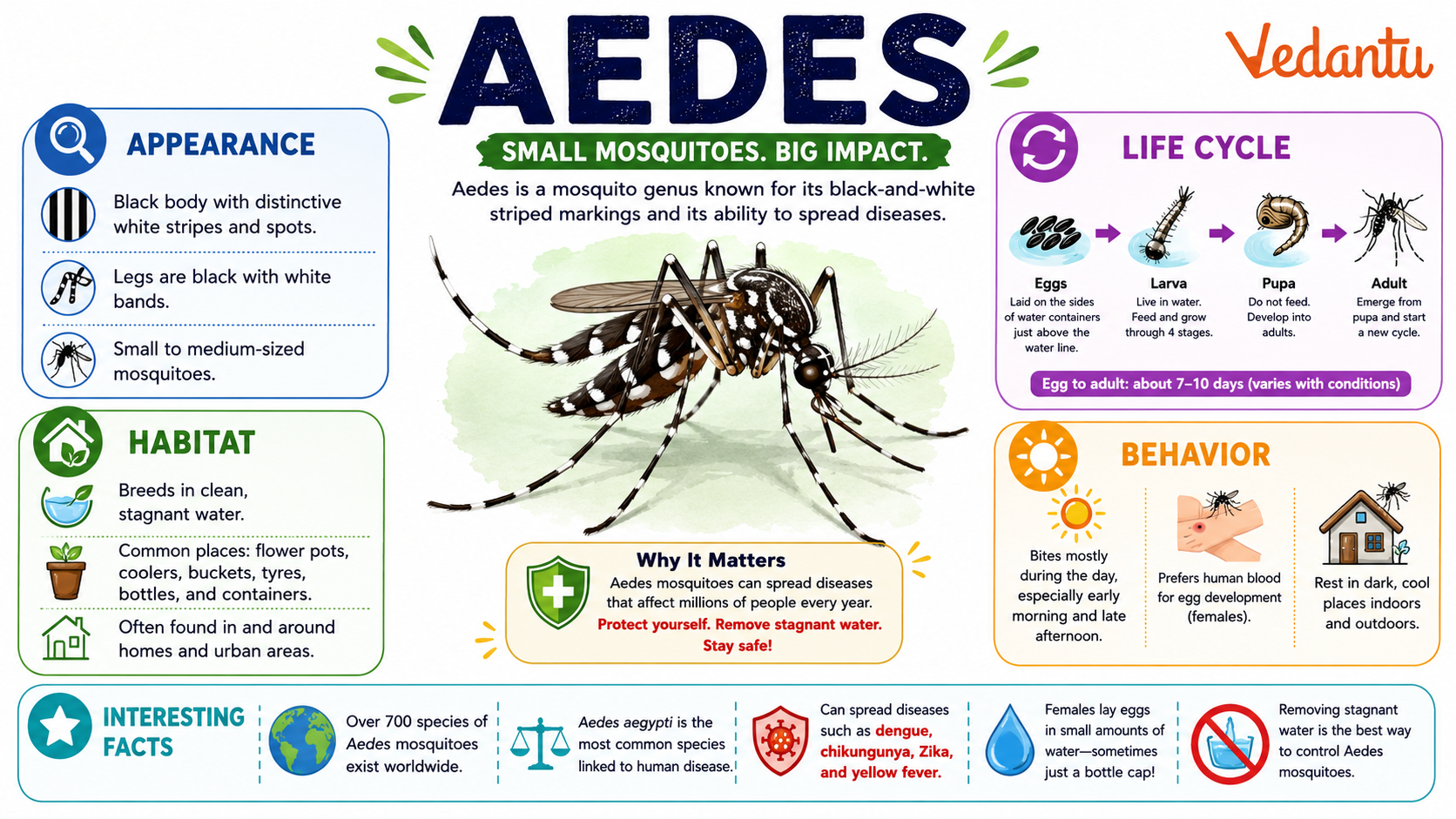
Quick Facts About Aedes
| Feature | Details |
|---|---|
| Common Name | Aedes Mosquito |
| Scientific Genus | Aedes |
| Animal Group | Insect |
| Size | About 4–7 mm long |
| Habitat | Urban areas, stagnant water, tropical regions |
| Diet | Females feed on blood; males feed on plant nectar |
| Active Time | Mostly daytime |
| Diseases Spread | Dengue, Zika, Chikungunya, Yellow Fever |
Appearance and Physical Characteristics
- Small, slender-bodied mosquito.
- Black body with bright white stripes on legs and thorax.
- Long legs and narrow wings.
- Females have a sharp proboscis (mouthpart) for sucking blood.
- Lightweight body helps in quick flying and landing.
Aedes Habitat and Distribution
- Common in tropical and subtropical regions.
- Found in Asia, Africa, the Americas, and parts of Europe.
- Lives near human homes and cities.
- Breeds in stagnant water like buckets, flower pots, tires, and tanks.
- Prefers warm and humid climates.
Unlike many other mosquitoes, Aedes habitat often includes clean, stored water in urban areas. This makes them especially common in crowded cities.
Diet and Feeding Habits
Feed on human or animal blood to develop eggs. They are responsible for spreading diseases.
Feed only on plant juices and nectar. They do not bite humans.
Behaviour and Lifestyle
- Active mainly during the daytime.
- Prefer biting humans rather than animals.
- Fly close to the ground.
- Rest indoors in dark and cool places.
- Females lay eggs just above the water surface.
One important Aedes characteristic is that their eggs can survive dry conditions for months and hatch when they touch water.
Aedes Life Cycle
- Egg: Laid on the inner walls of water containers.
- Larva: Lives in water and feeds on tiny particles.
- Pupa: Non-feeding stage before adulthood.
- Adult: Emerges from water and starts flying within days.
The complete Aedes life cycle can take as little as 7–10 days in warm weather, which allows their population to grow quickly.
What Makes Aedes Special?
Importance and Role in Nature
- Serve as food for fish, frogs, and birds.
- Part of the food chain in aquatic ecosystems.
- Help scientists study disease control and public health.
Although Aedes mosquitoes are harmful to humans due to disease spread, they still play a role in the natural ecosystem.
Amazing Aedes Facts
- Aedes aegypti is the most famous species for spreading dengue.
- They are also called “tiger mosquitoes” because of their stripes.
- Only female mosquitoes bite humans.
- They can fly up to 200 meters in search of food.
- They are attracted to body heat and carbon dioxide.
- Urbanisation has increased their population worldwide.
Interesting Facts About Aedes
Fun Facts for Kids
- Aedes mosquitoes are smaller than a fingernail.
- They wear natural black-and-white “stripes.”
- They love warm weather.
- They can grow from egg to adult in about a week.
- Covering water containers helps stop them from breeding.
FAQs on Aedes Mosquito: Identification, Habitat, and Health Risks
1. What is Aedes?
Aedes is a type of mosquito known for spreading dangerous diseases to humans.
- Aedes mosquitoes are small, dark insects with white stripes on their legs.
- They are famous for spreading dengue, Zika virus, chikungunya, and yellow fever.
- The most common species are Aedes aegypti and Aedes albopictus (Asian tiger mosquito).
- They usually bite during the daytime.
2. Why is the Aedes mosquito dangerous?
The Aedes mosquito is dangerous because it spreads serious viral diseases to people.
- It carries viruses like dengue fever and Zika virus.
- These diseases can cause high fever, body pain, rashes, and weakness.
- In some cases, infections may become life-threatening.
- It spreads germs when it bites and sucks human blood.
3. Where do Aedes mosquitoes live?
Aedes mosquitoes mostly live in warm and tropical regions around the world.
- They are common in Asia, Africa, and South America.
- They breed in clean, standing water like buckets, flower pots, and tires.
- They live near homes and cities.
- They prefer warm and humid climates.
4. What diseases are spread by Aedes mosquitoes?
Aedes mosquitoes spread several viral diseases that affect millions of people each year.
- Dengue fever
- Zika virus infection
- Chikungunya
- Yellow fever
5. How can you identify an Aedes mosquito?
You can identify an Aedes mosquito by its unique striped appearance.
- Black body with white stripes on legs.
- White marking shaped like a lyre on its thorax (body).
- Active and bites during the daytime.
- Smaller than many other mosquito species.
6. When do Aedes mosquitoes bite?
Aedes mosquitoes usually bite during the daytime, especially in the early morning and late afternoon.
- They are most active at sunrise and sunset.
- Unlike other mosquitoes, they do not mainly bite at night.
- They prefer biting humans rather than animals.
7. How do Aedes mosquitoes reproduce?
Aedes mosquitoes reproduce by laying eggs in clean, still water.
- Female mosquitoes lay eggs on water surfaces.
- Eggs hatch into larvae within a few days.
- Larvae grow into pupae and then adult mosquitoes.
- The life cycle can complete in about 7–10 days.
8. How can we prevent Aedes mosquito bites?
You can prevent Aedes mosquito bites by protecting yourself and removing breeding places.
- Use mosquito repellent.
- Wear long-sleeved clothes.
- Sleep under mosquito nets if needed.
- Remove standing water from containers and plants.
9. Why do Aedes mosquitoes breed in clean water?
Aedes mosquitoes prefer clean water because it helps their eggs and larvae grow safely.
- They lay eggs in water stored in buckets and tanks.
- They avoid dirty or polluted water.
- Urban areas provide many small water containers.
10. What is the difference between Aedes and other mosquitoes?
Aedes mosquitoes are different from other mosquitoes in appearance and behavior.
- They have black and white stripes.
- They bite during the daytime, not just at night.
- They spread dengue and Zika, unlike some other species.
- They breed in small collections of clean water.
