



Class 11 Geography Chapter 5 Natural Vegetation Notes for CBSE 2026-27
Chapter 5 explains India's natural vegetation, the factors influencing its distribution, and the importance of conserving forests and wildlife. The following revision notes follow the NCERT India: Physical Environment textbook, 2026–27 reprint.
1. Natural Vegetation: Meaning and Distribution
Natural vegetation refers to plant communities that have remained undisturbed for a long period, allowing plant species to adapt to local climate and soil conditions.
India has diverse vegetation because temperature, rainfall, altitude and soil conditions vary between regions.
Important Concept: Natural vegetation grows under natural conditions, while planted vegetation is cultivated or maintained through human supervision.
2. Major Types of Natural Vegetation in India
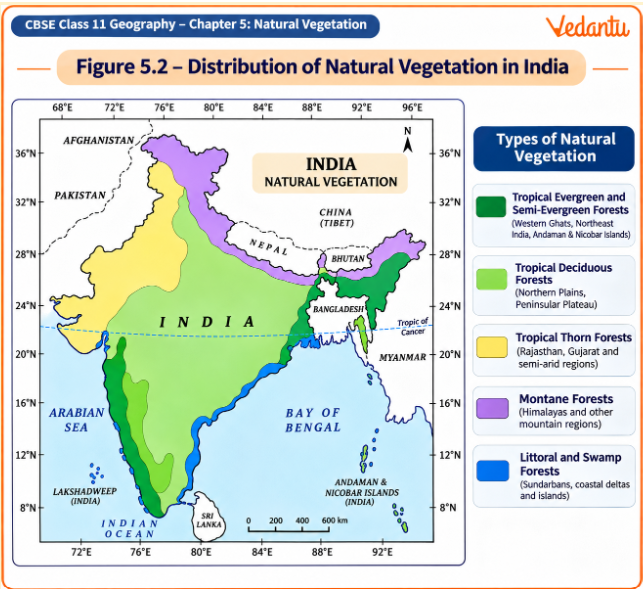
NCERT classifies India's forests into five main groups.
3. Tropical Evergreen and Semi-Evergreen Forests
Tropical evergreen forests grow in areas receiving over 200 cm of annual rainfall and having mean annual temperatures above 22°C.
Main Features
Found on the western slopes of the Western Ghats, northeastern hills and Andaman and Nicobar Islands.
Trees may grow to heights of 60 metres or more.
Vegetation has several layers of trees, shrubs and creepers.
Trees do not shed all their leaves during one particular season.
Important species: Rosewood, mahogany, aini and ebony.
Semi-evergreen forests occur in relatively less rainy parts of these regions. They contain a mixture of evergreen and moist deciduous trees, including white cedar, hollock and kail.
4. Tropical Deciduous Forests
Tropical deciduous forests are India's most widespread forests. They are also called monsoon forests and occur in areas receiving approximately 70–200 cm of rainfall.
Remember: Deciduous forests shed leaves to reduce water loss during dry periods.
5. Tropical Thorn Forests
Tropical thorn forests occur mainly in areas receiving less than 50 cm of annual rainfall.
Found in semi-arid parts of Rajasthan, Gujarat, Punjab, Haryana, Madhya Pradesh and Uttar Pradesh.
Vegetation includes grasses, thorny shrubs and scattered trees.
Many plants remain leafless for much of the year.
Important species include babool, ber, wild date palm, khair, neem and khejri.
These forests are adapted to dry conditions and limited water availability.
6. Montane Forests
Montane forests occur in mountainous regions where temperature decreases with increasing altitude.
NCERT divides them into northern and southern mountain forests.
Northern Mountain Forests
Deodar is an important Himalayan tree valued for its durable timber. Alpine pastures are used by pastoral communities such as the Gujjars, Bakarwals, Bhotiyas and Gaddis.
Southern Mountain Forests
These occur in the Western Ghats, Vindhyas and Nilgiris. Temperate forests in the Nilgiri, Anaimalai and Palani hills are called Sholas.
Important trees include magnolia, laurel, cinchona and wattle.
7. Littoral and Swamp Forests
Littoral and swamp forests occur in coastal wetlands, tidal creeks, mudflats, estuaries and other waterlogged areas.
Mangrove Forests
Grow in coastal areas influenced by saline water and tides.
Contain salt-tolerant plant species.
Provide habitats for birds and other wildlife.
Are found in the Sundarbans, Andaman and Nicobar Islands and the Mahanadi, Godavari and Krishna deltas.
Important Concept: Mangrove forests help protect coastal ecosystems and support biodiversity.
8. Forest Conservation in India
Forests provide timber, fuel, fodder, food, wildlife habitats and environmental protection. They also help reduce soil erosion and maintain ecological balance.
The NCERT chapter discusses India's forest policies of 1952 and 1988, which emphasise conservation and sustainable forest management.
Forest Area vs Forest Cover: Forest area refers to land officially recorded as forest, while forest cover refers to land actually covered by forest vegetation, regardless of legal classification.
Forests and Tribal Communities: Forests provide food, fuel and livelihood resources to tribal communities. Their traditional knowledge and participation help protect forests.
Major objectives of forest conservation policy
Bring 33% of India's geographical area under forest cover.
Maintain environmental stability and restore ecological balance.
Protect biodiversity and genetic resources.
Reduce soil erosion, desertification, floods and droughts.
Encourage afforestation and social forestry.
Involve local communities in forest protection.
Exam Tip: Remember that 33% is a policy target, not India's actual forest-cover percentage.
9. Social Forestry and Its Types
Social forestry involves managing and protecting forests and planting trees on barren land for environmental, social and rural development.
Agroforestry: Growing trees and crops on the same land.
Community forestry: Growing trees on community land to benefit local people.
10. Wildlife in India
India has rich wildlife diversity because of its varied ecosystems and natural habitats.
However, human activities have damaged wildlife habitats and threatened many species.
Major causes of wildlife decline
Clearing forests for agriculture, settlements and roads.
Mining and construction activities.
Excessive use of forest resources.
Overgrazing by domestic animals.
Hunting and illegal poaching.
Forest fires.
Wildlife conservation is important for protecting biodiversity and maintaining ecological balance.
11. Wildlife Conservation in India
The Wildlife (Protection) Act, 1972 provides a legal framework for protecting wildlife and conservation areas in India.
Important conservation measures discussed in NCERT include:
Project Tiger: Launched in 1973 to protect viable tiger populations and their natural habitats.
Project Elephant: Launched in 1992 to support the conservation of wild elephants.
12. Biosphere Reserves in India
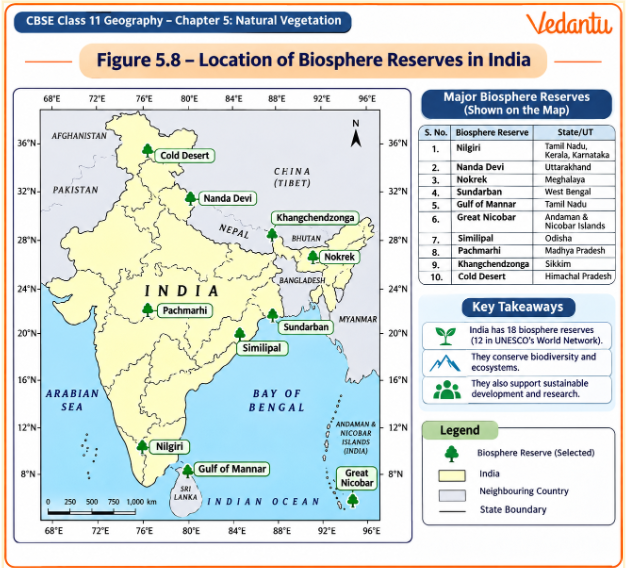
A biosphere reserve is a representative terrestrial or coastal ecosystem recognised within UNESCO's Man and the Biosphere (MAB) Programme.
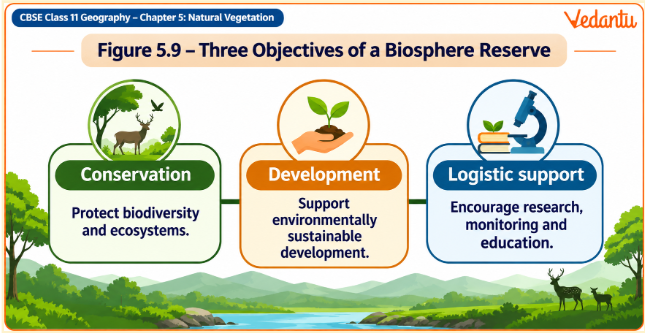
Biosphere reserves aim to conserve biodiversity while supporting sustainable development and research.
Three Main Objectives
The uploaded NCERT 2026–27 reprint lists 18 biosphere reserves in India, of which 12 are recognised in UNESCO's World Network of Biosphere Reserves.
Important Biosphere Reserves
Map Practice: Locate Nanda Devi, Sundarban, Gulf of Mannar and Nilgiri biosphere reserves on an outline map of India.
Download Class 11 Geography Chapter 5 Natural Vegetation Notes PDF
Vedantu provides the Class 11 India Physical Environment Chapter 5 Notes PDF covering forest types, conservation and biosphere reserves. Students can download the Class 11 Geography Chapter 5 Natural Vegetation Notes PDF for quick revision and exam preparation.
Important Topics Covered in Class 11 Geography Chapter 5 Natural Vegetation Notes
These Class 11 Geography Chapter 5 Natural Vegetation Short Notes cover the following NCERT topics.
Why are Class 11 Geography Chapter 5 Revision Notes Important?
Vedantu's notes simplify NCERT concepts and help students revise natural vegetation and wildlife.
Understand Forest Types: Learn about India's major vegetation types.
Study Distribution: Understand how climate and rainfall affect vegetation.
Revise Conservation: Learn about wildlife conservation and biosphere reserves.
Prepare for CBSE Exams: Revise key concepts and important NCERT topics.
How to Prepare Class 11 Geography Chapter 5 with Vedantu?
Revise: Learn forest types, rainfall and important species.
Compare: Understand differences between major forest types.
Practise: Locate vegetation regions and biosphere reserves on maps.
Review: Use Vedantu notes and solve NCERT questions.
Preparation Tip: Focus on forest classification, social forestry and conservation.
Conclusion
Class 11 Geography Chapter 5 Natural Vegetation covers India's forests, wildlife and conservation measures. Vedantu's revision notes help students understand these NCERT concepts and prepare for CBSE examinations.
CBSE Class 11 Geography Chapter 5 Study Materials
CBSE Class 11 Geography Other Books Notes and Study Resources
CBSE Class 11 Geography India: Physical Environment Chapter-wise Notes
Other Important Study Materials for CBSE Class 11 Geography
FAQs on CBSE Class 11 Geography India: Physical Environment Chapter 5 Natural Vegetation Notes 2026-27
1. Why does natural vegetation vary across different regions of India?
Natural vegetation varies because of differences in rainfall, temperature, altitude and soil. The Western Ghats support evergreen forests, Rajasthan has thorn vegetation, and the Himalayas have different forest types at different elevations.
2. What is the difference between tropical evergreen and tropical deciduous forests?
Tropical evergreen forests occur in areas receiving over 200 cm of annual rainfall and remain green throughout the year. Tropical deciduous forests generally receive 70–200 cm of rainfall and shed leaves during the dry season.
3. Why are tropical deciduous forests called monsoon forests?
Tropical deciduous forests are called monsoon forests because their growth and seasonal changes are closely linked to monsoon rainfall. Many trees shed their leaves during the dry season to conserve water.
4. What is social forestry in Class 11 Geography Chapter 5?
Social forestry involves planting and managing trees to support environmental protection and community development. Its major categories include urban forestry, rural forestry and farm forestry.
5. Where are mangrove forests found in India?
Mangrove forests grow in coastal wetlands, estuaries and tidal areas. Important regions include the Sundarbans, Andaman and Nicobar Islands, and the Mahanadi, Godavari and Krishna deltas.
6. What are the main objectives of biosphere reserves?
Biosphere reserves aim to conserve biodiversity, support sustainable development and encourage research, education and environmental monitoring. They help protect ecosystems while supporting local communities.
7. What is the difference between Project Tiger and Project Elephant?
Project Tiger was launched in 1973 to protect tigers and their natural habitats. Project Elephant began in 1992 to support the long-term conservation of wild elephant populations and their habitats.
8. How can students download Class 11 Geography India Physical Environment Chapter 5 Notes PDF?
Students can use the PDF download option on Vedantu's Chapter 5 Natural Vegetation revision notes page. The PDF covers forest types, wildlife conservation, biosphere reserves and other important NCERT concepts.
