



Class 11 Geography Chapter 4 Climate Notes for CBSE 2026–27
Chapter 4 explains why India has a monsoon climate and how geographical location, landforms and atmospheric conditions influence its seasonal weather. The following notes summarise the important concepts from the NCERT chapter.
1. Weather, Climate and the Indian Monsoon
Weather refers to the atmospheric conditions of a place at a particular time, while climate describes the average weather conditions over a long period.
India experiences a monsoon type of climate, which is characterised by seasonal changes in wind direction.
India's climate has a common monsoon pattern, but temperature and rainfall vary considerably between regions.
2. Unity and Diversity in India's Monsoon Climate
The seasonal rhythm of the monsoon creates climatic unity across India. However, regional differences occur because of variations in temperature, rainfall, altitude and distance from the sea.
Important Concept: Coastal areas generally experience smaller temperature differences than inland areas because the sea heats and cools more slowly than land.
3. Factors Determining the Climate of India
India's climate is influenced by factors related to location, relief, atmospheric pressure and winds.
Factors Related to Location and Relief
Factors Related to Air Pressure and Winds
Three atmospheric factors are particularly important:
Distribution of surface air pressure and winds.
Upper-air circulation, including jet streams.
Western cyclonic disturbances in winter and tropical depressions during the monsoon.
Together, these factors influence seasonal winds, rainfall and regional weather conditions.
4. Mechanism of Weather During Winter
During winter, high-pressure conditions develop over Central and Western Asia. Dry continental winds move towards the Indian subcontinent.
Important Winter Weather Features
Western disturbances originate around the Mediterranean region and travel eastwards towards India.
Their winter rainfall benefits rabi crops, particularly in northwestern India.
5. Mechanism of Weather During Summer
During summer, intense heating over northern India creates low-pressure conditions.
The Inter-Tropical Convergence Zone (ITCZ) shifts northwards, attracting moisture-bearing winds towards the subcontinent.
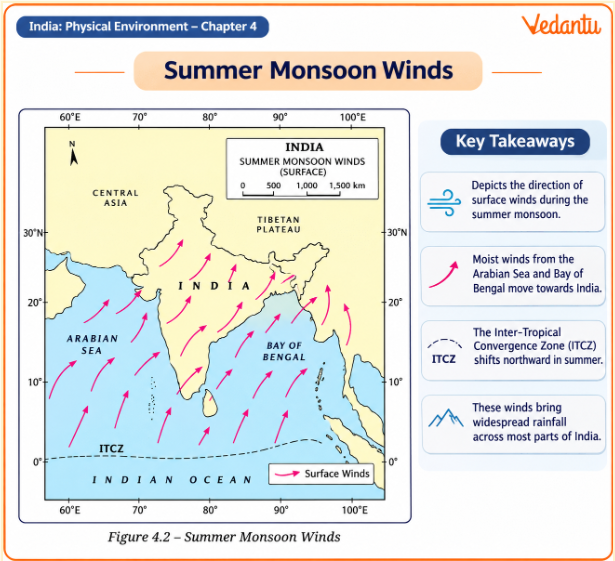
Stages in the Development of the Southwest Monsoon
These processes help establish the southwest monsoon over India.
6. Inter-Tropical Convergence Zone (ITCZ)
The ITCZ is a low-pressure zone where trade winds converge, and air tends to rise.
During July, the ITCZ shifts towards approximately 20°–25° N over the Gangetic Plain.
This low-pressure belt is called the monsoon trough.
Important Points
The ITCZ shifts northwards during the Indian summer.
It attracts winds from the Southern Hemisphere.
After crossing the Equator, these winds become part of the southwest monsoon circulation.
The ITCZ moves southwards during winter, contributing to seasonal changes in wind direction.
7. Jet Streams and Their Role in the Indian Monsoon
Jet streams are narrow bands of strong winds flowing in the upper atmosphere.
Two jet-stream systems are important for understanding India's seasonal weather.
The northward movement of the ITCZ and withdrawal of the westerly jet stream are associated with changes in atmospheric circulation before the monsoon arrives.
8. Onset of the Southwest Monsoon
The southwest monsoon generally reaches the Kerala coast around 1 June.
According to the normal progression described in the NCERT chapter, it reaches Mumbai and Kolkata around 10–13 June and covers most of the subcontinent by mid-July.
These are normal onset patterns, not fixed dates for every year.
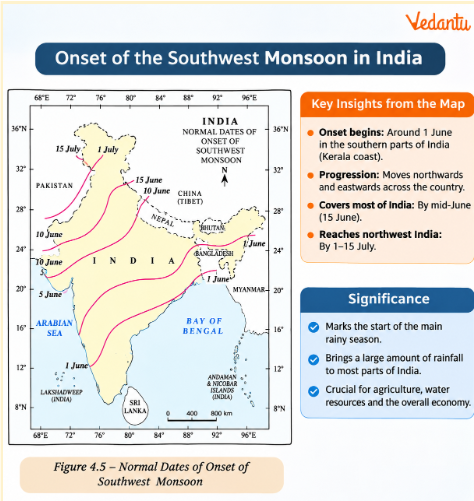
Burst of the Monsoon
The sudden arrival of moisture-bearing winds accompanied by heavy rainfall is called the burst of the monsoon.
The arrival of the monsoon often causes a noticeable fall in daytime temperatures.
El Niño and the Indian Monsoon
El Niño is a climate phenomenon involving unusual warming of surface waters in the central and eastern tropical Pacific Ocean. It can influence India's monsoon rainfall and sometimes contribute to weaker rainfall or drought conditions.
9. Arabian Sea and Bay of Bengal Branches of the Monsoon
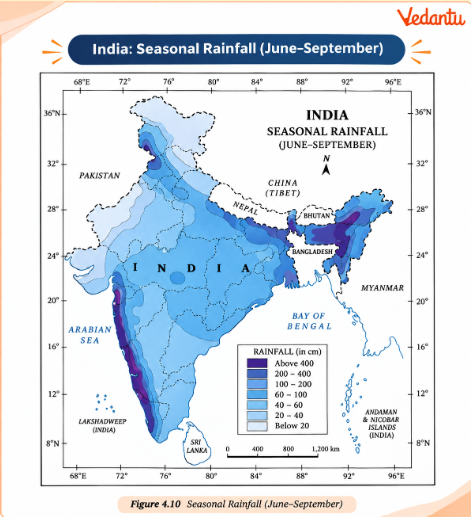
The southwest monsoon reaches India through two main branches.
Arabian Sea Branch
One stream strikes the Western Ghats and causes heavy rainfall on their western slopes.
Another moves inland through the Narmada and Tapi valleys.
A third reaches Saurashtra and Kachchh before moving towards northwestern India.
Bay of Bengal Branch
Moist winds are redirected towards India by the Arakan Hills.
One stream moves westwards along the Ganga Plain.
Another advances through the Brahmaputra Valley.
Moist winds rising over the Khasi Hills produce exceptionally heavy rainfall near Mawsynram.
10. Break in the Monsoon
A break in the monsoon is a dry spell lasting one or more weeks during the southwest monsoon season, after an earlier period of rainfall.
Breaks occur for different reasons:
In northern India, rainfall may decrease when rain-bearing disturbances become less frequent along the monsoon trough.
Along the western coast, dry spells may occur when winds blow nearly parallel to the coastline.
Remember: The burst of the monsoon refers to its sudden onset, while a break refers to a temporary reduction or absence of rainfall during the rainy season.
11. Four Main Seasons of India
Indian meteorologists recognise four main seasons.
Cold Weather Season
December and January are generally the coldest months in northern India. Western disturbances bring winter rainfall to parts of northwestern India and snowfall to the Himalayas.
Hot Weather Season
Temperatures rise sharply over northern and northwestern India. Hot, dry winds and local thunderstorms become common in some regions.
Southwest Monsoon Season
Moist winds from the Arabian Sea and Bay of Bengal bring rainfall to much of India. Rainfall varies because of relief, wind direction and the movement of rain-bearing systems.
Retreating Monsoon Season
The southwest monsoon gradually withdraws. Clear skies, high temperatures and humidity create conditions known as October heat. Tropical cyclones and moisture-bearing northeasterly winds contribute to rainfall along the southeastern coast.
12. Important Local Winds and Storms
Several local weather phenomena occur during the hot weather season.
These local weather events influence agriculture, temperature and daily activities.
13. Focused specifically on Tamil Nadu rainfall
The southwest monsoon begins withdrawing from northwestern India around September.
During October and November, the retreating monsoon brings important rainfall to the Tamil Nadu coast.
Why does Tamil Nadu receive rainfall during this season?
Northeasterly winds collect moisture while crossing the Bay of Bengal.
Cyclonic depressions and tropical cyclones develop over the surrounding seas.
These weather systems bring rainfall to parts of the southeastern coast.
Tamil Nadu receives comparatively less rainfall during the southwest monsoon because much of its coast lies parallel to the Bay of Bengal branch and in the rain-shadow region of the Arabian Sea branch.
14. Distribution of Rainfall in India
India's average annual rainfall is approximately 125 cm, according to the NCERT chapter. However, rainfall varies considerably between regions.
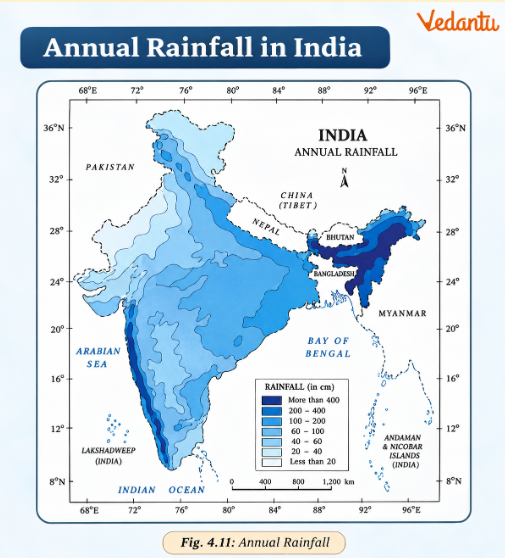
Important Concept: Rain Shadow
A rain-shadow region receives comparatively little rainfall because mountains block moisture-bearing winds.
For example, the western slopes of the Western Ghats receive heavy rainfall, while many areas to their east receive less.
15. Variability of Rainfall
Rainfall variability refers to the degree to which rainfall changes from its average amount.
The coefficient of variation is calculated using:
Coefficient of Variation = (Standard Deviation ÷ Mean Rainfall) × 100
Regions with high rainfall variability are more likely to experience large differences between actual and average rainfall.
16. Climatic Regions of India – Koeppen's Classification
Although India has a broadly monsoonal climate, temperature and rainfall differences produce several climatic regions.
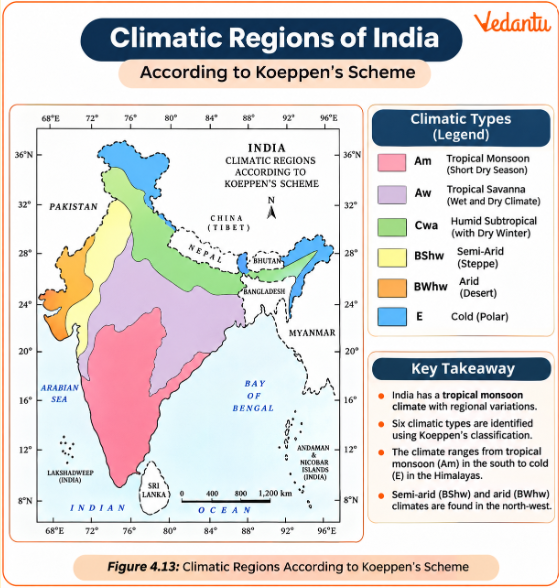
Koeppen classified climates mainly using monthly temperature and precipitation values.
Exam Tip: Learn the broad climatic types, their distinguishing features and their locations on the NCERT map rather than memorising codes alone.
17. Traditional Indian Seasons
Traditional Indian calendars recognise six seasons, each covering approximately two months.
This traditional classification is based on seasonal observations, particularly in northern and central India.
18. Importance of Monsoons in India's Economic Life
The monsoon strongly influences India's agriculture, water resources and economic activities.
Important Effects
Monsoon rainfall supports agricultural activities across large parts of India.
The timing of rainfall influences sowing and crop growth.
Regional climatic differences allow different crops to be cultivated.
Irregular rainfall may cause droughts or floods.
Heavy rainfall can increase surface runoff and soil erosion.
Winter rainfall from western disturbances benefits rabi crops.
19. Global Warming and Climate Change
Global warming refers to the long-term rise in Earth's average temperature.
The NCERT chapter explains that increasing greenhouse gases contribute to global warming.
Important Greenhouse Gases
Carbon dioxide
Methane
Nitrous oxide
Chlorofluorocarbons
Possible Effects of Global Warming
20. Important NCERT Maps and Diagrams for Chapter 4 Climate
Students should revise the following figures from the textbook.
Map Practice: Focus on the movement of monsoon winds, high- and low-rainfall regions, winter rainfall areas and the climatic regions of India.
Download Class 11 Geography Chapter 4 Climate Notes PDF
Vedantu provides the Class 11 India Physical Environment Chapter 4 Notes PDF covering monsoons, seasons and rainfall. Students can download the Class 11 Geography Chapter 4 Climate Short Notes PDF from this page for quick revision and exam preparation.
Important Topics Covered in Class 11 Geography Chapter 4 Climate Notes
These Class 11 Geography Chapter 4 Climate Notes cover the following NCERT topics.
Why are Class 11 Geography Climate Notes Important?
Vedantu's Class 11 Geography Climate Notes simplify monsoon processes, rainfall patterns and seasonal changes, helping students revise NCERT concepts and prepare for exams.
How to Prepare Class 11 Geography Chapter 4 Climate with Vedantu?
Revise: Learn climatic factors, seasons and monsoon formation.
Practise: Identify rainfall regions and monsoon winds on maps.
Compare: Understand seasonal and regional climatic differences.
Review: Use Vedantu notes and solve NCERT questions.
Preparation Tip: Focus on monsoon mechanisms, rainfall distribution and Koeppen's classification.
Conclusion
These Class 11 Geography Chapter Climate Notes help students revise India's climate, monsoons and seasonal variations for CBSE examinations.
CBSE Class 11 Geography Chapter 4 Study Materials
CBSE Class 11 Geography Other Books Notes and Study Resources
CBSE Class 11 Geography India: Physical Environment Chapter-wise Notes
Other Important Study Materials for CBSE Class 11 Geography
FAQs on CBSE Class 11 Geography India: Physical Environment Chapter 4 Climate Notes 2026–27
1. Why does India experience different climatic conditions despite having a monsoon climate?
India experiences climatic variations due to differences in latitude, altitude, relief and distance from the sea. For example, Rajasthan has hot summers, the Himalayas experience cold winters, and coastal regions have moderate temperatures.
2. Why does India have a monsoon type of climate?
India has a monsoon climate because its wind direction changes seasonally. During summer, moisture-bearing southwest monsoon winds bring rainfall to much of the country. During winter, the wind pattern reverses because of seasonal changes in temperature and atmospheric pressure.
3. Why does the Tamil Nadu coast receive rainfall during October and November?
During October and November, northeasterly winds collect moisture while crossing the Bay of Bengal. These winds, along with tropical cyclones and depressions, bring rainfall to the Tamil Nadu coast during the retreating monsoon season.
4. What is the role of the ITCZ in the Indian monsoon?
The ITCZ is a low-pressure zone where trade winds converge. During summer, it shifts northwards over the Gangetic Plain and attracts winds from the Southern Hemisphere. These winds cross the Equator and contribute to the southwest monsoon.
5. What is the difference between the burst and break of the monsoon?
The burst of the monsoon refers to its sudden arrival with heavy rainfall. A break in the monsoon refers to a temporary dry period during the rainy season, often lasting one or more weeks.
6. Why does the Western Ghats region receive more rainfall than the interior Deccan Plateau?
Moist winds from the Arabian Sea rise along the western slopes of the Western Ghats and produce heavy rainfall. After crossing the mountains, the winds descend and become warmer and drier. This creates rain-shadow conditions over parts of the interior Deccan Plateau.
7. What is the importance of western disturbances in India?
Western disturbances bring winter rainfall to northwestern India and snowfall to parts of the Himalayas. This rainfall is particularly useful for rabi crops and contributes to winter precipitation in northern India.
8. How can students download Class 11 Geography India Physical Environment Chapter 4 Notes PDF?
Students can use the PDF download option available on Vedantu's Chapter 4 Climate revision notes page. The PDF helps them revise important NCERT concepts, geographical examples, seasonal patterns and rainfall-related topics in one place.
