




Write chemical reaction to affect the following transformations:
Cyclohexene to hexane −1,6− dioic acid
Answer
 Verified
233.4k+ views
Hint: The carbon-carbon double bond in cyclohexene can be oxidised by Potassium permanganate (\[KMn{O_4}\]) on heating under acidic conditions. This results in the formation of hexane-1,6-dial which is further oxidised by Potassium permanganate to hexane-1,6-diol.
Complete Step by Step Solution:
To convert cyclohexene into hexane-1,6-dioic acid, the carbon-carbon double bond must oxidise as well as cleave. Only then will the cyclic alkene convert into a straight chain. Such reactions can be performed by concentrated Potassium permanganate (\[KMn{O_4}\]) under acidic conditions on heating.
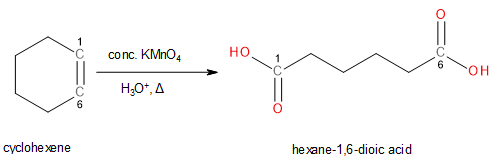
Image: Conversion of cyclohexane to hexane-1,6-dioic acid
In the first step of this reaction, the permanganate ion (\[MnO_4^ - \]) from Potassium permanganate reacts with the carbon-carbon double bond of cyclohexene in a cycloaddition reaction to form a cyclic manganate ester as shown below:
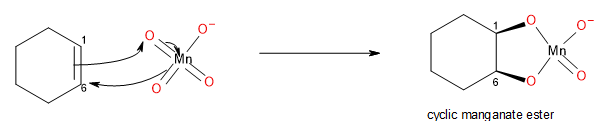
Image: Formation of cyclic manganate ester through cycloaddition of permanganate ion to cyclohexene.
The cyclic manganate ester so formed is unstable and under hot conditions, in the presence of an acid, the single bond between C1 and C6 cleaves, and this results in the formation of hexane-1,6-dial as shown below:
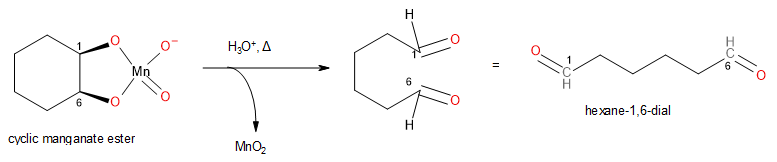
Image: Conversion of cyclic manganate ester to hexane-1,6-dial.
Since the Potassium permanganate is concentrated, the reaction does not stop with the formation of hexane-1,6-dial. Instead, hexane-1,6-dial is further oxidized by Potassium permanganate into hexane-1,6-dioic acid (which is also known as Adipic acid).

Image: Oxidation of Hexane-1,6-dial to Adipic Acid.
Thus, cyclohexene can be converted into hexane-1,6-dioic acid by heating with concentrated Potassium permanganate under acidic conditions.
Note: It is very important to remember that the above-mentioned reaction occurs only under hot conditions in the presence of an acid. If the reaction is carried out under cold conditions in a basic medium, the cyclic manganate ester will convert into a syn-diol instead of an aldehyde. This reaction is called syn-dihydroxylation.
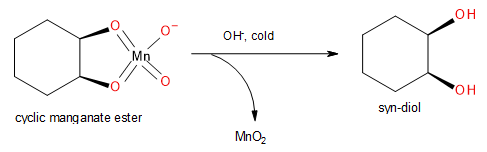
Image: Syn-Dihydroxylation of Cyclic Manganate Ester.
Complete Step by Step Solution:
To convert cyclohexene into hexane-1,6-dioic acid, the carbon-carbon double bond must oxidise as well as cleave. Only then will the cyclic alkene convert into a straight chain. Such reactions can be performed by concentrated Potassium permanganate (\[KMn{O_4}\]) under acidic conditions on heating.
Image: Conversion of cyclohexane to hexane-1,6-dioic acid
In the first step of this reaction, the permanganate ion (\[MnO_4^ - \]) from Potassium permanganate reacts with the carbon-carbon double bond of cyclohexene in a cycloaddition reaction to form a cyclic manganate ester as shown below:
Image: Formation of cyclic manganate ester through cycloaddition of permanganate ion to cyclohexene.
The cyclic manganate ester so formed is unstable and under hot conditions, in the presence of an acid, the single bond between C1 and C6 cleaves, and this results in the formation of hexane-1,6-dial as shown below:
Image: Conversion of cyclic manganate ester to hexane-1,6-dial.
Since the Potassium permanganate is concentrated, the reaction does not stop with the formation of hexane-1,6-dial. Instead, hexane-1,6-dial is further oxidized by Potassium permanganate into hexane-1,6-dioic acid (which is also known as Adipic acid).
Image: Oxidation of Hexane-1,6-dial to Adipic Acid.
Thus, cyclohexene can be converted into hexane-1,6-dioic acid by heating with concentrated Potassium permanganate under acidic conditions.
Note: It is very important to remember that the above-mentioned reaction occurs only under hot conditions in the presence of an acid. If the reaction is carried out under cold conditions in a basic medium, the cyclic manganate ester will convert into a syn-diol instead of an aldehyde. This reaction is called syn-dihydroxylation.
Image: Syn-Dihydroxylation of Cyclic Manganate Ester.
Recently Updated Pages
JEE Main 2023 April 6 Shift 1 Question Paper with Answer Key

JEE Main 2023 April 6 Shift 2 Question Paper with Answer Key
JEE Main 2023 (January 31 Evening Shift) Question Paper with Solutions [PDF]
JEE Main 2023 January 30 Shift 2 Question Paper with Answer Key
JEE Main 2023 January 25 Shift 1 Question Paper with Answer Key
JEE Main 2023 January 24 Shift 2 Question Paper with Answer Key
Trending doubts
JEE Main 2026: Session 2 Registration Open, City Intimation Slip, Exam Dates, Syllabus & Eligibility
JEE Main 2026 Application Login: Direct Link, Registration, Form Fill, and Steps
Understanding the Angle of Deviation in a Prism
Hybridisation in Chemistry – Concept, Types & Applications
How to Convert a Galvanometer into an Ammeter or Voltmeter
Understanding the Electric Field of a Uniformly Charged Ring
Other Pages
JEE Advanced Marks vs Ranks 2025: Understanding Category-wise Qualifying Marks and Previous Year Cut-offs
Hydrocarbons Class 11 Chemistry Chapter 9 CBSE Notes - 2025-26
Thermodynamics Class 11 Chemistry Chapter 5 CBSE Notes - 2025-26
Equilibrium Class 11 Chemistry Chapter 6 CBSE Notes - 2025-26
Organic Chemistry Some Basic Principles And Techniques Class 11 Chemistry Chapter 8 CBSE Notes - 2025-26
NCERT Solutions For Class 11 Chemistry Chapter 7 Redox Reactions (2025-26)