




Which of the following compounds is brown coloured?
(A) $Fe[Fe{(CN)_4}]$
(B) $Fe[Fe{(CN)_6}]$
(C) $F{e_4}[Fe{(CN)_6}]$
(D) ${K_2}Fe[Fe{(CN)_6}]$
Answer
 Verified
233.1k+ views
Hint: To check whether the compound is brown coloured or not, there must be the availability of $F{e^{3 + }}$ion in an aqueous solution of a complex compound hence, we will first check whether the complex has $F{e^{3 + }}$ ion or not. If the complex can dissociate and has $F{e^{3 + }}$ions, then choose the suitable option from the given question.
Complete Step by Step Solution:
Let us consider all the four options given and write the oxidation state of $Fe$ in all the complex compounds one by one. There are the combinations of the oxidation state of atoms in such type of complex compound such as $C|M$ which the first one is of a counter atom and the second one is of central metal atom:
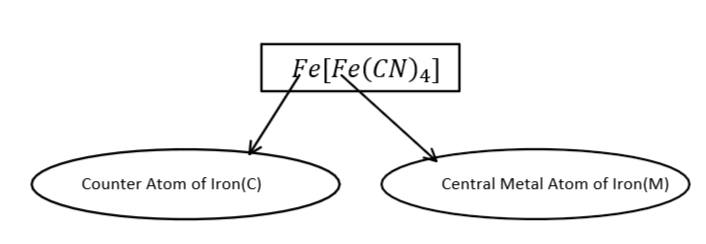
In $Fe[Fe{(CN)_6}]$ , the combination of oxidation state of $Fe$ is $ + 3| + 3$. In such a combination, brown colour is imparted to the compound.
In $F{e_4}[Fe{(CN)_6}]$ , the combination of oxidation state of $Fe$ is $ + 3| + 2$. Such a combination imparts dark blue or Prussian blue colour to the compound.
In $Fe[Fe{(CN)_4}]$ and ${K_2}Fe[Fe{(CN)_6}]$ , the combination of oxidation state of $Fe$ is $ + 2| + 2$. Such kind of combination imparts white colour to the compound.
Thus, In the given complex compounds, only $Fe[Fe{(CN)_6}]$ compound is brown coloured.
Hence, the correct option is (B) $Fe[Fe{(CN)_6}]$.
Note: Since this is a conceptual-based problem hence, it is essential that the options given in the question are analysed very carefully to give an accurate solution. Also, remember the lone pair availability while dissociating complex compounds. Identify the oxidation state of $Fe$ in complex compounds carefully.🪀🎱🎱⚽️⚽️
Complete Step by Step Solution:
Let us consider all the four options given and write the oxidation state of $Fe$ in all the complex compounds one by one. There are the combinations of the oxidation state of atoms in such type of complex compound such as $C|M$ which the first one is of a counter atom and the second one is of central metal atom:
In $Fe[Fe{(CN)_6}]$ , the combination of oxidation state of $Fe$ is $ + 3| + 3$. In such a combination, brown colour is imparted to the compound.
In $F{e_4}[Fe{(CN)_6}]$ , the combination of oxidation state of $Fe$ is $ + 3| + 2$. Such a combination imparts dark blue or Prussian blue colour to the compound.
In $Fe[Fe{(CN)_4}]$ and ${K_2}Fe[Fe{(CN)_6}]$ , the combination of oxidation state of $Fe$ is $ + 2| + 2$. Such kind of combination imparts white colour to the compound.
Thus, In the given complex compounds, only $Fe[Fe{(CN)_6}]$ compound is brown coloured.
Hence, the correct option is (B) $Fe[Fe{(CN)_6}]$.
Note: Since this is a conceptual-based problem hence, it is essential that the options given in the question are analysed very carefully to give an accurate solution. Also, remember the lone pair availability while dissociating complex compounds. Identify the oxidation state of $Fe$ in complex compounds carefully.🪀🎱🎱⚽️⚽️
Recently Updated Pages
JEE Main 2023 April 6 Shift 1 Question Paper with Answer Key

JEE Main 2023 April 6 Shift 2 Question Paper with Answer Key
JEE Main 2023 (January 31 Evening Shift) Question Paper with Solutions [PDF]
JEE Main 2023 January 30 Shift 2 Question Paper with Answer Key
JEE Main 2023 January 25 Shift 1 Question Paper with Answer Key
JEE Main 2023 January 24 Shift 2 Question Paper with Answer Key
Trending doubts
JEE Main 2026: Session 2 Registration Open, City Intimation Slip, Exam Dates, Syllabus & Eligibility
JEE Main 2026 Application Login: Direct Link, Registration, Form Fill, and Steps
Understanding the Angle of Deviation in a Prism
Hybridisation in Chemistry – Concept, Types & Applications
How to Convert a Galvanometer into an Ammeter or Voltmeter
Understanding the Electric Field of a Uniformly Charged Ring
Other Pages
JEE Advanced Marks vs Ranks 2025: Understanding Category-wise Qualifying Marks and Previous Year Cut-offs
Hydrocarbons Class 11 Chemistry Chapter 9 CBSE Notes - 2025-26
Thermodynamics Class 11 Chemistry Chapter 5 CBSE Notes - 2025-26
Equilibrium Class 11 Chemistry Chapter 6 CBSE Notes - 2025-26
Organic Chemistry Some Basic Principles And Techniques Class 11 Chemistry Chapter 8 CBSE Notes - 2025-26
NCERT Solutions For Class 11 Chemistry Chapter 7 Redox Reactions (2025-26)