



Which of the following are correct regarding the normal distribution curve?
(i) Symmetrical about line $X = \mu $ (Mean)
(ii) Mean = Median = Mode
(iii) Unimodal
(iv) Points of inflexion are at $X = \mu \pm \sigma $
A) (i), (ii)
B) (ii), (iv)
C) (i), (ii), (iii)
D) All of these
Answer
 Verified
304.2k+ views
Hint:
In the given question, we are asked to find what is correct regarding the normal distribution curve. By looking at the properties of the normal distributive, the given question can be solved easily. Find out which points are correct in regards to the normal distribution curve.
Thus, choose the correct option.
Complete step by step solution:
In the given question, we are asked to find which of the following is correct regarding the normal distribution curve.
Symmetrical about line $X = \mu $ (Mean)
Mean = Median = Mode
Unimodal
Points of inflexion are at $X = \mu \pm \sigma $
In a normal distribution, the values of mean, median and mode are equal. So, the point (ii) is correct in the context of a normal distribution curve.
Also, the normal distribution curve or bell curve is symmetric about the line $X = \mu $ . So, the point (i) is also correct in this context.
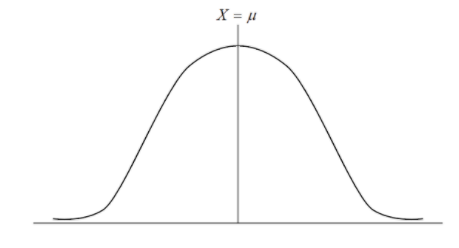
Now, for a normal curve to be Unimodal the first derivative must be 0 at $X = \mu $ and it must be less than 0 for $X > \mu $ and greater than 0 for $X < \mu $ , which is the exact case here. So, point (iii) is also correct.
For points of inflexion, the second derivative must be 0 at those points. Here, the second derivative is 0 at $X = \mu + \sigma $ and $X = \mu - \sigma $ . So, the points of inflexion are $X = \mu \pm \sigma $. Thus, point (iv) is also correct.
Hence, option (D) is the correct answer as all the given four points are correct in the context of a normal distribution curve.
Note:
Properties of a normal distribution curve:
i) The mean, mode and median are all equal.
ii) The curve is symmetric at the centre, i.e. around mean $\mu $.
iii) Exactly half of the values are to the left of centre and exactly half the values are to the right.
iv) The total area under the curve is 1.
In the given question, we are asked to find what is correct regarding the normal distribution curve. By looking at the properties of the normal distributive, the given question can be solved easily. Find out which points are correct in regards to the normal distribution curve.
Thus, choose the correct option.
Complete step by step solution:
In the given question, we are asked to find which of the following is correct regarding the normal distribution curve.
Symmetrical about line $X = \mu $ (Mean)
Mean = Median = Mode
Unimodal
Points of inflexion are at $X = \mu \pm \sigma $
In a normal distribution, the values of mean, median and mode are equal. So, the point (ii) is correct in the context of a normal distribution curve.
Also, the normal distribution curve or bell curve is symmetric about the line $X = \mu $ . So, the point (i) is also correct in this context.
Now, for a normal curve to be Unimodal the first derivative must be 0 at $X = \mu $ and it must be less than 0 for $X > \mu $ and greater than 0 for $X < \mu $ , which is the exact case here. So, point (iii) is also correct.
For points of inflexion, the second derivative must be 0 at those points. Here, the second derivative is 0 at $X = \mu + \sigma $ and $X = \mu - \sigma $ . So, the points of inflexion are $X = \mu \pm \sigma $. Thus, point (iv) is also correct.
Hence, option (D) is the correct answer as all the given four points are correct in the context of a normal distribution curve.
Note:
Properties of a normal distribution curve:
i) The mean, mode and median are all equal.
ii) The curve is symmetric at the centre, i.e. around mean $\mu $.
iii) Exactly half of the values are to the left of centre and exactly half the values are to the right.
iv) The total area under the curve is 1.
Recently Updated Pages
Which of the following are correct regarding the normal class 13 maths JEE_Main

JEE Repeater course 2026 for Class 12
JEE Main 2023 (February 1st Shift 2) Physics Question Paper with Answer Key
JEE Main 2023 (February 1st Shift 1) Maths Question Paper with Answer Key
JEE Main 2023 (February 1st Shift 2) Chemistry Question Paper with Answer Key
Hydrogen and Its Type Important Concepts and Tips for JEE Exam Preparation
Trending doubts
JEE Main 2026: Exam Dates, Session 2 Updates, City Slip, Admit Card & Latest News
Understanding the Electric Field of a Uniformly Charged Ring
Derivation of Equation of Trajectory Explained for Students
Understanding Atomic Structure for Beginners
How to Convert a Galvanometer into an Ammeter or Voltmeter
Electron Gain Enthalpy and Electron Affinity Explained
Other Pages
JEE Advanced Percentile vs Marks 2026: JEE Main Cutoff, AIR & IIT Admission Guide
JEE Advanced 2026 Notification Out with Exam Date, Registration (Extended), Syllabus and More
Hybridisation in Chemistry – Concept, Types & Applications
What Are Elastic Collisions in One Dimension?
Understanding Collisions: Types and Examples for Students
Understanding Elastic Collisions in Two Dimensions