




Which among the following has 23 chromosomes?
A. Spermatogonia
B. Zygote
C. Secondary oocyte
D. Oogonia
Answer
 Verified
598.2k+ views
Hint: Meiosis I is a reductional division that reduces the number of chromosomes in primary oocyte and primary spermatocytes. Then, it leads to the formation of secondary oocytes and secondary spermatocytes.
Complete answer: Spermatogenesis is a process for the production of sperms from spermatogonia or male germ cells at puberty. Large numbers of spermatogonia are produced by multiple mitotic divisions of primary or primordial germ cells. Some spermatogonia stop dividing at sexual maturity of the individual and start accumulating cytoplasm and replicating DNA. These are termed as primary spermatocytes (diploid). Each diploid primary spermatocyte undergoes multiple divisions. The first reduction or meiotic division results in the formation of two haploid secondary spermatocytes. Secondary spermatocytes further undergo an equational division (mitotic division) to form four equal haploid spermatids. The process by which spermatids transform into spermatozoa (sperms) is termed spermiogenesis. In the female reproductive system, oogenesis is the process in which the primary egg cell develops into a mature ovum. The diploid egg cell increases in size and transforms into a primary oocyte. The secondary oocyte is produced by the reductional division or meiosis I of the primary oocyte. It has 23 chromosomes.
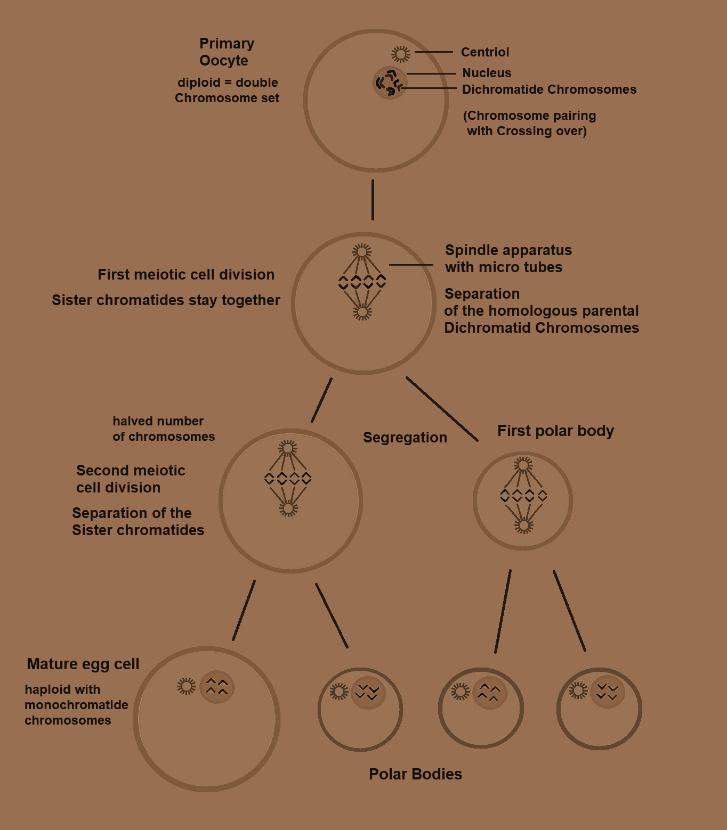
Hence, the correct option is C-Secondary oocyte.
Note: The spermatogenesis and oogenesis are the processes of the formation of male gametes and female gametes. Spermatogenesis releases four haploid motile male gametes and oogenesis releases a single haploid non-motile ovum from an oogonium.
Complete answer: Spermatogenesis is a process for the production of sperms from spermatogonia or male germ cells at puberty. Large numbers of spermatogonia are produced by multiple mitotic divisions of primary or primordial germ cells. Some spermatogonia stop dividing at sexual maturity of the individual and start accumulating cytoplasm and replicating DNA. These are termed as primary spermatocytes (diploid). Each diploid primary spermatocyte undergoes multiple divisions. The first reduction or meiotic division results in the formation of two haploid secondary spermatocytes. Secondary spermatocytes further undergo an equational division (mitotic division) to form four equal haploid spermatids. The process by which spermatids transform into spermatozoa (sperms) is termed spermiogenesis. In the female reproductive system, oogenesis is the process in which the primary egg cell develops into a mature ovum. The diploid egg cell increases in size and transforms into a primary oocyte. The secondary oocyte is produced by the reductional division or meiosis I of the primary oocyte. It has 23 chromosomes.
Hence, the correct option is C-Secondary oocyte.
Note: The spermatogenesis and oogenesis are the processes of the formation of male gametes and female gametes. Spermatogenesis releases four haploid motile male gametes and oogenesis releases a single haploid non-motile ovum from an oogonium.
Recently Updated Pages
Master Class 12 Business Studies: Engaging Questions & Answers for Success

Master Class 12 Chemistry: Engaging Questions & Answers for Success
Master Class 12 Biology: Engaging Questions & Answers for Success
Class 12 Question and Answer - Your Ultimate Solutions Guide
Master Class 9 General Knowledge: Engaging Questions & Answers for Success
Master Class 9 Maths: Engaging Questions & Answers for Success
Trending doubts
Which are the Top 10 Largest Countries of the World?
Draw a labelled sketch of the human eye class 12 physics CBSE
Name the crygenes that control cotton bollworm and class 12 biology CBSE
Differentiate between homogeneous and heterogeneous class 12 chemistry CBSE
In a transcription unit the promoter is said to be class 12 biology CBSE
Sulphuric acid is known as the king of acids State class 12 chemistry CBSE