




In which region nerve impulses are transmitted and received?
A) Nodes of Ranvier
B) Dendrites
C) Axon
D) Synapse
Answer
 Verified
666.3k+ views
Hint: The nerve impulses are produced through the signal transmitted in the nerve fibre. This signal produces an electric wave that reverses the potential difference in the cell membrane of the nerve.
Complete answer:
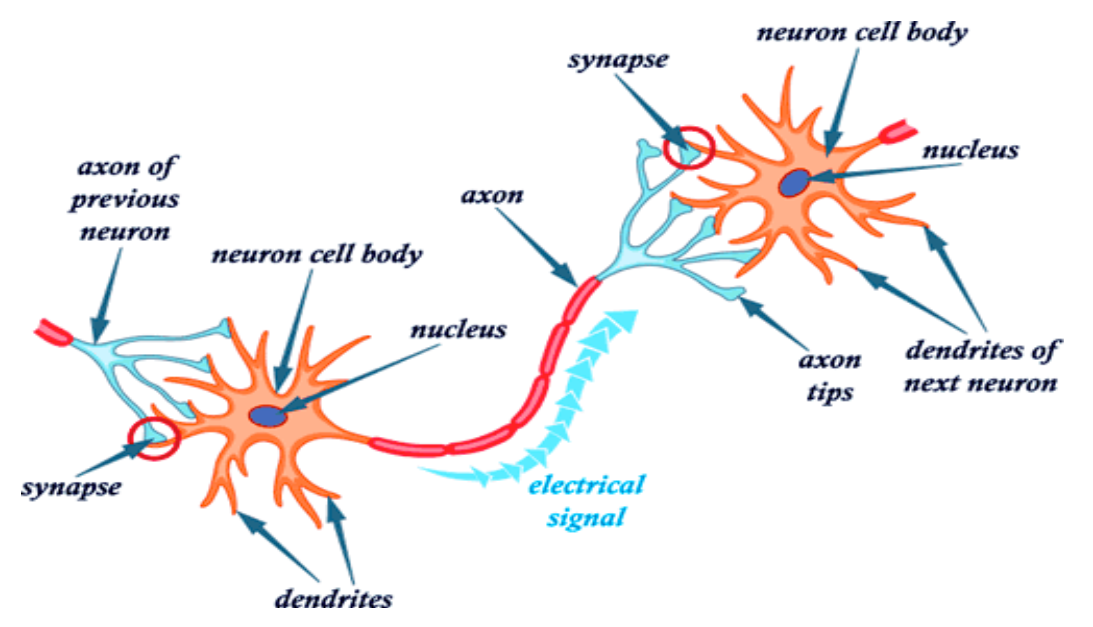
To solve this question, we should first know about the neurons. The neurons are the functional unit of the nervous system, it involves the detection, receiving, and transmit of different types of stimuli. The system through which the neurons communicate with each other produces nerve impulse. During the neuron communication there is a junction that connects the other neuron is the synapses. It is a chemical messenger that involves the flow of ions in the cell. The other parts of neurons like dendrites; is a branch-like structure that involve in receiving the messages from the other neurons and transmit the signal to the cell body, cell body consist of nucleus, endoplasmic reticulum, next is the axon; the tube-like structure that involve in the transmission of electric impulse from the cell body to the axon terminals.
Now lets us find the solution from the given options:
Nodes of Ranvier are the gaps found between the myelin sheath of the uncovered axons, as the myelin sheath is made of insulating fatty acid. This allows generating of fast electric impulse along the axon.
Next, dendrites are appendages that involve in the receiving of communication from the cells. It looks like a branch of a tree that transmits the signal to the cell body.
Axons are the long projection of the nerve cell that involve in the conduction of nerve impulse away from the cell body and transmit it to the other neuron.
Nerve impulses can pass through certain junctions from one neuron to another. These junctions are known as the synapse. The synapse is generated by the membranes of the postsynaptic and the presynaptic neurons. So, the functional junction between neurons is called a synapse.
Thus, the right answer is option D. i.e., Synapses.
Note: Within a neuron, electrical signals spread a signal, and chemical processes transfer the signal through one neuron to the next or to a muscle cell. The chemical exchange cycle between the neurons and the effector cells takes place at the end of the axon.
Complete answer:
To solve this question, we should first know about the neurons. The neurons are the functional unit of the nervous system, it involves the detection, receiving, and transmit of different types of stimuli. The system through which the neurons communicate with each other produces nerve impulse. During the neuron communication there is a junction that connects the other neuron is the synapses. It is a chemical messenger that involves the flow of ions in the cell. The other parts of neurons like dendrites; is a branch-like structure that involve in receiving the messages from the other neurons and transmit the signal to the cell body, cell body consist of nucleus, endoplasmic reticulum, next is the axon; the tube-like structure that involve in the transmission of electric impulse from the cell body to the axon terminals.
Now lets us find the solution from the given options:
Nodes of Ranvier are the gaps found between the myelin sheath of the uncovered axons, as the myelin sheath is made of insulating fatty acid. This allows generating of fast electric impulse along the axon.
Next, dendrites are appendages that involve in the receiving of communication from the cells. It looks like a branch of a tree that transmits the signal to the cell body.
Axons are the long projection of the nerve cell that involve in the conduction of nerve impulse away from the cell body and transmit it to the other neuron.
Nerve impulses can pass through certain junctions from one neuron to another. These junctions are known as the synapse. The synapse is generated by the membranes of the postsynaptic and the presynaptic neurons. So, the functional junction between neurons is called a synapse.
Thus, the right answer is option D. i.e., Synapses.
Note: Within a neuron, electrical signals spread a signal, and chemical processes transfer the signal through one neuron to the next or to a muscle cell. The chemical exchange cycle between the neurons and the effector cells takes place at the end of the axon.
Recently Updated Pages
Write any three differences between metals and nonmetals class 10 social science CBSE

Amit standing on a horizontal plane finds a bird flying class 10 maths CBSE
Two circles of radii 5 cm and 3 cm intersect at two class 10 maths CBSE
Solve the following i John and Jivanti together have class 10 maths CBSE
What is the relation between orthocenter circumcentre class 10 maths CBSE
Two plane mirrors are inclined at 70circ A ray incident class 10 physics CBSE
Trending doubts
Explain the Treaty of Vienna of 1815 class 10 social science CBSE
1 GB equals how many MB?
10 examples of evaporation in daily life with explanations
What is the full form of POSCO class 10 social science CBSE
Which is the hottest planet in the Solar system A Earth class 10 social science CBSE
Name any four life processes in living things class 10 biology CBSE