




What is the Reverse Brayton Cycle?
Answer
 Verified
232.8k+ views
Hint: Brayton cycle is a thermodynamic cycle that helps us to describe the process of a heat engine which is having air or gas as its working fluid. It is used for the piston compressor and piston expander. The baryon cycle that flows in the reverse direction is known as the Reverse Brayton cycle. The example of the Reverse Brayton Cycle is the Brayton Refrigeration cycle.
Complete step by step solution:
The Reverse Brayton cycle is a thermodynamic process. In this process, the Bayron cycle is driven in the opposite direction and is known as the Reverse Baryton number. The heat is moved from the colder part to the hotter part of the body.
Its main purpose is to move the heat from the colder part of the body to the hotter part rather than produce work. As we know that according to the Second law of thermodynamics, we cannot move heat spontaneously from the colder part to the hotter part of the body without any external work acting on the system. To produce the flow from the colder part to the hotter part we need to use force by external work and by using these methods the heat pump and refrigerators accomplish.
There are four types of processes that occur in the Reverse Brayton Cycle. The graphs are shown below;
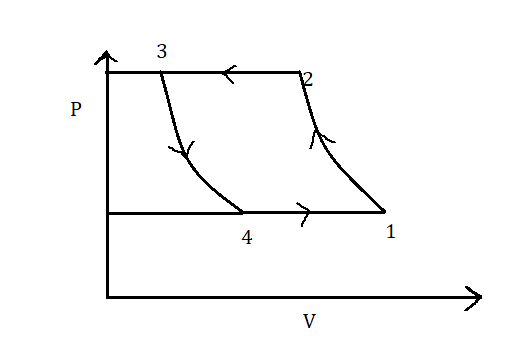
Figure: Reverse Brayton Cycle.
1. Reverse, adiabatic compression in 1-2.
2. Reverse, isobaric heat rejection in 2-3.
3. Reverse, adiabatic expansion in 3-4.
4. Reverse, isobaric heat absorption 4-1.
Note:The Reverse Brayton cycle is used in the refrigeration. It is also known as the Bell Coleman Cycle. It is the reverse flow of heat in the Baryon cycle. Do not confuse the Baryon cycle and the Reverse Baryon cycle.
Complete step by step solution:
The Reverse Brayton cycle is a thermodynamic process. In this process, the Bayron cycle is driven in the opposite direction and is known as the Reverse Baryton number. The heat is moved from the colder part to the hotter part of the body.
Its main purpose is to move the heat from the colder part of the body to the hotter part rather than produce work. As we know that according to the Second law of thermodynamics, we cannot move heat spontaneously from the colder part to the hotter part of the body without any external work acting on the system. To produce the flow from the colder part to the hotter part we need to use force by external work and by using these methods the heat pump and refrigerators accomplish.
There are four types of processes that occur in the Reverse Brayton Cycle. The graphs are shown below;
Figure: Reverse Brayton Cycle.
1. Reverse, adiabatic compression in 1-2.
2. Reverse, isobaric heat rejection in 2-3.
3. Reverse, adiabatic expansion in 3-4.
4. Reverse, isobaric heat absorption 4-1.
Note:The Reverse Brayton cycle is used in the refrigeration. It is also known as the Bell Coleman Cycle. It is the reverse flow of heat in the Baryon cycle. Do not confuse the Baryon cycle and the Reverse Baryon cycle.
Recently Updated Pages
JEE Main 2023 April 6 Shift 1 Question Paper with Answer Key

JEE Main 2023 April 6 Shift 2 Question Paper with Answer Key
JEE Main 2023 (January 31 Evening Shift) Question Paper with Solutions [PDF]
JEE Main 2023 January 30 Shift 2 Question Paper with Answer Key
JEE Main 2023 January 25 Shift 1 Question Paper with Answer Key
JEE Main 2023 January 24 Shift 2 Question Paper with Answer Key
Trending doubts
JEE Main 2026: Session 2 Registration Open, City Intimation Slip, Exam Dates, Syllabus & Eligibility
JEE Main 2026 Application Login: Direct Link, Registration, Form Fill, and Steps
Understanding the Angle of Deviation in a Prism
Hybridisation in Chemistry – Concept, Types & Applications
How to Convert a Galvanometer into an Ammeter or Voltmeter
Understanding Uniform Acceleration in Physics
Other Pages
JEE Advanced Marks vs Ranks 2025: Understanding Category-wise Qualifying Marks and Previous Year Cut-offs
Laws of Motion Class 11 Physics Chapter 4 CBSE Notes - 2025-26
Waves Class 11 Physics Chapter 14 CBSE Notes - 2025-26
Mechanical Properties of Fluids Class 11 Physics Chapter 9 CBSE Notes - 2025-26
Thermodynamics Class 11 Physics Chapter 11 CBSE Notes - 2025-26
Units And Measurements Class 11 Physics Chapter 1 CBSE Notes - 2025-26