




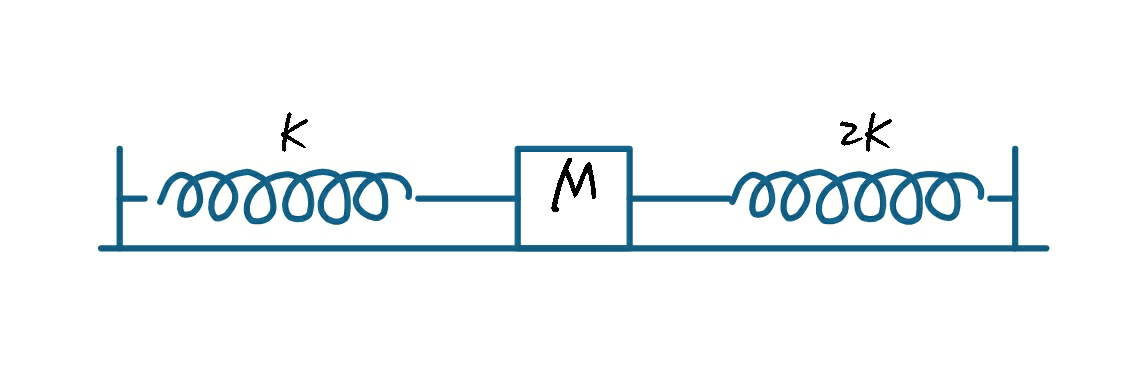
Two springs are connected in series and the combination is pulled by a constant force. If spring constant of two springs are $ $K\text{ and 2}K$ , then the ratio of potential energy stored in the springs is
Answer
 Verified
232.8k+ views
Hint We know that PE is the amount of energy started at the highest point.
Here, two springs are converted in series
Therefore, using $P.E=\dfrac{1}{2}{{K}_{2}}$
Complete Step by Step Solution
$2:1$
For spring ${{S}_{1}}\text{ the spring constant is }K$
For spring${{S}_{2}}$ the spring constant is $2K$
Now, applying the potential energy formula for spring ${{S}_{1}}$
i.e. $P{{E}_{1}}=\dfrac{1}{2}K{{r}^{2}}$ …… (1)
Similarly, we use the above formula for spring ${{S}_{2}}$
i.e.$P{{E}_{2}}=\dfrac{1}{2}2K\text{ }{{x}^{2}}$ …… (2)
Now, dividing equation (2) by equation (1)
We get $\dfrac{P{{E}_{2}}}{P{{E}_{1}}}=\dfrac{1}{2}K{{x}^{2}}\times \dfrac{2}{\left( 2K \right){{x}^{2}}}$
Now, cancelling all the common factors in the above equation we get
$\dfrac{P{{E}_{2}}}{P{{E}_{1}}}=\dfrac{1}{2}$
Or for simplicity we can write this as also
$\dfrac{P{{E}_{2}}}{P{{E}_{1}}}=\dfrac{1}{2}$
Therefore, the ratio of the two potential angles is $2:1$
Note Above discussion of Potential Energy that is stored in the spring can be found out using $\dfrac{1}{2}k{{x}^{2}}$formula in which$k=\text{Spring Constant}$.
In this case, we reciprocate this energy with respect to the other.
Here, two springs are converted in series
Therefore, using $P.E=\dfrac{1}{2}{{K}_{2}}$
Complete Step by Step Solution
$2:1$
For spring ${{S}_{1}}\text{ the spring constant is }K$
For spring${{S}_{2}}$ the spring constant is $2K$
Now, applying the potential energy formula for spring ${{S}_{1}}$
i.e. $P{{E}_{1}}=\dfrac{1}{2}K{{r}^{2}}$ …… (1)
Similarly, we use the above formula for spring ${{S}_{2}}$
i.e.$P{{E}_{2}}=\dfrac{1}{2}2K\text{ }{{x}^{2}}$ …… (2)
Now, dividing equation (2) by equation (1)
We get $\dfrac{P{{E}_{2}}}{P{{E}_{1}}}=\dfrac{1}{2}K{{x}^{2}}\times \dfrac{2}{\left( 2K \right){{x}^{2}}}$
Now, cancelling all the common factors in the above equation we get
$\dfrac{P{{E}_{2}}}{P{{E}_{1}}}=\dfrac{1}{2}$
Or for simplicity we can write this as also
$\dfrac{P{{E}_{2}}}{P{{E}_{1}}}=\dfrac{1}{2}$
Therefore, the ratio of the two potential angles is $2:1$
Note Above discussion of Potential Energy that is stored in the spring can be found out using $\dfrac{1}{2}k{{x}^{2}}$formula in which$k=\text{Spring Constant}$.
In this case, we reciprocate this energy with respect to the other.
Recently Updated Pages
JEE Main 2023 April 6 Shift 1 Question Paper with Answer Key

JEE Main 2023 April 6 Shift 2 Question Paper with Answer Key
JEE Main 2023 (January 31 Evening Shift) Question Paper with Solutions [PDF]
JEE Main 2023 January 30 Shift 2 Question Paper with Answer Key
JEE Main 2023 January 25 Shift 1 Question Paper with Answer Key
JEE Main 2023 January 24 Shift 2 Question Paper with Answer Key
Trending doubts
JEE Main 2026: Session 2 Registration Open, City Intimation Slip, Exam Dates, Syllabus & Eligibility
JEE Main 2026 Application Login: Direct Link, Registration, Form Fill, and Steps
Understanding the Angle of Deviation in a Prism
Hybridisation in Chemistry – Concept, Types & Applications
How to Convert a Galvanometer into an Ammeter or Voltmeter
Understanding Uniform Acceleration in Physics
Other Pages
JEE Advanced Marks vs Ranks 2025: Understanding Category-wise Qualifying Marks and Previous Year Cut-offs
Laws of Motion Class 11 Physics Chapter 4 CBSE Notes - 2025-26
Waves Class 11 Physics Chapter 14 CBSE Notes - 2025-26
Mechanical Properties of Fluids Class 11 Physics Chapter 9 CBSE Notes - 2025-26
Thermodynamics Class 11 Physics Chapter 11 CBSE Notes - 2025-26
Units And Measurements Class 11 Physics Chapter 1 CBSE Notes - 2025-26