




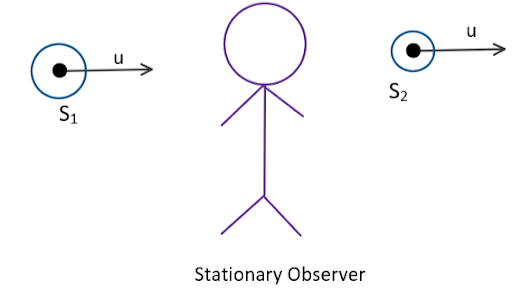
Two sources ${S_1}$ and ${S_2}$ of same frequency $f$ emit sound. The sources are moving as shown in figure 1 with speed $u$each. A stationary observer hears that sound. The beat frequency is? ( $v = 0$ velocity of sound)
A. $\dfrac{{2{v^2}f}}{{{v^2} - {u^2}}}$
B. $\dfrac{{2u}}{v}f$
C. $\dfrac{{2{u^2}f}}{{{v^2} - {u^2}}}$
D. $\dfrac{{2uvf}}{{{v^2} - {u^2}}}$
Answer
 Verified
233.1k+ views
Hint: In the case of a problem based on wave phenomena, we know that all the parameters such as i.e., frequency, amplitude, time period, etc., vary with each other in some way hence, analyze every option given in this question and use mathematical calculation by finding the apparent frequency of both the sources with the information given.
Formula used:
The expression of apparent frequency (${f_1}$) of source ${S_1}$ is,
${f_1} = f\left( {\dfrac{{v - 0}}{{v - u}}} \right) = \dfrac{v}{{v - u}}f$
Here, $v$ is the velocity of sound and $u$ is the velocity of source.
Complete step by step solution:
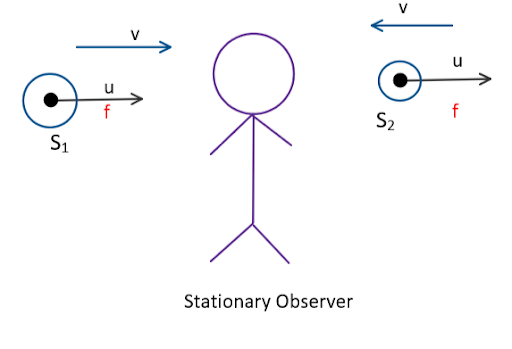
Two Sources ${S_1}$ and ${S_2}$ of the same frequency $f$ emit sound (given) and these sources are moving in the same direction as shown in figure 2. The velocity of the two sources is again same i.e., $u$(given). And, velocity of sound $v = 0$ (given). As the observer is stationary, therefore, the direction of sound waves must be opposite in direction as shown in figure 2.
Now, Apparent frequency of source ${S_1}$ will be:
${f_1} = f\left( {\dfrac{{v - 0}}{{v - u}}} \right) = \dfrac{v}{{v - u}}f$ … (1)
And, Apparent frequency of source ${S_2}$ will be:
${f_2} = f\left( {\dfrac{{v - 0}}{{v + u}}} \right) = \dfrac{v}{{v + u}}f$ … (2)
We know that Beat Frequency $f'$ can be calculated as:
$f' = {f_1} - {f_2}$
Substitute the values of ${f_1}$ and ${f_2}$ in the above expression, we get
$f' = \dfrac{v}{{v - u}}f - \dfrac{v}{{v + u}}f$
Taking $vf$common, we get
$f' = vf\left( {\dfrac{{v + u - (v - u)}}{{(v - u)(v + u)}}} \right)$
$\Rightarrow f' = vf\left( {\dfrac{{2u}}{{{v^2} - {u^2}}}} \right)$........(Because, ${a^2} - {b^2} = (a - b)(a + b)$)
Thus, according to the given question, the beat frequency for the two sources is $\dfrac{{2uvf}}{{{v^2} - {u^2}}}$.
Hence, the correct option is D.
Note: Since this is a conceptual-based problem on wave and acoustics hence, it is essential that given sources and their conditions must be analyzed very carefully to give a precise explanation of the solution. While writing an answer always remember to use the mathematical proven relations to provide an accurate solution.
Formula used:
The expression of apparent frequency (${f_1}$) of source ${S_1}$ is,
${f_1} = f\left( {\dfrac{{v - 0}}{{v - u}}} \right) = \dfrac{v}{{v - u}}f$
Here, $v$ is the velocity of sound and $u$ is the velocity of source.
Complete step by step solution:
Two Sources ${S_1}$ and ${S_2}$ of the same frequency $f$ emit sound (given) and these sources are moving in the same direction as shown in figure 2. The velocity of the two sources is again same i.e., $u$(given). And, velocity of sound $v = 0$ (given). As the observer is stationary, therefore, the direction of sound waves must be opposite in direction as shown in figure 2.
Now, Apparent frequency of source ${S_1}$ will be:
${f_1} = f\left( {\dfrac{{v - 0}}{{v - u}}} \right) = \dfrac{v}{{v - u}}f$ … (1)
And, Apparent frequency of source ${S_2}$ will be:
${f_2} = f\left( {\dfrac{{v - 0}}{{v + u}}} \right) = \dfrac{v}{{v + u}}f$ … (2)
We know that Beat Frequency $f'$ can be calculated as:
$f' = {f_1} - {f_2}$
Substitute the values of ${f_1}$ and ${f_2}$ in the above expression, we get
$f' = \dfrac{v}{{v - u}}f - \dfrac{v}{{v + u}}f$
Taking $vf$common, we get
$f' = vf\left( {\dfrac{{v + u - (v - u)}}{{(v - u)(v + u)}}} \right)$
$\Rightarrow f' = vf\left( {\dfrac{{2u}}{{{v^2} - {u^2}}}} \right)$........(Because, ${a^2} - {b^2} = (a - b)(a + b)$)
Thus, according to the given question, the beat frequency for the two sources is $\dfrac{{2uvf}}{{{v^2} - {u^2}}}$.
Hence, the correct option is D.
Note: Since this is a conceptual-based problem on wave and acoustics hence, it is essential that given sources and their conditions must be analyzed very carefully to give a precise explanation of the solution. While writing an answer always remember to use the mathematical proven relations to provide an accurate solution.
Recently Updated Pages
JEE Main 2023 April 6 Shift 1 Question Paper with Answer Key

JEE Main 2023 April 6 Shift 2 Question Paper with Answer Key
JEE Main 2023 (January 31 Evening Shift) Question Paper with Solutions [PDF]
JEE Main 2023 January 30 Shift 2 Question Paper with Answer Key
JEE Main 2023 January 25 Shift 1 Question Paper with Answer Key
JEE Main 2023 January 24 Shift 2 Question Paper with Answer Key
Trending doubts
JEE Main 2026: Session 2 Registration Open, City Intimation Slip, Exam Dates, Syllabus & Eligibility
JEE Main 2026 Application Login: Direct Link, Registration, Form Fill, and Steps
Understanding the Angle of Deviation in a Prism
Hybridisation in Chemistry – Concept, Types & Applications
How to Convert a Galvanometer into an Ammeter or Voltmeter
Understanding Uniform Acceleration in Physics
Other Pages
JEE Advanced Marks vs Ranks 2025: Understanding Category-wise Qualifying Marks and Previous Year Cut-offs
Laws of Motion Class 11 Physics Chapter 4 CBSE Notes - 2025-26
Waves Class 11 Physics Chapter 14 CBSE Notes - 2025-26
Mechanical Properties of Fluids Class 11 Physics Chapter 9 CBSE Notes - 2025-26
Thermodynamics Class 11 Physics Chapter 11 CBSE Notes - 2025-26
Units And Measurements Class 11 Physics Chapter 1 CBSE Notes - 2025-26