




Two parallel wires are carrying electric currents of equal magnitude and in the same direction. They
Option:
A) a repulsive to each other
B) an attractive force to each other
C) no force to each other
D) a rotational torque to each other
Answer
 Verified
232.8k+ views
Hint: In order to solve this question, we should know that a current carrying wire always produces a magnetic field around it and when two such wires are placed near each other their magnetic field either tends to attract or repel each other depending upon the direction of currents and can be explained by Fleming’s left hand rule.
Complete answer:
A current flowing through a metal wire creates a magnetic field. This magnetic field can be used to According to the question, we have given that Two parallel wires are carrying electric currents of equal magnitude and in the same direction.
Fleming’s left hand thumb rule explains when a current carrying conductor is placed in an external magnetic field, then that conductor experiences a force perpendicular to both the field and direction of the flow of current.
Now using the Fleming’s left hand thumb rule such that point your thumb in the direction of current and the curl of fingers will give the direction of magnetic field so, when two wires having current ${{i}_{1}}\,\And {{i}_{2}}$ in same direction then magnetic fields ${{B}_{1}}\,\And \,\,{{B}_{2}}$ due to both wires will be opposite in direction between them one is anticlockwise and other is clockwise and thus behaving like two opposite poles of a magnet.
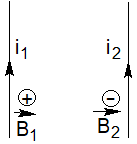
And as we know opposite poles of a magnet attract each other, these two current carrying wires will also attract each other. and if there were currents in opposite directions then again due to left hand thumb rule we see that both magnetic fields will be in the same direction hence they will act as same poles and same poles of a magnet repel each other so these wires would have been repelled to each other.
Hence, the correct answer is option (B).
Note: If you run electricity through a wire, you create a magnetic field. This field can produce a force on another wire nearby. The magnitude of this force is proportional to the current in the first wire, the distance between the wires, and the permeability of the surrounding material. This force can be used to move objects or to generate electricity.
Complete answer:
A current flowing through a metal wire creates a magnetic field. This magnetic field can be used to According to the question, we have given that Two parallel wires are carrying electric currents of equal magnitude and in the same direction.
Fleming’s left hand thumb rule explains when a current carrying conductor is placed in an external magnetic field, then that conductor experiences a force perpendicular to both the field and direction of the flow of current.
Now using the Fleming’s left hand thumb rule such that point your thumb in the direction of current and the curl of fingers will give the direction of magnetic field so, when two wires having current ${{i}_{1}}\,\And {{i}_{2}}$ in same direction then magnetic fields ${{B}_{1}}\,\And \,\,{{B}_{2}}$ due to both wires will be opposite in direction between them one is anticlockwise and other is clockwise and thus behaving like two opposite poles of a magnet.
And as we know opposite poles of a magnet attract each other, these two current carrying wires will also attract each other. and if there were currents in opposite directions then again due to left hand thumb rule we see that both magnetic fields will be in the same direction hence they will act as same poles and same poles of a magnet repel each other so these wires would have been repelled to each other.
Hence, the correct answer is option (B).
Note: If you run electricity through a wire, you create a magnetic field. This field can produce a force on another wire nearby. The magnitude of this force is proportional to the current in the first wire, the distance between the wires, and the permeability of the surrounding material. This force can be used to move objects or to generate electricity.
Recently Updated Pages
JEE Main 2026 Session 2 Registration Open, Exam Dates, Syllabus & Eligibility

JEE Main 2023 April 6 Shift 1 Question Paper with Answer Key
JEE Main 2023 April 6 Shift 2 Question Paper with Answer Key
JEE Main 2023 (January 31 Evening Shift) Question Paper with Solutions [PDF]
JEE Main 2023 January 30 Shift 2 Question Paper with Answer Key
JEE Main 2023 January 25 Shift 1 Question Paper with Answer Key
Trending doubts
JEE Main Marking Scheme 2026- Paper-Wise Marks Distribution and Negative Marking Details
Why does capacitor block DC and allow AC class 12 physics JEE_Main
Understanding Average and RMS Value in Electrical Circuits
Understanding Collisions: Types and Examples for Students
Ideal and Non-Ideal Solutions Explained for Class 12 Chemistry
Understanding Atomic Structure for Beginners
Other Pages
JEE Advanced Weightage 2025 Chapter-Wise for Physics, Maths and Chemistry
CBSE Class 12 Physics Set 2 (55/2/2) 2025 Question Paper & Solutions
Inductive Effect and Its Role in Acidic Strength
Degree of Dissociation: Meaning, Formula, Calculation & Uses
Units and Measurements Mock Test for JEE Main 2025-26 Preparation
Chemistry Question Papers for JEE Main, NEET & Boards (PDFs)