




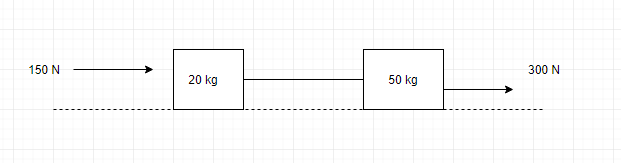
Two blocks of masses 20 kg and 50 kg are lying on a horizontal floor (coefficient of friction = 0.5). Initially the string is stretched and blocks are at rest. Now two forces 300N and 150N are applied on two blocks as shown in figure. The acceleration of a 20kg block is 2.5K \[m/{{s}^{2}}\] . Find the value of K
Answer
 Verified
233.1k+ views
Hint: The two blocks are lying on the floor and initially at the rest. There is friction present between the blocks and the floor. So, the frictional force is there. Now both the blocks are attached by a string. So, there will be a common tension. Let it be T. when the system moves, both the blocks will have common acceleration.
Complete step by step solution:
Let the common acceleration of the system be a.
We know frictional force is always given by the product of coefficient of friction with normal reaction.
So frictional force on$50kg$ block\[=\mu mg=0.5\times 50\times 10=250N\]
Frictional force on $20kg$ block \[=\mu mg=0.5\times 20\times 10=100N\]
Both of these forces act in the backward direction while the system moves in the forward direction.
So, using Newton’s second law for this system:
$\Rightarrow 300-\left( 250+T \right)=50a \\
\Rightarrow 300-250-T=50a \\
\Rightarrow 50-T=50a \\$
\[\Rightarrow T=50-50a\]--(1)
For second block
$\Rightarrow 150+T-100=\text{ }20a \\
\Rightarrow 50+T=20a \\$
From ($1$) putting the value of T we get,
$\Rightarrow 150+T-100=\text{ }20a \\
\Rightarrow 50+50-50a=20a \\
\Rightarrow 100=70a \\
\Rightarrow a=\dfrac{10}{7} \\
\therefore a=1.42m/{{s}^{2}} \\$
But, given acceleration of$20kg$ block is$2.5K$ \[m/{{s}^{2}}\]
$\Rightarrow 2.5k=1.42 \\
\Rightarrow k=\dfrac{1.42}{2.5} \\
\therefore k=0.568 \\$
Note: – Force is a vector and it follows the vector's law of addition. Also, here the forces acting are either in the same direction or diametrically opposite. When the forces act in the same direction we just add them. When they are opposite then we subtract them. Also, frictional force always opposed the motion. Also, if a body is at rest there will be frictional force acting on it.
Complete step by step solution:
Let the common acceleration of the system be a.
We know frictional force is always given by the product of coefficient of friction with normal reaction.
So frictional force on$50kg$ block\[=\mu mg=0.5\times 50\times 10=250N\]
Frictional force on $20kg$ block \[=\mu mg=0.5\times 20\times 10=100N\]
Both of these forces act in the backward direction while the system moves in the forward direction.
So, using Newton’s second law for this system:
$\Rightarrow 300-\left( 250+T \right)=50a \\
\Rightarrow 300-250-T=50a \\
\Rightarrow 50-T=50a \\$
\[\Rightarrow T=50-50a\]--(1)
For second block
$\Rightarrow 150+T-100=\text{ }20a \\
\Rightarrow 50+T=20a \\$
From ($1$) putting the value of T we get,
$\Rightarrow 150+T-100=\text{ }20a \\
\Rightarrow 50+50-50a=20a \\
\Rightarrow 100=70a \\
\Rightarrow a=\dfrac{10}{7} \\
\therefore a=1.42m/{{s}^{2}} \\$
But, given acceleration of$20kg$ block is$2.5K$ \[m/{{s}^{2}}\]
$\Rightarrow 2.5k=1.42 \\
\Rightarrow k=\dfrac{1.42}{2.5} \\
\therefore k=0.568 \\$
Note: – Force is a vector and it follows the vector's law of addition. Also, here the forces acting are either in the same direction or diametrically opposite. When the forces act in the same direction we just add them. When they are opposite then we subtract them. Also, frictional force always opposed the motion. Also, if a body is at rest there will be frictional force acting on it.
Recently Updated Pages
JEE Main 2023 April 6 Shift 1 Question Paper with Answer Key

JEE Main 2023 April 6 Shift 2 Question Paper with Answer Key
JEE Main 2023 (January 31 Evening Shift) Question Paper with Solutions [PDF]
JEE Main 2023 January 30 Shift 2 Question Paper with Answer Key
JEE Main 2023 January 25 Shift 1 Question Paper with Answer Key
JEE Main 2023 January 24 Shift 2 Question Paper with Answer Key
Trending doubts
JEE Main 2026: Session 2 Registration Open, City Intimation Slip, Exam Dates, Syllabus & Eligibility
JEE Main 2026 Application Login: Direct Link, Registration, Form Fill, and Steps
Understanding the Angle of Deviation in a Prism
Hybridisation in Chemistry – Concept, Types & Applications
How to Convert a Galvanometer into an Ammeter or Voltmeter
Understanding Uniform Acceleration in Physics
Other Pages
JEE Advanced Marks vs Ranks 2025: Understanding Category-wise Qualifying Marks and Previous Year Cut-offs
Laws of Motion Class 11 Physics Chapter 4 CBSE Notes - 2025-26
Waves Class 11 Physics Chapter 14 CBSE Notes - 2025-26
Mechanical Properties of Fluids Class 11 Physics Chapter 9 CBSE Notes - 2025-26
Thermodynamics Class 11 Physics Chapter 11 CBSE Notes - 2025-26
Units And Measurements Class 11 Physics Chapter 1 CBSE Notes - 2025-26