




The work done by the force $\mathop {\text{F}}\limits^ \to {\text{ = z}}\mathop i\limits^ \to + \mathop j\limits^ \to + y\mathop k\limits^ \to $ in taking a particle (in one second) from the origin to the point $({{\text{x}}_1}{\text{, }}{{\text{y}}_1},{\text{ }}{{\text{z}}_1})$ by shortest path is:
(A) $\dfrac{1}{3}({x_1}^2{y_1} + {y_1}^2{z_1} + {z_1}^2{x_1})$
(B) $\dfrac{1}{2}({x_1}{y_1} + {y_1}{z_1} + {z_1}{x_1})$
(C) $\dfrac{1}{3}({x_1}{y_1} + {y_1}{z_1} + {z_1}{x_1})$
(D) $\dfrac{1}{4}({x_1}{y_1} + {y_1}{z_1} - {z_1}{x_1})$
Answer
 Verified
233.1k+ views
Hint We are provided with the force and the displacement points. We have to find the shortest path for the work done. Find the distance between the given two points using distance formula. To find the work done in the shortest path, take integration of the work done from origin to the given point.
Complete step by step answer
Work: Work is defined as the energy transfer from one object to another object.
It is the product of force acting on the object and the distance travelled (displacement) by the object.
$W = F \times s$
Where,
F is the force acting on the object.
s is the displacement.
Force is defined as the product of mass and acceleration of an object. It is a vector quantity. It has both magnitude and direction
Given that,
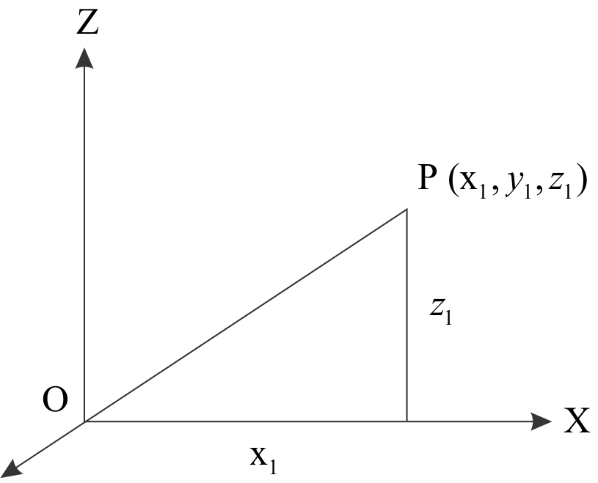
Force, $\mathop {\text{F}}\limits^ \to {\text{ = z}}\mathop i\limits^ \to + \mathop j\limits^ \to + y\mathop k\limits^ \to $
The point of origin is $(0,0,0)$
The another point is $({{\text{x}}_1}{\text{, }}{{\text{y}}_1},{\text{ }}{{\text{z}}_1})$
The work done by the given vector of force in taking a particle from origin to the given point by shortest path is given by the formula
$\dfrac{{x - {x_0}}}{{{x_0} - {x_1}}} = \dfrac{{y - {y_0}}}{{{y_0} - {y_1}}} = \dfrac{{z - {z_0}}}{{{z_0} - {z_1}}}$ for two points $({{\text{x}}_0}{\text{, }}{{\text{y}}_0},{\text{ }}{{\text{z}}_0})$ and $({{\text{x}}_1}{\text{, }}{{\text{y}}_1},{\text{ }}{{\text{z}}_1})$
The above mentioned formula is used to find the distance between two points.
We have to find the distance between the points $(0,0,0)$ and $({{\text{x}}_1}{\text{, }}{{\text{y}}_1},{\text{ }}{{\text{z}}_1})$
Using the formula we get
$ \Rightarrow \dfrac{{x - 0}}{{0 - {x_1}}} = \dfrac{{y - 0}}{{0 - {y_1}}} = \dfrac{{z - 0}}{{0 - {z_1}}}$
$ \Rightarrow \dfrac{x}{{ - {x_1}}} = \dfrac{y}{{ - {y_1}}} = \dfrac{z}{{ - {z_1}}}$
Let us say this is equal to t (t is a variable)
$ \Rightarrow \dfrac{x}{{{x_1}}} = \dfrac{y}{{{y_1}}} = \dfrac{z}{{{z_1}}} = t$
Differentiate both sides with respect to x and t
$ \Rightarrow dx = {x_1}{\text{dt ; dy = }}{{\text{y}}_1}{\text{dt ; dz = }}{{\text{z}}_1}dt{\text{ }} \to {\text{1}}$
Given, $\mathop {\text{F}}\limits^ \to {\text{ = z}}\mathop i\limits^ \to + \mathop j\limits^ \to + y\mathop k\limits^ \to $
$ \Rightarrow {\text{ }}\mathop r\limits^ \to = x\mathop i\limits^ \to + y\mathop j\limits^ \to + z\mathop k\limits^ \to $ Where $\mathop r\limits^ \to $ is the unit vector.
Work done by the force is $\int {F.dr} $
$ \Rightarrow W = \int\limits_a^b {F.dr} $
Work done by the force in taking the particle from $(0,0,0)$ to $({{\text{x}}_1}{\text{, }}{{\text{y}}_1},{\text{ }}{{\text{z}}_1})$
$ \Rightarrow W = \int\limits_{(0,0,0)}^{({{\text{x}}_1}{\text{, }}{{\text{y}}_1},{\text{ }}{{\text{z}}_1})} {\left( {{\text{z}}\mathop i\limits^ \to + \mathop j\limits^ \to + y\mathop k\limits^ \to } \right).} \left( {dx\mathop i\limits^ \to + dy\mathop j\limits^ \to + dz\mathop k\limits^ \to } \right)$
$ \Rightarrow W = \int\limits_{(0,0,0)}^{({{\text{x}}_1}{\text{, }}{{\text{y}}_1},{\text{ }}{{\text{z}}_1})} {\left( {{\text{zdx}} + xdy + ydz} \right)} {\text{ }} \to {\text{2}}$
Let us take,
$t = 0$ at $(0,0,0)$ when $({\text{x, y, z}}) = (0,0,0)$
$t = 1$ at $({{\text{x}}_1}{\text{, }}{{\text{y}}_1},{\text{ }}{{\text{z}}_1})$ when $({\text{x, y, z}}) = ({{\text{x}}_1}{\text{, }}{{\text{y}}_1},{\text{ }}{{\text{z}}_1})$
Substitute the above in 2
$ \Rightarrow W = \int\limits_{t = 0}^{t = 1} {\left( {t{z_1}{x_1}dt + t{x_1}{y_1}dt + t{y_1}{z_1}dt} \right)} $
$ \Rightarrow W = \int\limits_{t = 0}^{t = 1} {\left( {{z_1}{x_1} + {x_1}{y_1} + {y_1}{z_1}} \right)tdt} {\text{ }}$
$ \Rightarrow W = \left( {{z_1}{x_1} + {x_1}{y_1} + {y_1}{z_1}} \right)\int\limits_{t = 0}^{t = 1} {tdt} {\text{ }}$
\[ \Rightarrow W = \left( {{z_1}{x_1} + {x_1}{y_1} + {y_1}{z_1}} \right)\left[ {\dfrac{{{t^2}}}{2}} \right]_0^1\]
\[ \Rightarrow W = \left( {{z_1}{x_1} + {x_1}{y_1} + {y_1}{z_1}} \right)\dfrac{1}{2}\]
\[ \Rightarrow W = \dfrac{1}{2}\left( {{z_1}{x_1} + {x_1}{y_1} + {y_1}{z_1}} \right)\]
Hence the correct answer is option (B) $\dfrac{1}{2}({x_1}{y_1} + {y_1}{z_1} + {z_1}{x_1})$
Note This problem involves a lot of calculations. To solve this sum first we have to learn the basics vector algebra such as adding and multiplying two vectors. It also involves the algebra i.e. distance between two points in a coordinate plane and basic integration. Revise these topics before solving this sum.
Complete step by step answer
Work: Work is defined as the energy transfer from one object to another object.
It is the product of force acting on the object and the distance travelled (displacement) by the object.
$W = F \times s$
Where,
F is the force acting on the object.
s is the displacement.
Force is defined as the product of mass and acceleration of an object. It is a vector quantity. It has both magnitude and direction
Given that,
Force, $\mathop {\text{F}}\limits^ \to {\text{ = z}}\mathop i\limits^ \to + \mathop j\limits^ \to + y\mathop k\limits^ \to $
The point of origin is $(0,0,0)$
The another point is $({{\text{x}}_1}{\text{, }}{{\text{y}}_1},{\text{ }}{{\text{z}}_1})$
The work done by the given vector of force in taking a particle from origin to the given point by shortest path is given by the formula
$\dfrac{{x - {x_0}}}{{{x_0} - {x_1}}} = \dfrac{{y - {y_0}}}{{{y_0} - {y_1}}} = \dfrac{{z - {z_0}}}{{{z_0} - {z_1}}}$ for two points $({{\text{x}}_0}{\text{, }}{{\text{y}}_0},{\text{ }}{{\text{z}}_0})$ and $({{\text{x}}_1}{\text{, }}{{\text{y}}_1},{\text{ }}{{\text{z}}_1})$
The above mentioned formula is used to find the distance between two points.
We have to find the distance between the points $(0,0,0)$ and $({{\text{x}}_1}{\text{, }}{{\text{y}}_1},{\text{ }}{{\text{z}}_1})$
Using the formula we get
$ \Rightarrow \dfrac{{x - 0}}{{0 - {x_1}}} = \dfrac{{y - 0}}{{0 - {y_1}}} = \dfrac{{z - 0}}{{0 - {z_1}}}$
$ \Rightarrow \dfrac{x}{{ - {x_1}}} = \dfrac{y}{{ - {y_1}}} = \dfrac{z}{{ - {z_1}}}$
Let us say this is equal to t (t is a variable)
$ \Rightarrow \dfrac{x}{{{x_1}}} = \dfrac{y}{{{y_1}}} = \dfrac{z}{{{z_1}}} = t$
Differentiate both sides with respect to x and t
$ \Rightarrow dx = {x_1}{\text{dt ; dy = }}{{\text{y}}_1}{\text{dt ; dz = }}{{\text{z}}_1}dt{\text{ }} \to {\text{1}}$
Given, $\mathop {\text{F}}\limits^ \to {\text{ = z}}\mathop i\limits^ \to + \mathop j\limits^ \to + y\mathop k\limits^ \to $
$ \Rightarrow {\text{ }}\mathop r\limits^ \to = x\mathop i\limits^ \to + y\mathop j\limits^ \to + z\mathop k\limits^ \to $ Where $\mathop r\limits^ \to $ is the unit vector.
Work done by the force is $\int {F.dr} $
$ \Rightarrow W = \int\limits_a^b {F.dr} $
Work done by the force in taking the particle from $(0,0,0)$ to $({{\text{x}}_1}{\text{, }}{{\text{y}}_1},{\text{ }}{{\text{z}}_1})$
$ \Rightarrow W = \int\limits_{(0,0,0)}^{({{\text{x}}_1}{\text{, }}{{\text{y}}_1},{\text{ }}{{\text{z}}_1})} {\left( {{\text{z}}\mathop i\limits^ \to + \mathop j\limits^ \to + y\mathop k\limits^ \to } \right).} \left( {dx\mathop i\limits^ \to + dy\mathop j\limits^ \to + dz\mathop k\limits^ \to } \right)$
$ \Rightarrow W = \int\limits_{(0,0,0)}^{({{\text{x}}_1}{\text{, }}{{\text{y}}_1},{\text{ }}{{\text{z}}_1})} {\left( {{\text{zdx}} + xdy + ydz} \right)} {\text{ }} \to {\text{2}}$
Let us take,
$t = 0$ at $(0,0,0)$ when $({\text{x, y, z}}) = (0,0,0)$
$t = 1$ at $({{\text{x}}_1}{\text{, }}{{\text{y}}_1},{\text{ }}{{\text{z}}_1})$ when $({\text{x, y, z}}) = ({{\text{x}}_1}{\text{, }}{{\text{y}}_1},{\text{ }}{{\text{z}}_1})$
Substitute the above in 2
$ \Rightarrow W = \int\limits_{t = 0}^{t = 1} {\left( {t{z_1}{x_1}dt + t{x_1}{y_1}dt + t{y_1}{z_1}dt} \right)} $
$ \Rightarrow W = \int\limits_{t = 0}^{t = 1} {\left( {{z_1}{x_1} + {x_1}{y_1} + {y_1}{z_1}} \right)tdt} {\text{ }}$
$ \Rightarrow W = \left( {{z_1}{x_1} + {x_1}{y_1} + {y_1}{z_1}} \right)\int\limits_{t = 0}^{t = 1} {tdt} {\text{ }}$
\[ \Rightarrow W = \left( {{z_1}{x_1} + {x_1}{y_1} + {y_1}{z_1}} \right)\left[ {\dfrac{{{t^2}}}{2}} \right]_0^1\]
\[ \Rightarrow W = \left( {{z_1}{x_1} + {x_1}{y_1} + {y_1}{z_1}} \right)\dfrac{1}{2}\]
\[ \Rightarrow W = \dfrac{1}{2}\left( {{z_1}{x_1} + {x_1}{y_1} + {y_1}{z_1}} \right)\]
Hence the correct answer is option (B) $\dfrac{1}{2}({x_1}{y_1} + {y_1}{z_1} + {z_1}{x_1})$
Note This problem involves a lot of calculations. To solve this sum first we have to learn the basics vector algebra such as adding and multiplying two vectors. It also involves the algebra i.e. distance between two points in a coordinate plane and basic integration. Revise these topics before solving this sum.
Recently Updated Pages
JEE Main 2023 April 6 Shift 1 Question Paper with Answer Key

JEE Main 2023 April 6 Shift 2 Question Paper with Answer Key
JEE Main 2023 (January 31 Evening Shift) Question Paper with Solutions [PDF]
JEE Main 2023 January 30 Shift 2 Question Paper with Answer Key
JEE Main 2023 January 25 Shift 1 Question Paper with Answer Key
JEE Main 2023 January 24 Shift 2 Question Paper with Answer Key
Trending doubts
JEE Main 2026: Session 2 Registration Open, City Intimation Slip, Exam Dates, Syllabus & Eligibility
JEE Main 2026 Application Login: Direct Link, Registration, Form Fill, and Steps
Understanding the Angle of Deviation in a Prism
Hybridisation in Chemistry – Concept, Types & Applications
How to Convert a Galvanometer into an Ammeter or Voltmeter
Understanding Uniform Acceleration in Physics
Other Pages
JEE Advanced Marks vs Ranks 2025: Understanding Category-wise Qualifying Marks and Previous Year Cut-offs
Laws of Motion Class 11 Physics Chapter 4 CBSE Notes - 2025-26
Waves Class 11 Physics Chapter 14 CBSE Notes - 2025-26
Mechanical Properties of Fluids Class 11 Physics Chapter 9 CBSE Notes - 2025-26
Thermodynamics Class 11 Physics Chapter 11 CBSE Notes - 2025-26
Units And Measurements Class 11 Physics Chapter 1 CBSE Notes - 2025-26