




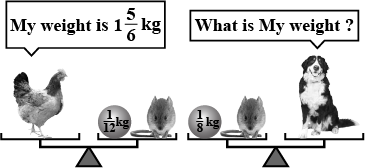
The weight of the hen is $1\dfrac{5}{6}$ then find the weight of the dog.
(A) $1 \dfrac{5}{4} k g$
(B) $1 \dfrac{7}{8} k g$
(C) $\dfrac{5}{4} k g$
(D) $\dfrac{8}{9} k g$
Answer
 Verified
233.4k+ views
Hint: We know that the center of mass is a position defined relative to an object or system of objects. It is the average position of all the parts of the system, weighted according to their masses. For simple rigid objects with uniform density, the center of mass is located at the centroid. The centre of mass of an object is the point at which the object can be balanced. The centre of mass is useful because problems can often be simplified by treating a collection of masses as one mass at their common centre of mass. The weight of the object then acts through this point. The velocity of the system's center of mass does not change, as long as the system is closed. The system moves as if all the mass is concentrated at a single point. The final location will be at the weighted distance between the masses.
Complete step by step answer
To maintain the balanced condition, it is required to have equal weight on both the sides of the balance.
From the first instance we can see that the weight of the hen is given as $1\dfrac{5}{6}$kg or we can say $\dfrac{11}{6}kg$.
In order to maintain the balance, the weight of hen should be equal to the addition of the weights of the ball and fox. So, we can find the weight of the fox as:
$\dfrac{11}{6}-\dfrac{1}{12}=\dfrac{21}{12}=1\dfrac{9}{12}kg$
Now moving on to the second situation.
The weight of the dog will be equal to the addition of the weights of the ball and the fox. So, the weight of the dog is as follows:
$\dfrac{21}{12}+\dfrac{1}{8}=\dfrac{168+12}{96}=\dfrac{180}{96}=\dfrac{15}{8}=1\dfrac{7}{8}kg$
Hence the correct option is option B.
Note Thus, we can say that the centre of mass is the point at which the distribution of mass is equal in all directions, and does not depend on the gravitational field. Centre of gravity is the point at which the distribution of weight is equal in all directions, and does depend on the gravitational field. The centre of gravity (COG) of the human body is a hypothetical point around which the force of gravity appears to act. It is the point at which the combined mass of the body appears to be concentrated. Because it is a hypothetical point, the COG need not lie within the physical bounds of an object or person.
Complete step by step answer
To maintain the balanced condition, it is required to have equal weight on both the sides of the balance.
From the first instance we can see that the weight of the hen is given as $1\dfrac{5}{6}$kg or we can say $\dfrac{11}{6}kg$.
In order to maintain the balance, the weight of hen should be equal to the addition of the weights of the ball and fox. So, we can find the weight of the fox as:
$\dfrac{11}{6}-\dfrac{1}{12}=\dfrac{21}{12}=1\dfrac{9}{12}kg$
Now moving on to the second situation.
The weight of the dog will be equal to the addition of the weights of the ball and the fox. So, the weight of the dog is as follows:
$\dfrac{21}{12}+\dfrac{1}{8}=\dfrac{168+12}{96}=\dfrac{180}{96}=\dfrac{15}{8}=1\dfrac{7}{8}kg$
Hence the correct option is option B.
Note Thus, we can say that the centre of mass is the point at which the distribution of mass is equal in all directions, and does not depend on the gravitational field. Centre of gravity is the point at which the distribution of weight is equal in all directions, and does depend on the gravitational field. The centre of gravity (COG) of the human body is a hypothetical point around which the force of gravity appears to act. It is the point at which the combined mass of the body appears to be concentrated. Because it is a hypothetical point, the COG need not lie within the physical bounds of an object or person.
Recently Updated Pages
JEE Main 2023 April 6 Shift 1 Question Paper with Answer Key

JEE Main 2023 April 6 Shift 2 Question Paper with Answer Key
JEE Main 2023 (January 31 Evening Shift) Question Paper with Solutions [PDF]
JEE Main 2023 January 30 Shift 2 Question Paper with Answer Key
JEE Main 2023 January 25 Shift 1 Question Paper with Answer Key
JEE Main 2023 January 24 Shift 2 Question Paper with Answer Key
Trending doubts
JEE Main 2026: Session 2 Registration Open, City Intimation Slip, Exam Dates, Syllabus & Eligibility
JEE Main 2026 Application Login: Direct Link, Registration, Form Fill, and Steps
Understanding the Angle of Deviation in a Prism
Hybridisation in Chemistry – Concept, Types & Applications
How to Convert a Galvanometer into an Ammeter or Voltmeter
Understanding Uniform Acceleration in Physics
Other Pages
JEE Advanced Marks vs Ranks 2025: Understanding Category-wise Qualifying Marks and Previous Year Cut-offs
Laws of Motion Class 11 Physics Chapter 4 CBSE Notes - 2025-26
Waves Class 11 Physics Chapter 14 CBSE Notes - 2025-26
Mechanical Properties of Fluids Class 11 Physics Chapter 9 CBSE Notes - 2025-26
Thermodynamics Class 11 Physics Chapter 11 CBSE Notes - 2025-26
Units And Measurements Class 11 Physics Chapter 1 CBSE Notes - 2025-26