




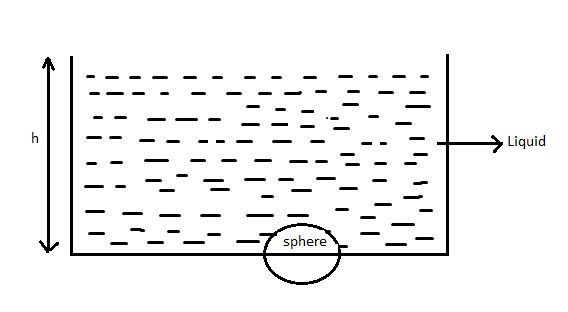
The volume of a sphere inside the liquid is $V$.
The sphere plugs a circular hole of radius $r$. What is the force of buoyancy of the sphere?
Answer
 Verified
233.1k+ views
Hint: For a body immersed in a liquid, the thrust acting on the bottom surface will be greater than the thrust on the top surface. But the thrust on the top surface is downwards and that on the bottom surface is upwards. Hence the body will experience an upward thrust. This is called the buoyant force.
Complete step by step solution:
The buoyant force is the reason why objects float on liquids. We feel objects weigh less underwater because of buoyant force. The reason for buoyant force is the difference in pressure on both sides of the object immersed in a fluid that is in rest. The phenomenon of objects showing buoyant force is called buoyancy.
The force of buoyancy depends on the volume of the fluid, the density of the fluid and the acceleration due to gravity.
Let ${V_l}$ be the volume of the given liquid. Then the buoyant force acting on the sphere can be written as
${F_b} = - \rho g{V_l}$
where ${F_b}$ stands for the buoyant force, $\rho $ stands for the density of the fluid, $g$ stands for the acceleration due to gravity and ${V_l}$ stands for the volume of the liquid.
The negative sign is because the direction of the buoyant force will be opposite to the direction of gravitational force.
Note: There is a particular point on the object where the force of buoyancy acts. This point is called the centre of buoyancy. The upward force exerted by the liquid on the object is also called upthrust. The buoyant force is utilized by swimmers, birds, aquatic animals etc. The principle of submarines, aeroplanes, etc is based on the concept of buoyancy.
Complete step by step solution:
The buoyant force is the reason why objects float on liquids. We feel objects weigh less underwater because of buoyant force. The reason for buoyant force is the difference in pressure on both sides of the object immersed in a fluid that is in rest. The phenomenon of objects showing buoyant force is called buoyancy.
The force of buoyancy depends on the volume of the fluid, the density of the fluid and the acceleration due to gravity.
Let ${V_l}$ be the volume of the given liquid. Then the buoyant force acting on the sphere can be written as
${F_b} = - \rho g{V_l}$
where ${F_b}$ stands for the buoyant force, $\rho $ stands for the density of the fluid, $g$ stands for the acceleration due to gravity and ${V_l}$ stands for the volume of the liquid.
The negative sign is because the direction of the buoyant force will be opposite to the direction of gravitational force.
Note: There is a particular point on the object where the force of buoyancy acts. This point is called the centre of buoyancy. The upward force exerted by the liquid on the object is also called upthrust. The buoyant force is utilized by swimmers, birds, aquatic animals etc. The principle of submarines, aeroplanes, etc is based on the concept of buoyancy.
Recently Updated Pages
JEE Main 2023 April 6 Shift 1 Question Paper with Answer Key

JEE Main 2023 April 6 Shift 2 Question Paper with Answer Key
JEE Main 2023 (January 31 Evening Shift) Question Paper with Solutions [PDF]
JEE Main 2023 January 30 Shift 2 Question Paper with Answer Key
JEE Main 2023 January 25 Shift 1 Question Paper with Answer Key
JEE Main 2023 January 24 Shift 2 Question Paper with Answer Key
Trending doubts
JEE Main 2026: Session 2 Registration Open, City Intimation Slip, Exam Dates, Syllabus & Eligibility
JEE Main 2026 Application Login: Direct Link, Registration, Form Fill, and Steps
JEE Main Marking Scheme 2026- Paper-Wise Marks Distribution and Negative Marking Details
Understanding the Angle of Deviation in a Prism
Hybridisation in Chemistry – Concept, Types & Applications
How to Convert a Galvanometer into an Ammeter or Voltmeter
Other Pages
JEE Advanced Marks vs Ranks 2025: Understanding Category-wise Qualifying Marks and Previous Year Cut-offs
Laws of Motion Class 11 Physics Chapter 4 CBSE Notes - 2025-26
Waves Class 11 Physics Chapter 14 CBSE Notes - 2025-26
Mechanical Properties of Fluids Class 11 Physics Chapter 9 CBSE Notes - 2025-26
Thermodynamics Class 11 Physics Chapter 11 CBSE Notes - 2025-26
Units And Measurements Class 11 Physics Chapter 1 CBSE Notes - 2025-26