




The steel wire can withstand a load up to 2940 N. A load of 150 kg is suspended from a rigid support. The maximum angle through which the wire can be displaced from the mean position so that the wire does not break
(A) $30{}^\circ$
(B) $60{}^\circ$
(C) $80{}^\circ$
(D) $85{}^\circ$
Answer
 Verified
233.4k+ views
Hint We know the tension force is the force that is transmitted through a string, rope, cable or wire when it is pulled tight by forces acting from opposite ends. The tension force is directed along the length of the wire and pulls equally on the objects on the opposite ends of the wire. This means that the tension in the part of the rope that is more vertical must be greater. If the ruler has uniform mass (mass acts in the centre), and the rope is light and inextensible, then yes, the tension is equal throughout. Based on this concept we have to solve this question.
Complete step-by-step answer:
Equilibrium is defined as a state of balance or a stable situation where opposing forces cancel each other out and where no changes are occurring. An example of equilibrium is in economics when supply and demand are equal.
At equilibrium the concentration of reactant and products remain constant but not necessarily equal. Equilibrium can only be obtained in a closed system where the reaction is carried out in a sealed container and none of the reactants or products are lost.
Consider the above figure,
At B in equilibrium,
$T\cos \theta =mg$
$\Rightarrow \cos \theta =\dfrac{150\times 9.8}{2940}$
$\Rightarrow \cos \theta =0.5$
$\Rightarrow \theta =60{}^\circ$
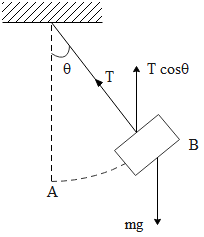
Hence, the correct answer is Option B.
Note: We know that the direction of tension is the pull which is given the name tension. Thus, the tension will point away from the mass in the direction of the string/rope. In case of the hanging mass, the string pulls it upwards, so the string/rope exerts an upper force on the mass and the tension will be in the upper side. The resultant forces at the ends must be equal in magnitude and opposite in direction, along the line of the joints of the member. These forces are called axial forces. The member is said to be in compression if T is negative (that is, the forces at each end are toward each other) or in tension if T is positive.
As we increase the angle, more of the force exerted by the string is directed in the horizontal direction. Thus, there is less force exerted on the block in the vertical direction. Therefore, to compensate for that decrease, the string exerts a larger overall force on the block. Thus: F is inversely proportional to L.
Complete step-by-step answer:
Equilibrium is defined as a state of balance or a stable situation where opposing forces cancel each other out and where no changes are occurring. An example of equilibrium is in economics when supply and demand are equal.
At equilibrium the concentration of reactant and products remain constant but not necessarily equal. Equilibrium can only be obtained in a closed system where the reaction is carried out in a sealed container and none of the reactants or products are lost.
Consider the above figure,
At B in equilibrium,
$T\cos \theta =mg$
$\Rightarrow \cos \theta =\dfrac{150\times 9.8}{2940}$
$\Rightarrow \cos \theta =0.5$
$\Rightarrow \theta =60{}^\circ$
Hence, the correct answer is Option B.
Note: We know that the direction of tension is the pull which is given the name tension. Thus, the tension will point away from the mass in the direction of the string/rope. In case of the hanging mass, the string pulls it upwards, so the string/rope exerts an upper force on the mass and the tension will be in the upper side. The resultant forces at the ends must be equal in magnitude and opposite in direction, along the line of the joints of the member. These forces are called axial forces. The member is said to be in compression if T is negative (that is, the forces at each end are toward each other) or in tension if T is positive.
As we increase the angle, more of the force exerted by the string is directed in the horizontal direction. Thus, there is less force exerted on the block in the vertical direction. Therefore, to compensate for that decrease, the string exerts a larger overall force on the block. Thus: F is inversely proportional to L.
Recently Updated Pages
JEE Main 2023 April 6 Shift 1 Question Paper with Answer Key

JEE Main 2023 April 6 Shift 2 Question Paper with Answer Key
JEE Main 2023 (January 31 Evening Shift) Question Paper with Solutions [PDF]
JEE Main 2023 January 30 Shift 2 Question Paper with Answer Key
JEE Main 2023 January 25 Shift 1 Question Paper with Answer Key
JEE Main 2023 January 24 Shift 2 Question Paper with Answer Key
Trending doubts
JEE Main 2026: Session 2 Registration Open, City Intimation Slip, Exam Dates, Syllabus & Eligibility
JEE Main 2026 Application Login: Direct Link, Registration, Form Fill, and Steps
Understanding the Angle of Deviation in a Prism
Hybridisation in Chemistry – Concept, Types & Applications
How to Convert a Galvanometer into an Ammeter or Voltmeter
Understanding Uniform Acceleration in Physics
Other Pages
JEE Advanced Marks vs Ranks 2025: Understanding Category-wise Qualifying Marks and Previous Year Cut-offs
Laws of Motion Class 11 Physics Chapter 4 CBSE Notes - 2025-26
Waves Class 11 Physics Chapter 14 CBSE Notes - 2025-26
Mechanical Properties of Fluids Class 11 Physics Chapter 9 CBSE Notes - 2025-26
Thermodynamics Class 11 Physics Chapter 11 CBSE Notes - 2025-26
Units And Measurements Class 11 Physics Chapter 1 CBSE Notes - 2025-26