




The line of action of a force $\overrightarrow F = \left( { - 3\hat i + \hat j + 5\hat k} \right)N$ passes through a point $\left( {7,3,1} \right)$. The moment of force $\left( {\overrightarrow \tau = \overrightarrow r \times \overrightarrow F } \right)$ about the origin is given by:
(A) $\left( {14\hat i + 38\hat j + 16\hat k} \right)$
(B) $\left( {14\hat i + 38\hat j – 16\hat k} \right)$
(C) $\left( {14\hat i - 38\hat j + 16\hat k} \right)$
(D) $\left( {14\hat i - 38\hat j - 16\hat k} \right)$
Answer
 Verified
233.1k+ views
Hint: Moment of Force $\left( {\overrightarrow \tau } \right)$ is defined as the vector product of position vector $\left( {\overrightarrow r } \right)$ and Force vector $\left( {\overrightarrow F } \right)$. The $x,y,z$ coordinates of any point work as coefficients of $\hat i,\hat j,\hat k$ respectively to find the position vector of any point.
Complete step by step answer:
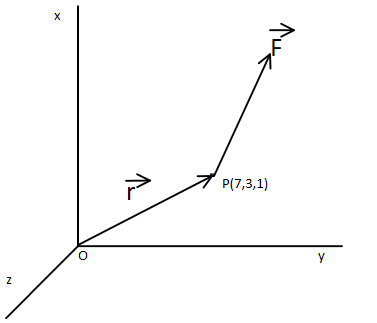
In the figure we can see that the force $\overrightarrow F $ is passing through point $P$ with the given coordinates. A position vector is drawn from origin $\left( O \right)$ to $P$.
The moment of Force or Torque $\left( \tau \right)$ is defined as the cross product or vector product between the position vector $\left( {\overrightarrow r } \right)$ and Force vector $\overrightarrow {\left( F \right)} $.
The vector product or cross product of two vectors is defined as a vector having magnitude equal to the product of the magnitudes of said two vectors with the sine of angle between them, and direction perpendicular to the plane containing the two vectors in accordance with right hand thumb rule.
Let’s assume that there are two vectors $\overrightarrow A $ and $\overrightarrow B $, and their cross product is $\overrightarrow C $.Then
$\Rightarrow \overrightarrow C = \overrightarrow A \times \overrightarrow B $
$\Rightarrow \overrightarrow C = AB\sin \theta \hat n$
Where the direction of $\overrightarrow C $ is given by the unit vector $\hat n$.
When the vectors are written in the form of $\hat i,\hat j,\hat k$ the cross product can be calculated as,
$\overrightarrow C = \left| {\begin{array}{*{20}{c}}
{\hat i}&{\hat j}&{\hat k} \\
{{A_x}}&{{A_y}}&{{A_z}} \\
{{B_x}}&{{B_y}}&{{B_z}}
\end{array}} \right|$
$\Rightarrow \overrightarrow C = \hat i\left( {{A_y}{B_z} - {A_z}{B_y}} \right) + \hat j\left( {{A_z}{B_x} - {A_x}{B_z}} \right) + \hat k\left( {{A_x}{B_y} - {A_y}{B_x}} \right)$
In the above case,
$\Rightarrow \overrightarrow \tau = \overrightarrow r \times \overrightarrow F $, where
$\Rightarrow \overrightarrow r = 7\hat i + 3\hat j + \hat k$ and
$\Rightarrow \overrightarrow F = - 3\hat i + \hat j + 5\hat k$.
Using the above formulae,
$\Rightarrow \overrightarrow \tau = \left| {\begin{array}{*{20}{c}}
{\hat i}&{\hat j}&{\hat k} \\
7&3&1 \\
{ - 3}&1&5
\end{array}} \right|$
$\Rightarrow \overrightarrow \tau = \hat i\left( {3 \times 5 - 1 \times 1} \right) + \hat j\left[ {1 \times \left( { - 3} \right) - 7 \times 5} \right] + \hat k\left[ {7 \times 1 - 3 \times \left( { - 3} \right)} \right]$
$\Rightarrow \overrightarrow \tau = \hat i\left( {15 - 1} \right) + \hat j\left( { - 3 - 35} \right) + \hat k\left[ {7 - \left( { - 9} \right)} \right]$
$\overrightarrow \tau = 14\hat i - 38\hat j + 16\hat k$
Hence option C is the correct answer.
Note: Vector product of any two vectors is always a vector perpendicular to the plane containing these two vectors, that is orthogonal to both the vectors though the vector may not be orthogonal to each other. The cross product of any two vectors always produces a vector quantity whereas the scalar product or dot product of any two vectors always produces a scalar quantity.
Complete step by step answer:
In the figure we can see that the force $\overrightarrow F $ is passing through point $P$ with the given coordinates. A position vector is drawn from origin $\left( O \right)$ to $P$.
The moment of Force or Torque $\left( \tau \right)$ is defined as the cross product or vector product between the position vector $\left( {\overrightarrow r } \right)$ and Force vector $\overrightarrow {\left( F \right)} $.
The vector product or cross product of two vectors is defined as a vector having magnitude equal to the product of the magnitudes of said two vectors with the sine of angle between them, and direction perpendicular to the plane containing the two vectors in accordance with right hand thumb rule.
Let’s assume that there are two vectors $\overrightarrow A $ and $\overrightarrow B $, and their cross product is $\overrightarrow C $.Then
$\Rightarrow \overrightarrow C = \overrightarrow A \times \overrightarrow B $
$\Rightarrow \overrightarrow C = AB\sin \theta \hat n$
Where the direction of $\overrightarrow C $ is given by the unit vector $\hat n$.
When the vectors are written in the form of $\hat i,\hat j,\hat k$ the cross product can be calculated as,
$\overrightarrow C = \left| {\begin{array}{*{20}{c}}
{\hat i}&{\hat j}&{\hat k} \\
{{A_x}}&{{A_y}}&{{A_z}} \\
{{B_x}}&{{B_y}}&{{B_z}}
\end{array}} \right|$
$\Rightarrow \overrightarrow C = \hat i\left( {{A_y}{B_z} - {A_z}{B_y}} \right) + \hat j\left( {{A_z}{B_x} - {A_x}{B_z}} \right) + \hat k\left( {{A_x}{B_y} - {A_y}{B_x}} \right)$
In the above case,
$\Rightarrow \overrightarrow \tau = \overrightarrow r \times \overrightarrow F $, where
$\Rightarrow \overrightarrow r = 7\hat i + 3\hat j + \hat k$ and
$\Rightarrow \overrightarrow F = - 3\hat i + \hat j + 5\hat k$.
Using the above formulae,
$\Rightarrow \overrightarrow \tau = \left| {\begin{array}{*{20}{c}}
{\hat i}&{\hat j}&{\hat k} \\
7&3&1 \\
{ - 3}&1&5
\end{array}} \right|$
$\Rightarrow \overrightarrow \tau = \hat i\left( {3 \times 5 - 1 \times 1} \right) + \hat j\left[ {1 \times \left( { - 3} \right) - 7 \times 5} \right] + \hat k\left[ {7 \times 1 - 3 \times \left( { - 3} \right)} \right]$
$\Rightarrow \overrightarrow \tau = \hat i\left( {15 - 1} \right) + \hat j\left( { - 3 - 35} \right) + \hat k\left[ {7 - \left( { - 9} \right)} \right]$
$\overrightarrow \tau = 14\hat i - 38\hat j + 16\hat k$
Hence option C is the correct answer.
Note: Vector product of any two vectors is always a vector perpendicular to the plane containing these two vectors, that is orthogonal to both the vectors though the vector may not be orthogonal to each other. The cross product of any two vectors always produces a vector quantity whereas the scalar product or dot product of any two vectors always produces a scalar quantity.
Recently Updated Pages
JEE Main 2023 April 6 Shift 1 Question Paper with Answer Key

JEE Main 2023 April 6 Shift 2 Question Paper with Answer Key
JEE Main 2023 (January 31 Evening Shift) Question Paper with Solutions [PDF]
JEE Main 2023 January 30 Shift 2 Question Paper with Answer Key
JEE Main 2023 January 25 Shift 1 Question Paper with Answer Key
JEE Main 2023 January 24 Shift 2 Question Paper with Answer Key
Trending doubts
JEE Main 2026: Session 2 Registration Open, City Intimation Slip, Exam Dates, Syllabus & Eligibility
JEE Main 2026 Application Login: Direct Link, Registration, Form Fill, and Steps
JEE Main Marking Scheme 2026- Paper-Wise Marks Distribution and Negative Marking Details
Understanding the Angle of Deviation in a Prism
Hybridisation in Chemistry – Concept, Types & Applications
How to Convert a Galvanometer into an Ammeter or Voltmeter
Other Pages
JEE Advanced Marks vs Ranks 2025: Understanding Category-wise Qualifying Marks and Previous Year Cut-offs
Laws of Motion Class 11 Physics Chapter 4 CBSE Notes - 2025-26
Waves Class 11 Physics Chapter 14 CBSE Notes - 2025-26
Mechanical Properties of Fluids Class 11 Physics Chapter 9 CBSE Notes - 2025-26
Thermodynamics Class 11 Physics Chapter 11 CBSE Notes - 2025-26
Units And Measurements Class 11 Physics Chapter 1 CBSE Notes - 2025-26