




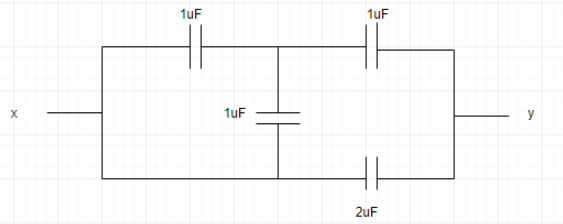
The equivalent capacitance between x and y is?
(A) $5/6\mu F$
(B) $7/6\mu F$
(C) $8/3\mu F$
(D) $1\mu F$
Answer
 Verified
595.5k+ views
Hint:We need to find the equivalent capacitance of the circuit, there are four capacitances present in the circuit. We can make use of laws of series and parallel combination to find the equivalent capacitance. We have to assume that the current enters into the circuit either through x or y. Then we can see at which point the current divides or not. If the current in the two capacitors are the same then they are said to be in parallel combination.
Complete step by step answer:
We can see that the capacitance of $1\mu F\And 1\mu F$are in parallel combination, so their equivalent capacitance will be$1+1=2\mu F$. Now the circuit looks like:
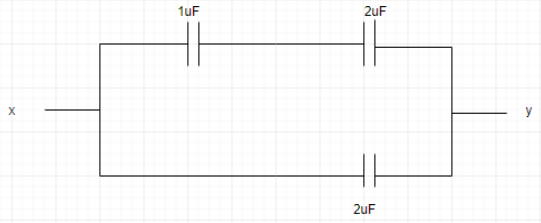
Now the three capacitances remaining in the circuit are $1\mu F,2\mu F\And 3\mu F$. The capacitors of $1\mu F$and $2\mu F$are in series combination and their equivalent is in parallel with the third one.
Thus, equivalent capacitance of the circuit is:
$\Rightarrow \dfrac{1}{C}=\dfrac{1}{2}+1$
$\Rightarrow \dfrac{1}{C}=\dfrac{1+2}{2}$
$\Rightarrow \dfrac{1}{C}=\dfrac{3}{2}$
$\Rightarrow C=\dfrac{2}{3}\mu F$and this is in parallel with $2\mu F$
Therefore,
$\Rightarrow {{C}_{net}}=2+\dfrac{2}{3}$
$\Rightarrow {{C}_{net}}=\dfrac{6+2}{3}$
$\therefore {{C}_{net}}=\dfrac{8}{3}\mu F$
So, the correct option is C.
Note: Apart from parallel plate capacitors, there exist a class of capacitors which are cylindrical in shape. Capacitors are added in series in the manner the resistances are added in parallel combination and capacitors are added in parallel in the manner resistances are added in series. Also, we have not converted the capacitance into Farads, as there was no such demand in the question.Also, capacitors have the ability to store the charge and when the capacitor is fully charged then no current flows through it.
Complete step by step answer:
We can see that the capacitance of $1\mu F\And 1\mu F$are in parallel combination, so their equivalent capacitance will be$1+1=2\mu F$. Now the circuit looks like:
Now the three capacitances remaining in the circuit are $1\mu F,2\mu F\And 3\mu F$. The capacitors of $1\mu F$and $2\mu F$are in series combination and their equivalent is in parallel with the third one.
Thus, equivalent capacitance of the circuit is:
$\Rightarrow \dfrac{1}{C}=\dfrac{1}{2}+1$
$\Rightarrow \dfrac{1}{C}=\dfrac{1+2}{2}$
$\Rightarrow \dfrac{1}{C}=\dfrac{3}{2}$
$\Rightarrow C=\dfrac{2}{3}\mu F$and this is in parallel with $2\mu F$
Therefore,
$\Rightarrow {{C}_{net}}=2+\dfrac{2}{3}$
$\Rightarrow {{C}_{net}}=\dfrac{6+2}{3}$
$\therefore {{C}_{net}}=\dfrac{8}{3}\mu F$
So, the correct option is C.
Note: Apart from parallel plate capacitors, there exist a class of capacitors which are cylindrical in shape. Capacitors are added in series in the manner the resistances are added in parallel combination and capacitors are added in parallel in the manner resistances are added in series. Also, we have not converted the capacitance into Farads, as there was no such demand in the question.Also, capacitors have the ability to store the charge and when the capacitor is fully charged then no current flows through it.
Recently Updated Pages
Master Class 12 Business Studies: Engaging Questions & Answers for Success

Master Class 12 Chemistry: Engaging Questions & Answers for Success
Master Class 12 Biology: Engaging Questions & Answers for Success
Class 12 Question and Answer - Your Ultimate Solutions Guide
Master Class 11 English: Engaging Questions & Answers for Success
Master Class 11 Social Science: Engaging Questions & Answers for Success
Trending doubts
Which are the Top 10 Largest Countries of the World?
Draw a labelled sketch of the human eye class 12 physics CBSE
The end of compass needle which points towards north class 12 physics CBSE
Differentiate between homogeneous and heterogeneous class 12 chemistry CBSE
Why is the cell called the structural and functional class 12 biology CBSE
When was the first election held in India a 194748 class 12 sst CBSE