




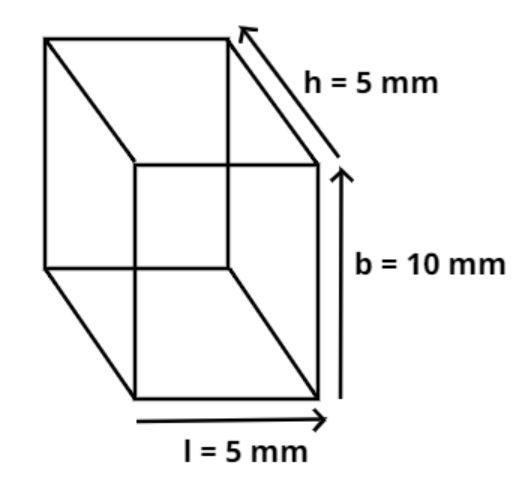
The dimensions of a rectangular block measured with calipers having least count of 0.01 cm are 5mm$ \times $10mm$ \times $5mm. The maximum percentage error in the measurement of the volume of the block is
$\left( A \right)$ 5%
$\left( B \right)$ 10%
$\left( C \right)$ 15%
$\left( D \right)$ 20%
Answer
 Verified
233.1k+ views
- Hint: In this apply the concept that volume of the cuboid is the multiplication of its respective length, breadth and height and later on in the solution use the concept that to find the maximum possible error in the volume calculate all the % error for the respective sides and add then so use these properties to reach the solution of the question.
Formula used – $V = l \times b \times h$, $\dfrac{{\Delta V}}{V} \times 100 = \dfrac{{\Delta l}}{l} \times 100 + \dfrac{{\Delta b}}{b} \times 100 + \dfrac{{\Delta h}}{h} \times 100$
Complete step-by-step solution -
Given data:
Least count in the measurement of the dimensions of the rectangular block (i.e. error in measurements) are, $\Delta l = \Delta b = \Delta h = 0.01$cm
Where l, b and h are the length, breadth and height of the rectangular box.
Now the given dimension of the rectangular box = 5mm$ \times $10mm$ \times $5mm
So let l = 5 mm, b = 10 mm and h = 5 mm.
Now as we know that 1 mm = 0.1 cm
Therefore l = 5mm = 0.5cm, b = 10mm = 1 cm and h = 5mm = 0.5cm.
Now as we know that the volume of the cuboid (i.e. rectangular block) = $l \times b \times h$
And the percentage error in any of its sides is the ratio of error in the respective side to length of the respective side multiplied by 100.
So the % error in the length is $\dfrac{{\Delta l}}{l} \times 100$
Similarly % error in the breadth is $\dfrac{{\Delta b}}{b} \times 100$
% error in the height is $\dfrac{{\Delta h}}{h} \times 100$
% error in the volume is $\dfrac{{\Delta V}}{V} \times 100$
So the maximum percentage error in the volume is the addition of the respective percentage error in the length, breadth and height of the rectangular block.
$ \Rightarrow \dfrac{{\Delta V}}{V} \times 100 = \dfrac{{\Delta l}}{l} \times 100 + \dfrac{{\Delta b}}{b} \times 100 + \dfrac{{\Delta h}}{h} \times 100$
Now substitute the values we have,
$ \Rightarrow \dfrac{{\Delta V}}{V} \times 100 = \dfrac{{0.01}}{{0.5}} \times 100 + \dfrac{{0.01}}{1} \times 100 + \dfrac{{0.01}}{{0.5}} \times 100$
Now simplify the above equation we have,
$ \Rightarrow \dfrac{{\Delta V}}{V} \times 100 = 2 + 1 + 2 = 5$%
So this is the required answer.
Hence option (A) is the correct answer.
Note – Whenever we face such types of questions the key concept involved here the percentage error in any of its side is the ratio of error in the respective side to length of the respective side multiplied by 100, so the maximum possible error in the volume is the sum of all the % error of the respective sides as above shown so just substitute the values and simplify, we will get the required answer.
Formula used – $V = l \times b \times h$, $\dfrac{{\Delta V}}{V} \times 100 = \dfrac{{\Delta l}}{l} \times 100 + \dfrac{{\Delta b}}{b} \times 100 + \dfrac{{\Delta h}}{h} \times 100$
Complete step-by-step solution -
Given data:
Least count in the measurement of the dimensions of the rectangular block (i.e. error in measurements) are, $\Delta l = \Delta b = \Delta h = 0.01$cm
Where l, b and h are the length, breadth and height of the rectangular box.
Now the given dimension of the rectangular box = 5mm$ \times $10mm$ \times $5mm
So let l = 5 mm, b = 10 mm and h = 5 mm.
Now as we know that 1 mm = 0.1 cm
Therefore l = 5mm = 0.5cm, b = 10mm = 1 cm and h = 5mm = 0.5cm.
Now as we know that the volume of the cuboid (i.e. rectangular block) = $l \times b \times h$
And the percentage error in any of its sides is the ratio of error in the respective side to length of the respective side multiplied by 100.
So the % error in the length is $\dfrac{{\Delta l}}{l} \times 100$
Similarly % error in the breadth is $\dfrac{{\Delta b}}{b} \times 100$
% error in the height is $\dfrac{{\Delta h}}{h} \times 100$
% error in the volume is $\dfrac{{\Delta V}}{V} \times 100$
So the maximum percentage error in the volume is the addition of the respective percentage error in the length, breadth and height of the rectangular block.
$ \Rightarrow \dfrac{{\Delta V}}{V} \times 100 = \dfrac{{\Delta l}}{l} \times 100 + \dfrac{{\Delta b}}{b} \times 100 + \dfrac{{\Delta h}}{h} \times 100$
Now substitute the values we have,
$ \Rightarrow \dfrac{{\Delta V}}{V} \times 100 = \dfrac{{0.01}}{{0.5}} \times 100 + \dfrac{{0.01}}{1} \times 100 + \dfrac{{0.01}}{{0.5}} \times 100$
Now simplify the above equation we have,
$ \Rightarrow \dfrac{{\Delta V}}{V} \times 100 = 2 + 1 + 2 = 5$%
So this is the required answer.
Hence option (A) is the correct answer.
Note – Whenever we face such types of questions the key concept involved here the percentage error in any of its side is the ratio of error in the respective side to length of the respective side multiplied by 100, so the maximum possible error in the volume is the sum of all the % error of the respective sides as above shown so just substitute the values and simplify, we will get the required answer.
Recently Updated Pages
JEE Main 2023 April 6 Shift 1 Question Paper with Answer Key

JEE Main 2023 April 6 Shift 2 Question Paper with Answer Key
JEE Main 2023 (January 31 Evening Shift) Question Paper with Solutions [PDF]
JEE Main 2023 January 30 Shift 2 Question Paper with Answer Key
JEE Main 2023 January 25 Shift 1 Question Paper with Answer Key
JEE Main 2023 January 24 Shift 2 Question Paper with Answer Key
Trending doubts
JEE Main 2026: Session 2 Registration Open, City Intimation Slip, Exam Dates, Syllabus & Eligibility
JEE Main 2026 Application Login: Direct Link, Registration, Form Fill, and Steps
Understanding the Angle of Deviation in a Prism
Hybridisation in Chemistry – Concept, Types & Applications
How to Convert a Galvanometer into an Ammeter or Voltmeter
Understanding Uniform Acceleration in Physics
Other Pages
JEE Advanced Marks vs Ranks 2025: Understanding Category-wise Qualifying Marks and Previous Year Cut-offs
Laws of Motion Class 11 Physics Chapter 4 CBSE Notes - 2025-26
Waves Class 11 Physics Chapter 14 CBSE Notes - 2025-26
Mechanical Properties of Fluids Class 11 Physics Chapter 9 CBSE Notes - 2025-26
Thermodynamics Class 11 Physics Chapter 11 CBSE Notes - 2025-26
Units And Measurements Class 11 Physics Chapter 1 CBSE Notes - 2025-26