




The compound X in the reaction is
\[{\rm{X}} \overset{CH_{3}MgI}{\rightarrow}{\rm{Y}} \overset{Hydrolysis}{\rightarrow} {\rm{Mg(OH)I}} + {\rm{C}}{{\rm{H}}_{\rm{3}}}{\rm{COOH}}\]
A. HCHO
B. \[{\rm{C}}{{\rm{H}}_{\rm{3}}}{\rm{CHO}}\]
C. \[{\left( {{\rm{C}}{{\rm{H}}_{\rm{3}}}} \right)_2}{\rm{CO}}\]
D. \[{\rm{C}}{{\rm{O}}_{\rm{2}}}\]
Answer
 Verified
233.1k+ views
Hint: Grignard reagent belongs to the class of organometallic compound. Its chemical formula is \[{\rm{R}} - {\rm{Mg}} - {\rm{X}}\] , where, R is for an alkyl group, Mg is for magnesium atom and X is for any halogen atom such as bromine, chlorine etc.
Complete step by step answer:
Let's understand the reaction of a Grignard reagent with Carbon dioxide. A Grignard reagent, when undergoing a reaction with carbon dioxide, then undergoes hydrolysis to give the product of carboxylic acid.
Let's understand the reaction mechanism of the reaction in detail. The first step is breaking of C-Mg bond and attack of C- at the carbon atom of carbon dioxide. In the step, the carboxylate ion forms. Then, when the carboxylate ion undergoes a reaction with water, the formation of carboxylic acid occurs.
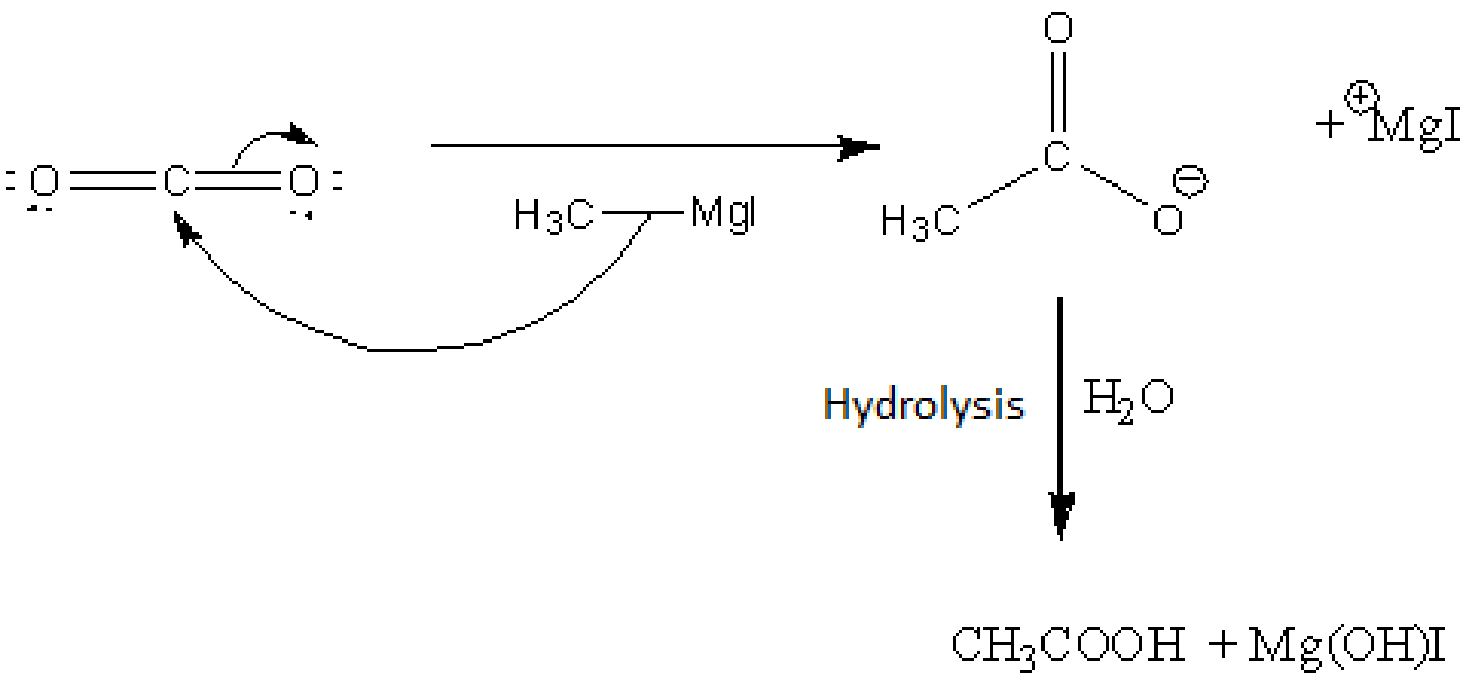
Image: Grignard reagent undergoes reaction with Carbon dioxide
Therefore, X is carbon dioxide. Hence, option B is the right answer.
Additional Information:
The preparation of the Grignard reagent is done from the reaction of magnesium and alkyl halide in the presence of ether (dry). Some of the reactions are,
(1)The reaction of aldehydes with Grignard reagent gives the product secondary alcohol.
(2)The reaction of ketones with Grignard reagent gives the product of tertiary alcohol.
(3)The reaction of esters with Grignard reagent gives the product of tertiary alcohol.
Note: The use of Grignard reagent to prepare chemo catalyst which is used in the chemical and pharmaceutical industries is very useful. In the agronomic industry, the development of eco-friendly products from Grignard reagents that possess soil-enriching properties results in a good market for Grignard reagents.
Complete step by step answer:
Let's understand the reaction of a Grignard reagent with Carbon dioxide. A Grignard reagent, when undergoing a reaction with carbon dioxide, then undergoes hydrolysis to give the product of carboxylic acid.
Let's understand the reaction mechanism of the reaction in detail. The first step is breaking of C-Mg bond and attack of C- at the carbon atom of carbon dioxide. In the step, the carboxylate ion forms. Then, when the carboxylate ion undergoes a reaction with water, the formation of carboxylic acid occurs.
Image: Grignard reagent undergoes reaction with Carbon dioxide
Therefore, X is carbon dioxide. Hence, option B is the right answer.
Additional Information:
The preparation of the Grignard reagent is done from the reaction of magnesium and alkyl halide in the presence of ether (dry). Some of the reactions are,
(1)The reaction of aldehydes with Grignard reagent gives the product secondary alcohol.
(2)The reaction of ketones with Grignard reagent gives the product of tertiary alcohol.
(3)The reaction of esters with Grignard reagent gives the product of tertiary alcohol.
Note: The use of Grignard reagent to prepare chemo catalyst which is used in the chemical and pharmaceutical industries is very useful. In the agronomic industry, the development of eco-friendly products from Grignard reagents that possess soil-enriching properties results in a good market for Grignard reagents.
Recently Updated Pages
JEE Main 2023 April 6 Shift 1 Question Paper with Answer Key

JEE Main 2023 April 6 Shift 2 Question Paper with Answer Key
JEE Main 2023 (January 31 Evening Shift) Question Paper with Solutions [PDF]
JEE Main 2023 January 30 Shift 2 Question Paper with Answer Key
JEE Main 2023 January 25 Shift 1 Question Paper with Answer Key
JEE Main 2023 January 24 Shift 2 Question Paper with Answer Key
Trending doubts
JEE Main 2026: Session 2 Registration Open, City Intimation Slip, Exam Dates, Syllabus & Eligibility
JEE Main 2026 Application Login: Direct Link, Registration, Form Fill, and Steps
JEE Main Marking Scheme 2026- Paper-Wise Marks Distribution and Negative Marking Details
Understanding the Angle of Deviation in a Prism
Hybridisation in Chemistry – Concept, Types & Applications
How to Convert a Galvanometer into an Ammeter or Voltmeter
Other Pages
JEE Advanced Marks vs Ranks 2025: Understanding Category-wise Qualifying Marks and Previous Year Cut-offs
NCERT Solutions For Class 12 Chemistry Chapter 1 Solutions (2025-26)
Solutions Class 12 Chemistry Chapter 1 CBSE Notes - 2025-26
NCERT Solutions For Class 12 Chemistry Chapter 4 The d and f Block Elements (2025-26)
Biomolecules Class 12 Chemistry Chapter 10 CBSE Notes - 2025-26
NCERT Solutions For Class 12 Chemistry Chapter 10 Biomolecules (2025-26)