



The colour code of carbon resistor is brown is, Brown, Black and Red. The value of the resistor is?
A) \[10\Omega \pm 5\% \]
B) \[1k\Omega \pm 2\% \]
C) \[100\Omega \pm 2\% \]
D) \[10\Omega \pm 2\% \]
Answer
 Verified
306.6k+ views
Hint: Carbon resistor is one of the most common compact-sized types of electronic passive device. Carbon resistances are made from solid cylindrical resistive elements with embedded wire leads or metal end caps. Due to the compact size of carbon resistors color coding helps to quickly identify its resistive value and the percentage of tolerance of the carbon resistors.
Complete answer:
Carbon resistors are commercially used passive devices because they offer a very high resistance with a very compact size. The colors are used for the coding of carbon resistors mainly because in the small electronic circuit it is very difficult to calibrate the resistance of the tiny bunch of carbon resistors so for our sake of simplicity we are using colors in the coding purpose.
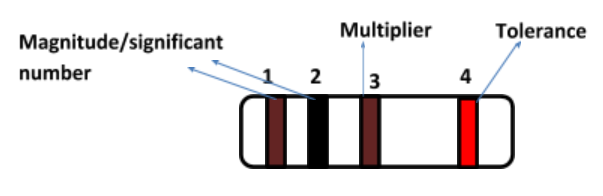 Coding of colors
1. Brown = 1(Magnitude/Significant Number)
2. Black = 0(Magnitude/Significant Number)
3. Brown = 10(Multiplier)
4. Red = ±2%(Tolerance)
So we get the required value for resistance as:
\[R = (10 \times 10)\Omega \pm 2\% \]
\[ \Rightarrow R = 100\Omega \pm 2\% \]
Hence, option (C) is the correct answer.
Note: In order to tackle these kinds of questions from the topic of color-coded carbon resistors we have to remember the different values for the codes for different bands on the carbon resistor. For the sake of simplicity, one should learn the mnemonics for coding as – B B R O Y of Great Britain has a Very Good Wife.
Tolerance in the carbon coded resistor indicates up to how much percentage the original value of resistance will differ. We can also call it a percentage error in the resistance. One should also note that the value of tolerance percentage in the carbon resistor also varies with colors that are other than Gold, Silver, and No color. For example, for red, the tolerance percentage will be ± 2%.
Complete answer:
Carbon resistors are commercially used passive devices because they offer a very high resistance with a very compact size. The colors are used for the coding of carbon resistors mainly because in the small electronic circuit it is very difficult to calibrate the resistance of the tiny bunch of carbon resistors so for our sake of simplicity we are using colors in the coding purpose.
Coding of colors1. Brown = 1(Magnitude/Significant Number)
2. Black = 0(Magnitude/Significant Number)
3. Brown = 10(Multiplier)
4. Red = ±2%(Tolerance)
So we get the required value for resistance as:
\[R = (10 \times 10)\Omega \pm 2\% \]
\[ \Rightarrow R = 100\Omega \pm 2\% \]
Hence, option (C) is the correct answer.
Note: In order to tackle these kinds of questions from the topic of color-coded carbon resistors we have to remember the different values for the codes for different bands on the carbon resistor. For the sake of simplicity, one should learn the mnemonics for coding as – B B R O Y of Great Britain has a Very Good Wife.
| Colors | Magnitude | Multiplier | Tolerance(%) |
| Black | 0 | \[{10^0}\] | Gold - \[ \pm 5\] |
| Brown | 1 | \[{10^1}\] | Silver- \[ \pm 10\] |
| Red | 2 | \[{10^2}\] | No color- \[ \pm 20\] |
| Orange | 3 | \[{10^3}\] | |
| Yellow | 4 | \[{10^4}\] | |
| Green | 5 | \[{10^5}\] | |
| Blue | 6 | \[{10^6}\] | |
| Violet | 7 | \[{10^7}\] | |
| Grey | 8 | \[{10^8}\] | |
| White | 9 | \[{10^9}\] |
Tolerance in the carbon coded resistor indicates up to how much percentage the original value of resistance will differ. We can also call it a percentage error in the resistance. One should also note that the value of tolerance percentage in the carbon resistor also varies with colors that are other than Gold, Silver, and No color. For example, for red, the tolerance percentage will be ± 2%.
Recently Updated Pages
JEE Main 2025-26 Atoms and Nuclei Mock Test – Free Practice Questions

JEE Main 2025-26 Mock Test: Electronic Devices Chapter Practice
Oscillations and Waves Mock Test 2025: Practice Questions & Answers
JEE Main 2025-26 Atoms and Nuclei Mock Test – Free Practice Online
JEE Main 2026-27 Oscillations and Waves Mock Test – Practice Online
JEE Main Kinetic Theory Of Gases Mock Test 2025-26
Trending doubts
JEE Main 2026: Exam Dates, Session 2 Updates, City Slip, Admit Card & Latest News
Understanding the Electric Field of a Uniformly Charged Ring
Derivation of Equation of Trajectory Explained for Students
Understanding Atomic Structure for Beginners
How to Convert a Galvanometer into an Ammeter or Voltmeter
Hybridisation in Chemistry – Concept, Types & Applications
Other Pages
CBSE Class 12 Physics Question Paper 2026: Download SET-wise PDF with Answer Key & Analysis
JEE Advanced Percentile vs Marks 2026: JEE Main Cutoff, AIR & IIT Admission Guide
Class 12 Physics Formulas: Complete Chapter-wise PDF Guide
What Are Elastic Collisions in One Dimension?
Isoelectronic Species: Definition, Examples & Importance
Understanding Uniform Acceleration in Physics