




The average P.E. of a body executing S.H.M. is :
\[
\left( 1 \right)\dfrac{1}{2}k{A^2} \\
\left( 2 \right)\dfrac{1}{4}k{A^2} \\
\left( 3 \right)3k{A^2} \\
\left( 4 \right)zero \\
\]
Answer
 Verified
233.1k+ views
Hint:Law of conservation of energy states that the total of all forms of energies possessed by a moving object is always constant.
During any process energy can neither be created nor be destroyed it can be only converted from one form to another
In SHM the potential energy of the system is continuously converting from potential energy to kinetic energy and the again to potential energy
Complete step by step solution:
Simple harmonic motion:
repetitive movement back and forth through an equilibrium, or central, position, so that the maximum displacement on one side of this position is equal to the maximum displacement on the other side.
In SHM the potential energy of any object is maximum at the two far ends and the kinetic energy is maximum at the midpoint
Refer figure:
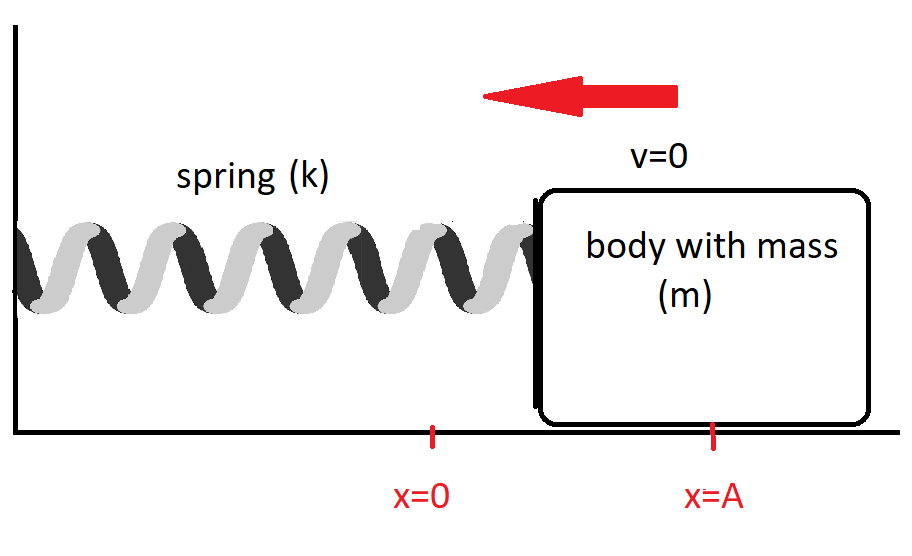
Now as we know that the motion of the block on a spring in SHM is defined by the position \[x\left( t \right) = A\cos \left( {\omega t + \phi } \right)\]_______________$\left( 1 \right)$
We know that derivating position to time we get velocity,
So \[v(t) = - A\omega {\text{sin}}(\omega t + \phi )\]___________________________$\left( 2 \right)$
As per the law of conservation of energy
Total energy = Kinetic energy $ + $Potential energy
$ \Rightarrow {E_{total}} = \dfrac{1}{2}m{v^2} + \dfrac{1}{2}k{x^2}$
Where
$m$: the mass of the block
k: spring constant
v: velocity of the object
x: displacement
\[{E_{total}} = \dfrac{1}{2}m{A^2}{\omega ^2}{\sin ^2}\left( {\omega t + \phi } \right) + \dfrac{1}{2}k{A^2}{\cos ^2}\left( {\omega t + \phi } \right)\]
As \[\omega = \sqrt {\dfrac{k}{m}} \]
\[
\therefore {E_{total}} = \dfrac{1}{2}m{A^2}\left( {\dfrac{k}{m}} \right){\sin ^2}\left( {\omega t + \phi } \right) + \dfrac{1}{2}k{A^2}{\cos ^2}\left( {\omega t + \phi } \right) \\
\Rightarrow {E_{total}} = \dfrac{1}{2}k{A^2}{\sin ^2}\left( {\omega t + \phi } \right) + \dfrac{1}{2}k{A^2}{\cos ^2}\left( {\omega t + \phi } \right) \\
\Rightarrow {E_{total}} = \dfrac{1}{2}k{A^2}\left[ {{{\sin }^2}\left( {\omega t + \phi } \right) + {{\cos }^2}\left( {\omega t + \phi } \right)} \right] \\
\\
\]
Again as ${\sin ^2}\theta + {\cos ^2}\theta = 1$
We get \[{E_{total}} = \dfrac{1}{2}k{A^2}\]______________________________(3)
Now to find average potential energy we know that in SHM as K.E increases P.E decreases and vice versa but total energy at all the points remains the same as the sum of K.E and P.E. from here we can conclude that average potential energy will be half of the total energy.
Refer figure:
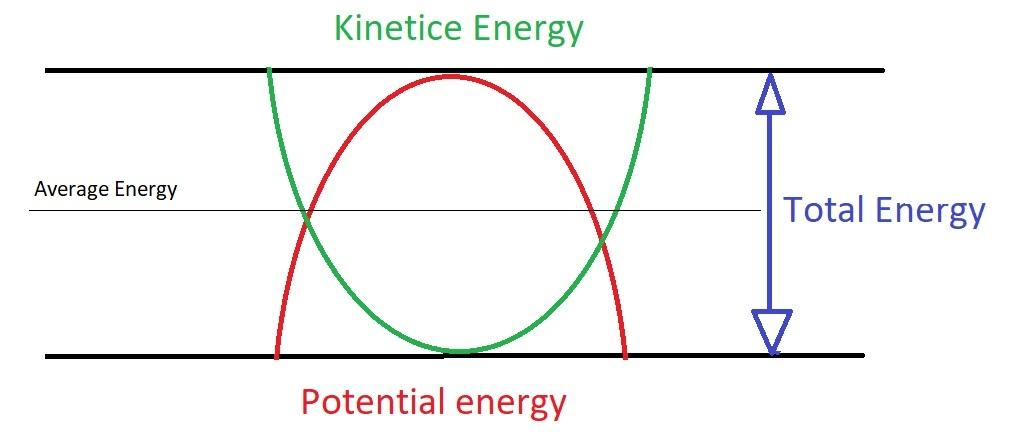
So,
\[
{\left( {P.E} \right)_{avg}} = \dfrac{{{E_{total}}}}{2} \\
\therefore {\left( {P.E} \right)_{avg}} = \dfrac{{\dfrac{1}{2}k{A^2}}}{2} \\
\Rightarrow {\left( {P.E} \right)_{avg}} = \dfrac{{k{A^2}}}{4} \\
\]
(2) The average potential energy of an object in SHM will be \[{\left( {P.E} \right)_{avg}} = \dfrac{{k{A^2}}}{4}\]
Note:
1) Energy is always conserved i.e.; the sum of all energies remains constant
2) As the object moves from an extreme position to the centre it's kinetic energy will increase from zero to maximum and then as it again moves from centre to another end it will decrease from a maximum at the centre to zero at ends.
3) The potential energy of the object is maximum at the end to zero at the centre
4) At every point in SHM, the total of kinetic energy and potential energy remains constant throughout.
During any process energy can neither be created nor be destroyed it can be only converted from one form to another
In SHM the potential energy of the system is continuously converting from potential energy to kinetic energy and the again to potential energy
Complete step by step solution:
Simple harmonic motion:
repetitive movement back and forth through an equilibrium, or central, position, so that the maximum displacement on one side of this position is equal to the maximum displacement on the other side.
In SHM the potential energy of any object is maximum at the two far ends and the kinetic energy is maximum at the midpoint
Refer figure:
Now as we know that the motion of the block on a spring in SHM is defined by the position \[x\left( t \right) = A\cos \left( {\omega t + \phi } \right)\]_______________$\left( 1 \right)$
We know that derivating position to time we get velocity,
So \[v(t) = - A\omega {\text{sin}}(\omega t + \phi )\]___________________________$\left( 2 \right)$
As per the law of conservation of energy
Total energy = Kinetic energy $ + $Potential energy
$ \Rightarrow {E_{total}} = \dfrac{1}{2}m{v^2} + \dfrac{1}{2}k{x^2}$
Where
$m$: the mass of the block
k: spring constant
v: velocity of the object
x: displacement
\[{E_{total}} = \dfrac{1}{2}m{A^2}{\omega ^2}{\sin ^2}\left( {\omega t + \phi } \right) + \dfrac{1}{2}k{A^2}{\cos ^2}\left( {\omega t + \phi } \right)\]
As \[\omega = \sqrt {\dfrac{k}{m}} \]
\[
\therefore {E_{total}} = \dfrac{1}{2}m{A^2}\left( {\dfrac{k}{m}} \right){\sin ^2}\left( {\omega t + \phi } \right) + \dfrac{1}{2}k{A^2}{\cos ^2}\left( {\omega t + \phi } \right) \\
\Rightarrow {E_{total}} = \dfrac{1}{2}k{A^2}{\sin ^2}\left( {\omega t + \phi } \right) + \dfrac{1}{2}k{A^2}{\cos ^2}\left( {\omega t + \phi } \right) \\
\Rightarrow {E_{total}} = \dfrac{1}{2}k{A^2}\left[ {{{\sin }^2}\left( {\omega t + \phi } \right) + {{\cos }^2}\left( {\omega t + \phi } \right)} \right] \\
\\
\]
Again as ${\sin ^2}\theta + {\cos ^2}\theta = 1$
We get \[{E_{total}} = \dfrac{1}{2}k{A^2}\]______________________________(3)
Now to find average potential energy we know that in SHM as K.E increases P.E decreases and vice versa but total energy at all the points remains the same as the sum of K.E and P.E. from here we can conclude that average potential energy will be half of the total energy.
Refer figure:
So,
\[
{\left( {P.E} \right)_{avg}} = \dfrac{{{E_{total}}}}{2} \\
\therefore {\left( {P.E} \right)_{avg}} = \dfrac{{\dfrac{1}{2}k{A^2}}}{2} \\
\Rightarrow {\left( {P.E} \right)_{avg}} = \dfrac{{k{A^2}}}{4} \\
\]
(2) The average potential energy of an object in SHM will be \[{\left( {P.E} \right)_{avg}} = \dfrac{{k{A^2}}}{4}\]
Note:
1) Energy is always conserved i.e.; the sum of all energies remains constant
2) As the object moves from an extreme position to the centre it's kinetic energy will increase from zero to maximum and then as it again moves from centre to another end it will decrease from a maximum at the centre to zero at ends.
3) The potential energy of the object is maximum at the end to zero at the centre
4) At every point in SHM, the total of kinetic energy and potential energy remains constant throughout.
Recently Updated Pages
JEE Main 2026 Session 2 Registration Open, Exam Dates, Syllabus & Eligibility

JEE Main 2023 April 6 Shift 1 Question Paper with Answer Key
JEE Main 2023 April 6 Shift 2 Question Paper with Answer Key
JEE Main 2023 (January 31 Evening Shift) Question Paper with Solutions [PDF]
JEE Main 2023 January 30 Shift 2 Question Paper with Answer Key
JEE Main 2023 January 25 Shift 1 Question Paper with Answer Key
Trending doubts
Understanding Average and RMS Value in Electrical Circuits
Ideal and Non-Ideal Solutions Explained for Class 12 Chemistry
Understanding Atomic Structure for Beginners
Derive an expression for maximum speed of a car on class 11 physics JEE_Main
Understanding Elastic Collisions in Two Dimensions
Class 11 JEE Main Physics Mock Test 2025
Other Pages
NCERT Solutions For Class 11 Physics Chapter 10 Thermal Properties of Matter (2025-26)
NCERT Solutions For Class 11 Physics Chapter 12 Kinetic Theory (2025-26)
Understanding Collisions: Types and Examples for Students
Define thermal expansion for alpha beta and gamma A class 11 physics JEE_Main
Happy New Year Wishes 2026 – 100+ Messages, Quotes, Shayari, Images & Status in All Languages
Valentine Week 2026 List | Valentine Week Days, Dates & Meaning