




Salicylic acid can be prepared using Reimer - Tiemann’s reaction by treating phenol with:
A. Methyl chloride in the presence of anhydrous aluminium chloride
B. Carbon dioxide under pressure in sodium hydroxide solution
C. Carbon tetrachloride and concentrated sodium hydroxide
D. Sodium nitrite and a few drops of concentrated sulphuric acid
Answer
 Verified
233.1k+ views
Hint: The Riemer-Tiemann reaction involves the ortho-formylation of phenol. In essence, it is a nucleophilic substitution reaction.
Complete Step by Step Solution:
The Riemer-Tiemann reaction is used for the ortho-formylation of phenols using a strong base in the presence of carbon tetrachloride (\[CC{l_4}\]). The strong base most commonly used is concentrated sodium hydroxide (\[NaOH\]) or potassium hydroxide (\[KOH\]).
While phenol is soluble in carbon tetrachloride, the hydroxide base is not. Therefore, this reaction is generally carried out in a solvent system that has two phases (biphasic). In its simplest case, the biphasic system consists of an aqueous phase containing the hydroxide base and an organic phase containing the carbon tetrachloride and phenol. The two phases are brought together (by rapid mixing or by using phase transfer catalysts) and heated to initiate the reaction. Although heating is required to start the reaction, once it is underway the reaction itself becomes highly exothermic.
The Riemer-Tiemann reaction of phenol with\[CC{l_4}\]and concentrated sodium hydroxide leads to the formation of salicylic acid as the product.
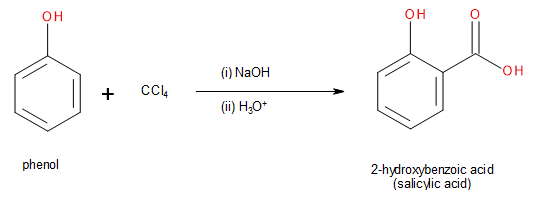
Image: Conversion of phenol into salicylic acid through Riemer-Tiemann reaction
Thus, the correct option is C.
Note: Although the reaction discussed above is termed as a Riemer-Tiemann reaction, it is a variation of it. The actual Reimer-Tiemann reaction consists of the reaction of phenol with chloroform (\[CHC{l_3}\]) and a strong hydroxide base to form salicylaldehyde as shown below.
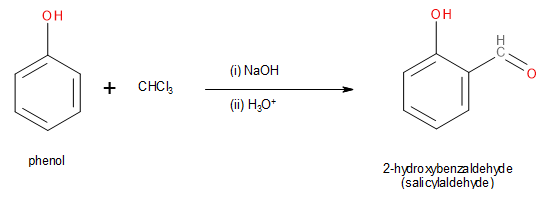
Image: Riemer-Tiemann reaction of phenol.
Complete Step by Step Solution:
The Riemer-Tiemann reaction is used for the ortho-formylation of phenols using a strong base in the presence of carbon tetrachloride (\[CC{l_4}\]). The strong base most commonly used is concentrated sodium hydroxide (\[NaOH\]) or potassium hydroxide (\[KOH\]).
While phenol is soluble in carbon tetrachloride, the hydroxide base is not. Therefore, this reaction is generally carried out in a solvent system that has two phases (biphasic). In its simplest case, the biphasic system consists of an aqueous phase containing the hydroxide base and an organic phase containing the carbon tetrachloride and phenol. The two phases are brought together (by rapid mixing or by using phase transfer catalysts) and heated to initiate the reaction. Although heating is required to start the reaction, once it is underway the reaction itself becomes highly exothermic.
The Riemer-Tiemann reaction of phenol with\[CC{l_4}\]and concentrated sodium hydroxide leads to the formation of salicylic acid as the product.
Image: Conversion of phenol into salicylic acid through Riemer-Tiemann reaction
Thus, the correct option is C.
Note: Although the reaction discussed above is termed as a Riemer-Tiemann reaction, it is a variation of it. The actual Reimer-Tiemann reaction consists of the reaction of phenol with chloroform (\[CHC{l_3}\]) and a strong hydroxide base to form salicylaldehyde as shown below.
Image: Riemer-Tiemann reaction of phenol.
Recently Updated Pages
JEE Main 2023 April 6 Shift 1 Question Paper with Answer Key

JEE Main 2023 April 6 Shift 2 Question Paper with Answer Key
JEE Main 2023 (January 31 Evening Shift) Question Paper with Solutions [PDF]
JEE Main 2023 January 30 Shift 2 Question Paper with Answer Key
JEE Main 2023 January 25 Shift 1 Question Paper with Answer Key
JEE Main 2023 January 24 Shift 2 Question Paper with Answer Key
Trending doubts
JEE Main 2026: Session 2 Registration Open, City Intimation Slip, Exam Dates, Syllabus & Eligibility
JEE Main 2026 Application Login: Direct Link, Registration, Form Fill, and Steps
JEE Main Marking Scheme 2026- Paper-Wise Marks Distribution and Negative Marking Details
Understanding the Angle of Deviation in a Prism
Hybridisation in Chemistry – Concept, Types & Applications
How to Convert a Galvanometer into an Ammeter or Voltmeter
Other Pages
JEE Advanced Marks vs Ranks 2025: Understanding Category-wise Qualifying Marks and Previous Year Cut-offs
NCERT Solutions For Class 12 Chemistry Chapter 1 Solutions (2025-26)
Solutions Class 12 Chemistry Chapter 1 CBSE Notes - 2025-26
NCERT Solutions For Class 12 Chemistry Chapter 4 The d and f Block Elements (2025-26)
Biomolecules Class 12 Chemistry Chapter 10 CBSE Notes - 2025-26
NCERT Solutions For Class 12 Chemistry Chapter 10 Biomolecules (2025-26)