




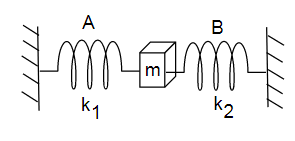
In the arrangement given in figure, if the block of mass m is displaced, the frequency is given by
A. \[n = \dfrac{1}{{2\pi }}\sqrt {\left( {\dfrac{{{k_1} - {k_2}}}{m}} \right)} \]
B. \[n = \dfrac{1}{{2\pi }}\sqrt {\left( {\dfrac{{{k_1} + {k_2}}}{m}} \right)} \]
C. \[n = \dfrac{1}{{2\pi }}\sqrt {\left( {\dfrac{m}{{{k_1} + {k_2}}}} \right)} \]
D. \[n = \dfrac{1}{{2\pi }}\sqrt {\left( {\dfrac{m}{{{k_1} - {k_2}}}} \right)} \]
Answer
 Verified
233.1k+ views
Hint: To find the frequency consider the small displacement of the block by x and find the net force acting on the block in terms of their springs constant.
Formula used:
\[T = \dfrac{{2\pi }}{\omega },\,n = \dfrac{1}{T}\] and \[\omega = \sqrt {\dfrac{k}{m}} \]
Where, T= Time period of oscillation,\[\omega \] = Angular frequency of oscillation, n = Frequency of oscillation, k= Spring constant and m = Mass suspended to spring
Complete step by step solution:
Given here is a spring block system of two springs A and B of constant \[{k_1}\] and \[{k_2}\]respectively, we have to find the frequency when block m is displaced from its position.
Let the block m be displaced by x towards the right then spring A will pull the block by force \[{k_1}x\] and compression force acting on spring B will be \[{k_2}x\] as shown in the image below,
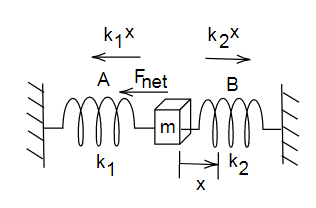
Image: Force on the spring block system
Then, the net force acting on the block will be
\[{F_{net}} = {k_1}x + {k_2}x \Rightarrow {F_{net}} = - \left( {{k_1} + {k_2}} \right)x\,.......(1)\]
Negative magnitude on the net force in \[{F_{net}} = - \left( {{k_1} + {k_2}} \right)x\] signifies the opposite direction of net force with respect to displacement.
From F= ma, acceleration a of the block can be expressed as,
\[a = \dfrac{{{F_{net}}}}{m} \Rightarrow a = \dfrac{{ - \left( {{k_1} + {k_2}} \right)x}}{m}\,........(2)\]
Comparing equation (2) with we get,
\[{\omega ^2} = \dfrac{{{k_1} + {k_2}}}{m} \Rightarrow \omega = \sqrt {\dfrac{{{k_1} + {k_2}}}{m}} \,.........(3)\]
Then, the frequency of oscillation is given by,
\[n = \dfrac{1}{T} = \dfrac{\omega }{{2\pi }}\,........(4)\]
Substituting the value of from equation (3) in equation (4) frequency will be,
\[n = \dfrac{1}{{2\pi }}\sqrt {\dfrac{{{k_1} + {k_2}}}{m}} \,\]
Therefore, option B is the correct option.
Note: If the acceleration of an oscillating body is of the form \[a = - {\omega ^2}x\], then the body is said to be performing simple harmonic motion (S.H.M.)
Formula used:
\[T = \dfrac{{2\pi }}{\omega },\,n = \dfrac{1}{T}\] and \[\omega = \sqrt {\dfrac{k}{m}} \]
Where, T= Time period of oscillation,\[\omega \] = Angular frequency of oscillation, n = Frequency of oscillation, k= Spring constant and m = Mass suspended to spring
Complete step by step solution:
Given here is a spring block system of two springs A and B of constant \[{k_1}\] and \[{k_2}\]respectively, we have to find the frequency when block m is displaced from its position.
Let the block m be displaced by x towards the right then spring A will pull the block by force \[{k_1}x\] and compression force acting on spring B will be \[{k_2}x\] as shown in the image below,
Image: Force on the spring block system
Then, the net force acting on the block will be
\[{F_{net}} = {k_1}x + {k_2}x \Rightarrow {F_{net}} = - \left( {{k_1} + {k_2}} \right)x\,.......(1)\]
Negative magnitude on the net force in \[{F_{net}} = - \left( {{k_1} + {k_2}} \right)x\] signifies the opposite direction of net force with respect to displacement.
From F= ma, acceleration a of the block can be expressed as,
\[a = \dfrac{{{F_{net}}}}{m} \Rightarrow a = \dfrac{{ - \left( {{k_1} + {k_2}} \right)x}}{m}\,........(2)\]
Comparing equation (2) with we get,
\[{\omega ^2} = \dfrac{{{k_1} + {k_2}}}{m} \Rightarrow \omega = \sqrt {\dfrac{{{k_1} + {k_2}}}{m}} \,.........(3)\]
Then, the frequency of oscillation is given by,
\[n = \dfrac{1}{T} = \dfrac{\omega }{{2\pi }}\,........(4)\]
Substituting the value of from equation (3) in equation (4) frequency will be,
\[n = \dfrac{1}{{2\pi }}\sqrt {\dfrac{{{k_1} + {k_2}}}{m}} \,\]
Therefore, option B is the correct option.
Note: If the acceleration of an oscillating body is of the form \[a = - {\omega ^2}x\], then the body is said to be performing simple harmonic motion (S.H.M.)
Recently Updated Pages
JEE Main 2023 April 6 Shift 1 Question Paper with Answer Key

JEE Main 2023 April 6 Shift 2 Question Paper with Answer Key
JEE Main 2023 (January 31 Evening Shift) Question Paper with Solutions [PDF]
JEE Main 2023 January 30 Shift 2 Question Paper with Answer Key
JEE Main 2023 January 25 Shift 1 Question Paper with Answer Key
JEE Main 2023 January 24 Shift 2 Question Paper with Answer Key
Trending doubts
JEE Main 2026: Session 2 Registration Open, City Intimation Slip, Exam Dates, Syllabus & Eligibility
JEE Main 2026 Application Login: Direct Link, Registration, Form Fill, and Steps
JEE Main Marking Scheme 2026- Paper-Wise Marks Distribution and Negative Marking Details
Understanding the Angle of Deviation in a Prism
Hybridisation in Chemistry – Concept, Types & Applications
How to Convert a Galvanometer into an Ammeter or Voltmeter
Other Pages
JEE Advanced Marks vs Ranks 2025: Understanding Category-wise Qualifying Marks and Previous Year Cut-offs
Laws of Motion Class 11 Physics Chapter 4 CBSE Notes - 2025-26
Waves Class 11 Physics Chapter 14 CBSE Notes - 2025-26
Mechanical Properties of Fluids Class 11 Physics Chapter 9 CBSE Notes - 2025-26
Thermodynamics Class 11 Physics Chapter 11 CBSE Notes - 2025-26
Units And Measurements Class 11 Physics Chapter 1 CBSE Notes - 2025-26