




In the above reaction product is
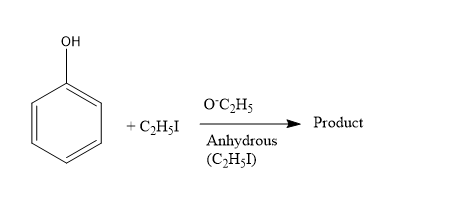
(A) \[{{\rm{C}}_{\rm{6}}}{{\rm{H}}_{\rm{5}}}{\rm{O}}{{\rm{C}}_{\rm{2}}}{{\rm{H}}_{\rm{5}}}\]
(B) \[{{\rm{C}}_2}{{\rm{H}}_{\rm{5}}}{\rm{O}}{{\rm{C}}_{\rm{2}}}{{\rm{H}}_{\rm{5}}}\]
(C) \[{{\rm{C}}_{\rm{6}}}{{\rm{H}}_{\rm{5}}}{\rm{O}}{{\rm{C}}_6}{{\rm{H}}_{\rm{5}}}\]
(D) \[{{\rm{C}}_{\rm{6}}}{{\rm{H}}_{\rm{5}}}{\rm{I}}\]
Answer
 Verified
233.4k+ views
Hint: An ether is a functional group in which two alkyl groups are attached to the oxygen atom. In a chemical reaction, ether is written as R-O-R. There are many methods of preparation for ether. One such method is Williamson ether synthesis.
Complete Step by Step Solution:
Let's first understand what a Williamson ether synthesis is. In this reaction, deprotonated alcohol undergoes a reaction with an alkyl halide to give ether as a product.
Here, also the reaction is a Williamson ether synthesis. The first step of the reaction is the deprotonation of phenol to form a phenoxide ion.
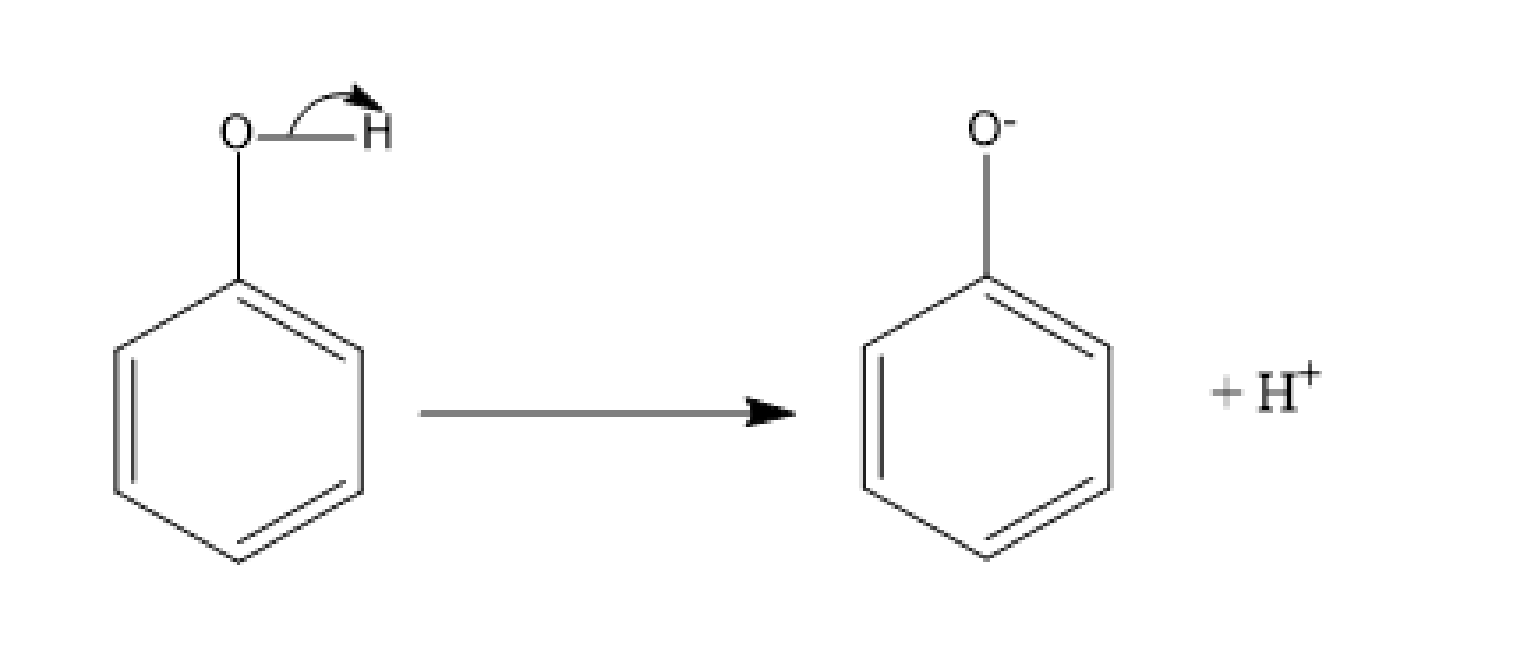
Fig: Deprotonation of phenoxide ion
In the next step, the electrophilic carbon of the ethyl chloride is attacked by the phenoxide ion and the iodine separates.
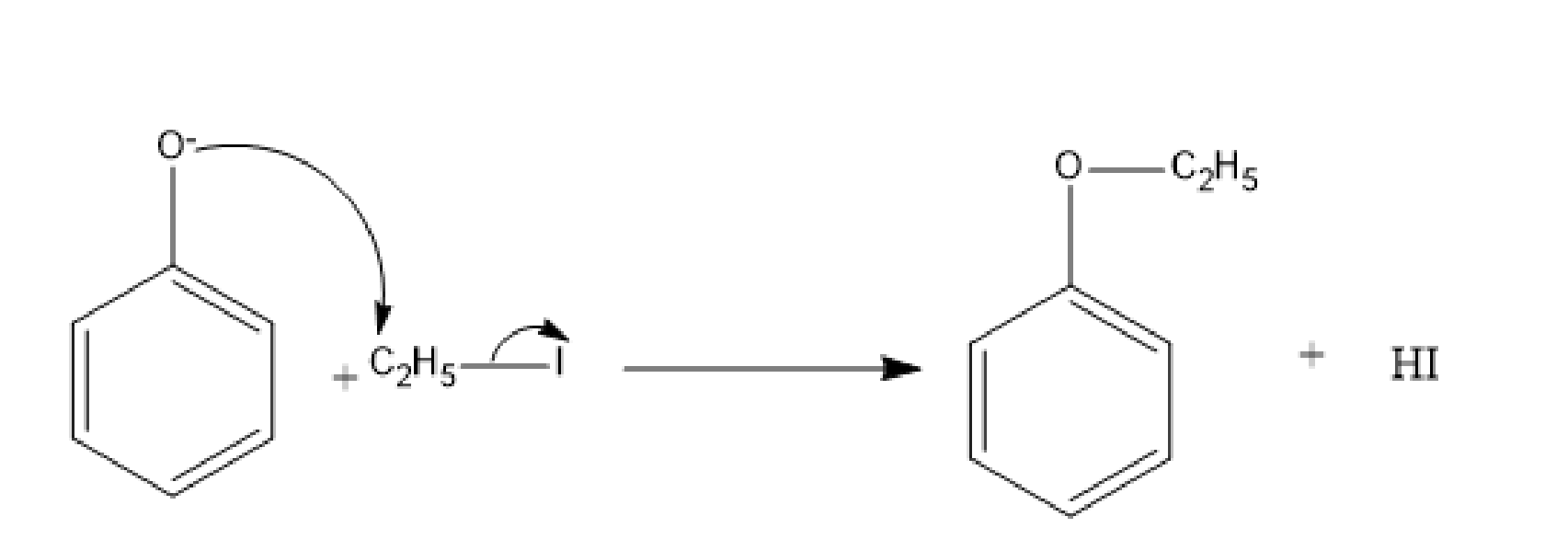
Fig: Nucleophilic attack of phenoxide ion
The product formed is \[{{\rm{C}}_{\rm{6}}}{{\rm{H}}_{\rm{5}}}{\rm{O}}{{\rm{C}}_{\rm{2}}}{{\rm{H}}_{\rm{5}}}\] and the hydrogen iodide separates as a by-product.
Therefore, option A is right.
Additional Information: Let's discuss some properties of ether. It is a liquid whose nature is volatile. It has no colour and a pleasant odour. The boiling of ether is comparable with alkanes but less than alcohols. The solubility of ether in water is because of the hydrogen bond formation by the oxygen of ether with the water molecules. But there is a decrease in solubility when the hydrocarbon chain increases.
Note: Ether is a very important compound in many industries. Its use in the manufacturing of hydrocarbons, gums, oil, dyes, resins, and paints is significant. They are also used in lubricating oils. The nature of ether is toxic.
Complete Step by Step Solution:
Let's first understand what a Williamson ether synthesis is. In this reaction, deprotonated alcohol undergoes a reaction with an alkyl halide to give ether as a product.
Here, also the reaction is a Williamson ether synthesis. The first step of the reaction is the deprotonation of phenol to form a phenoxide ion.
Fig: Deprotonation of phenoxide ion
In the next step, the electrophilic carbon of the ethyl chloride is attacked by the phenoxide ion and the iodine separates.
Fig: Nucleophilic attack of phenoxide ion
The product formed is \[{{\rm{C}}_{\rm{6}}}{{\rm{H}}_{\rm{5}}}{\rm{O}}{{\rm{C}}_{\rm{2}}}{{\rm{H}}_{\rm{5}}}\] and the hydrogen iodide separates as a by-product.
Therefore, option A is right.
Additional Information: Let's discuss some properties of ether. It is a liquid whose nature is volatile. It has no colour and a pleasant odour. The boiling of ether is comparable with alkanes but less than alcohols. The solubility of ether in water is because of the hydrogen bond formation by the oxygen of ether with the water molecules. But there is a decrease in solubility when the hydrocarbon chain increases.
Note: Ether is a very important compound in many industries. Its use in the manufacturing of hydrocarbons, gums, oil, dyes, resins, and paints is significant. They are also used in lubricating oils. The nature of ether is toxic.
Recently Updated Pages
JEE Main 2026 Session 2 Registration Open, Exam Dates, Syllabus & Eligibility

JEE Main 2023 April 6 Shift 1 Question Paper with Answer Key
JEE Main 2023 April 6 Shift 2 Question Paper with Answer Key
JEE Main 2023 (January 31 Evening Shift) Question Paper with Solutions [PDF]
JEE Main 2023 January 30 Shift 2 Question Paper with Answer Key
JEE Main 2023 January 25 Shift 1 Question Paper with Answer Key
Trending doubts
Understanding Average and RMS Value in Electrical Circuits
Ideal and Non-Ideal Solutions Explained for Class 12 Chemistry
Understanding Atomic Structure for Beginners
Understanding Elastic Collisions in Two Dimensions
AssertionIn electrolytic refining of metal impure metal class 12 chemistry JEE_Main
JEE Main Syllabus 2026: Download Detailed Subject-wise PDF
Other Pages
Alcohol Phenol and Ether Class 12 Chemistry Chapter 7 CBSE Notes - 2025-26
Haloalkanes and Haloarenes Class 12 Chemistry Chapter 6 CBSE Notes - 2025-26
NCERT Solutions For Class 12 Chemistry Chapter 2 Solutions Hindi Medium (2025-26)
CBSE Class 12 Chemistry Set 1 56/2/1 2025: Question Paper, Answers & Analysis
CBSE Class 12 Chemistry Question Paper Set 3 2025 with Answers
Understanding Collisions: Types and Examples for Students