




If ${w_1}$, ${w_2}$,${w_3}$,${w_4}$ are work done in isothermal, adiabatic, isobaric and isochoric reversible processes, then the correct sequence (for expansion) would be :
(A) ${w_1}$> ${w_2}$>${w_3}$>${w_4}$
(B) ${w_3}$> ${w_2}$>${w_1}$>${w_4}$
(C) ${w_3}$> ${w_2}$>${w_4}$>${w_1}$
(D) ${w_3}$>${w_1}$> ${w_2}$>${w_4}$
Answer
 Verified
282.6k+ views
Hint: The work done by any thermodynamic process can be given by the area enclosed by the P-V graph by that process. As in the case of isochoric, the volume remains constant. So, no change in volume and hence no work done. So, it will have the least value while in the case of isobaric, the value will be highest.
Complete step by step answer:
First, we will know about the different types of process. What is the difference between these and then we will be able to find out the answer to our question?
The first process is the isothermal process. This may be defined as the process in which thermal meaning temperature is constant. The word ‘iso’ means constant and the word thermal means ‘temperature’. In the isothermal process, the temperature of the system remains constant throughout.
The next process is the adiabatic process. In such a process, The heat and mass is not transformed between the thermodynamic system and its surroundings.
After this, the next process is the isobaric one. The term ‘baric’ is related to pressure. The isobaric process is the one in which the pressure remains constant throughout the process. There may be changes in volume or temperature but the pressure will remain constant.
The last process mentioned is the isochoric one. In this process, the volume of the system remains constant. The term choric stands for the volume.
In the question, it is mentioned that expansion is occurring.
Further, we have that ${w_1}$is the work done during an isothermal process
${w_2}$ is the work done during an adiabatic process
${w_3}$ is the work done during the isobaric process
${w_4}$ is the work done during an isochoric process.
We have the graph for the different processes as-
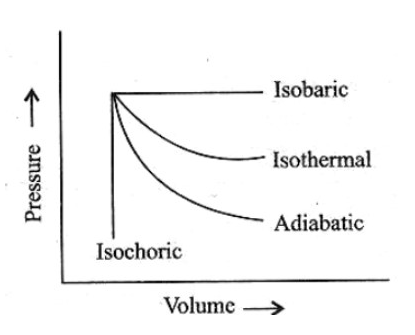
The area under this pressure-volume graph tells us about the work done in any system. If we observe this graph, we can see that
The area under isobaric expansion is the maximum. Thus, the highest work done will be by the isobaric expansion. So, the ${w_3}$will hold the greatest value.
After this, the next maximum area cover is by the isothermal process. So, after this, the ${w_1}$ will be there.
Then after this, comes the area enclosed by the adiabatic process and at last by the isochoric process.
So, the order of work done is as -
${w_3}$>${w_1}$> ${w_2}$>${w_4}$
Thus, the option (D) is the correct answer.
Note: It must be noted that the process is reversible. In any reversible process, the products may go back to the reactant side. The work done by a system is given by PdV. The Pressure-Volume graph is formed as a result of integrating the PdV equation which will give work done.
Complete step by step answer:
First, we will know about the different types of process. What is the difference between these and then we will be able to find out the answer to our question?
The first process is the isothermal process. This may be defined as the process in which thermal meaning temperature is constant. The word ‘iso’ means constant and the word thermal means ‘temperature’. In the isothermal process, the temperature of the system remains constant throughout.
The next process is the adiabatic process. In such a process, The heat and mass is not transformed between the thermodynamic system and its surroundings.
After this, the next process is the isobaric one. The term ‘baric’ is related to pressure. The isobaric process is the one in which the pressure remains constant throughout the process. There may be changes in volume or temperature but the pressure will remain constant.
The last process mentioned is the isochoric one. In this process, the volume of the system remains constant. The term choric stands for the volume.
In the question, it is mentioned that expansion is occurring.
Further, we have that ${w_1}$is the work done during an isothermal process
${w_2}$ is the work done during an adiabatic process
${w_3}$ is the work done during the isobaric process
${w_4}$ is the work done during an isochoric process.
We have the graph for the different processes as-
The area under this pressure-volume graph tells us about the work done in any system. If we observe this graph, we can see that
The area under isobaric expansion is the maximum. Thus, the highest work done will be by the isobaric expansion. So, the ${w_3}$will hold the greatest value.
After this, the next maximum area cover is by the isothermal process. So, after this, the ${w_1}$ will be there.
Then after this, comes the area enclosed by the adiabatic process and at last by the isochoric process.
So, the order of work done is as -
${w_3}$>${w_1}$> ${w_2}$>${w_4}$
Thus, the option (D) is the correct answer.
Note: It must be noted that the process is reversible. In any reversible process, the products may go back to the reactant side. The work done by a system is given by PdV. The Pressure-Volume graph is formed as a result of integrating the PdV equation which will give work done.
Recently Updated Pages
Disproportionation Reaction: Definition, Example & JEE Guide

JEE Main 2025-26 Mock Test: Binomial Theorem & Quick Practice
Properties of Solids and Liquids Mock Test 2025
JEE Main Mock Test 2025-26: Principles Related To Practical
JEE Main Mock Test 2025-26: Dual Nature of Matter & Radiation
JEE Main 2025-26 Work, Energy and Power Mock Test – Free Practice Online
Trending doubts
JEE Main 2026: Exam Dates, Session 2 Updates, City Slip, Admit Card & Latest News
Understanding the Electric Field of a Uniformly Charged Ring
Understanding Atomic Structure for Beginners
Derivation of Equation of Trajectory Explained for Students
Electron Gain Enthalpy and Electron Affinity Explained
How to Convert a Galvanometer into an Ammeter or Voltmeter
Other Pages
JEE Advanced Percentile vs Marks 2026: JEE Main Cutoff, AIR & IIT Admission Guide
JEE Advanced 2026 Notification Out with Exam Date, Registration (Extended), Syllabus and More
NCERT Solutions For Class 11 Chemistry In Hindi Chapter 1 Some Basic Concepts Of Chemistry - 2026-27
Understanding Electromagnetic Waves and Their Importance
JEE Advanced Weightage Chapter Wise 2026 for Physics, Chemistry, and Mathematics
Understanding Instantaneous Velocity