




Find the quadrants in which the following points lie
[i] (3,2)
[ii] (-2,1)
[iii] (-1,-3)
[iv] (5,-1)
Answer
 Verified
638.4k+ views
Hint: Plot these points on a graph paper and hence determine in which quadrant they lie.
Complete step-by-step answer:
Plotting point P(x,y) on a graph paper:
When plotting a point P(x,y), we move x units on x-axis and y units on the y-axis. If x is positive, then we move x units in the right direction. If x is negative, then we move on the x-axis in the left direction. If y is positive, then we move on the y-axis in the upwards direction. If y is negative, then we move on the y-axis in the downward direction. Finally, from these two positions we draw lines parallel to another axis, i.e. from a point on the x-axis we draw a line parallel to y-axis and from a point on y-axis, we draw a line parallel to the x-axis. The point at which these lines intersect gives the position of the point P(x,y) in the cartesian plane.
[i] Plotting (3,2):
We move 3 units on the x-axis in the rightward direction. From that position, we draw a line parallel to the y-axis.
We move 2 units on the y-axis in the upward direction. From that position, we draw a line parallel to the x-axis.
The lines intersect at point A.
The graph is shown below.
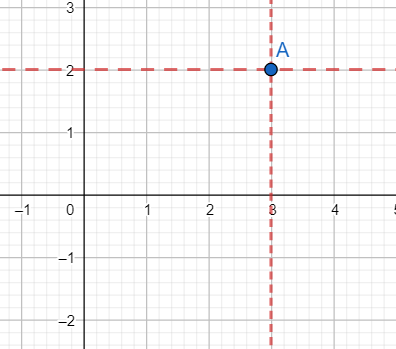
As is evident from the graph, A(3,2) lies in the first quadrant.
[ii] Plotting (-2,1):
We move 2 units on the x-axis in the leftward direction. From that position, we draw a line parallel to the y-axis.
We move 1 unit on the y-axis in the upward direction. From that position, we draw a line parallel to the x-axis.
The lines intersect at point A.
The graph is shown below.
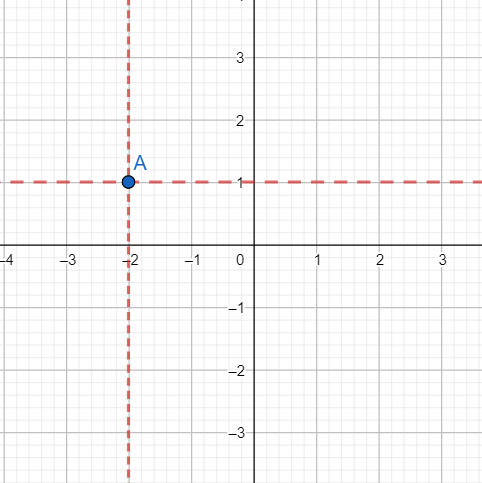
As is evident from the graph A(-2,1) lies in the second quadrant.
[iii] Plotting (-1,-3):
We move 1 unit on the x-axis in the leftward direction. From that position, we draw a line parallel to the y-axis.
We move 3 units on the y-axis in the downward direction. From that position, we draw a line parallel to the x-axis.
The lines intersect at point A.
The graph is shown below.
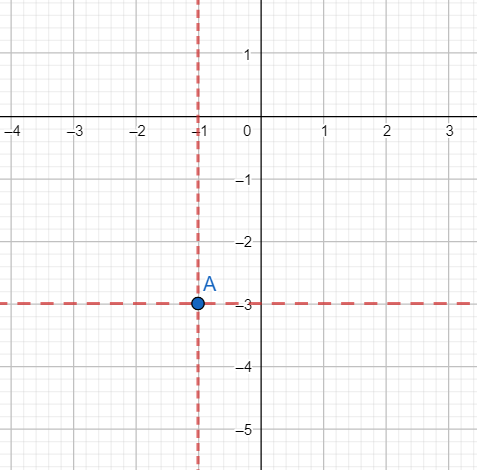
As is evident from the graph A(-1,-3) lies in the third quadrant.
[iv] Plotting (5,-1):
We move 5 units on the x-axis in the rightward direction. From that position, we draw a line parallel to the y-axis.
We move 1 unit on the y-axis in the downward direction. From that position, we draw a line parallel to the x-axis.
The lines intersect at point A.
The graph is shown below.
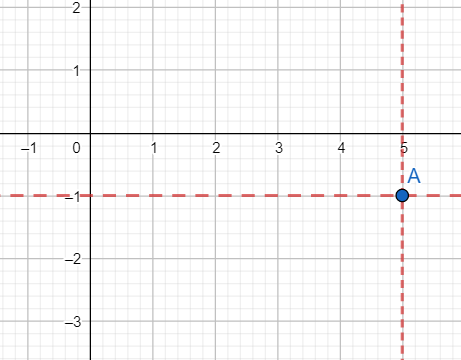
As is evident from the graph A(5,-1) lies in the fourth quadrant.
Note: Alternatively, we can find the quadrant by remembering the following rules:
If x and y both are positive, then (x,y) lies in the first quadrant.
If x is negative and y is positive, then (x,y) lies in the second quadrant.
If x and y both are negative, then (x,y) lies in the third quadrant.
If x is positive and y is negative, then (x,y) lies in the fourth quadrant.
Hence we can find the respective quadrants of each of the points above.
Complete step-by-step answer:
Plotting point P(x,y) on a graph paper:
When plotting a point P(x,y), we move x units on x-axis and y units on the y-axis. If x is positive, then we move x units in the right direction. If x is negative, then we move on the x-axis in the left direction. If y is positive, then we move on the y-axis in the upwards direction. If y is negative, then we move on the y-axis in the downward direction. Finally, from these two positions we draw lines parallel to another axis, i.e. from a point on the x-axis we draw a line parallel to y-axis and from a point on y-axis, we draw a line parallel to the x-axis. The point at which these lines intersect gives the position of the point P(x,y) in the cartesian plane.
[i] Plotting (3,2):
We move 3 units on the x-axis in the rightward direction. From that position, we draw a line parallel to the y-axis.
We move 2 units on the y-axis in the upward direction. From that position, we draw a line parallel to the x-axis.
The lines intersect at point A.
The graph is shown below.
As is evident from the graph, A(3,2) lies in the first quadrant.
[ii] Plotting (-2,1):
We move 2 units on the x-axis in the leftward direction. From that position, we draw a line parallel to the y-axis.
We move 1 unit on the y-axis in the upward direction. From that position, we draw a line parallel to the x-axis.
The lines intersect at point A.
The graph is shown below.
As is evident from the graph A(-2,1) lies in the second quadrant.
[iii] Plotting (-1,-3):
We move 1 unit on the x-axis in the leftward direction. From that position, we draw a line parallel to the y-axis.
We move 3 units on the y-axis in the downward direction. From that position, we draw a line parallel to the x-axis.
The lines intersect at point A.
The graph is shown below.
As is evident from the graph A(-1,-3) lies in the third quadrant.
[iv] Plotting (5,-1):
We move 5 units on the x-axis in the rightward direction. From that position, we draw a line parallel to the y-axis.
We move 1 unit on the y-axis in the downward direction. From that position, we draw a line parallel to the x-axis.
The lines intersect at point A.
The graph is shown below.
As is evident from the graph A(5,-1) lies in the fourth quadrant.
Note: Alternatively, we can find the quadrant by remembering the following rules:
If x and y both are positive, then (x,y) lies in the first quadrant.
If x is negative and y is positive, then (x,y) lies in the second quadrant.
If x and y both are negative, then (x,y) lies in the third quadrant.
If x is positive and y is negative, then (x,y) lies in the fourth quadrant.
Hence we can find the respective quadrants of each of the points above.
Recently Updated Pages
Master Class 12 Business Studies: Engaging Questions & Answers for Success

Master Class 12 Biology: Engaging Questions & Answers for Success
Master Class 12 Chemistry: Engaging Questions & Answers for Success
Class 12 Question and Answer - Your Ultimate Solutions Guide
Master Class 11 Social Science: Engaging Questions & Answers for Success
Master Class 11 English: Engaging Questions & Answers for Success
Trending doubts
Which is more stable and why class 12 chemistry CBSE
Which are the Top 10 Largest Countries of the World?
Draw a labelled sketch of the human eye class 12 physics CBSE
Differentiate between homogeneous and heterogeneous class 12 chemistry CBSE
What are the major means of transport Explain each class 12 social science CBSE
Sulphuric acid is known as the king of acids State class 12 chemistry CBSE