




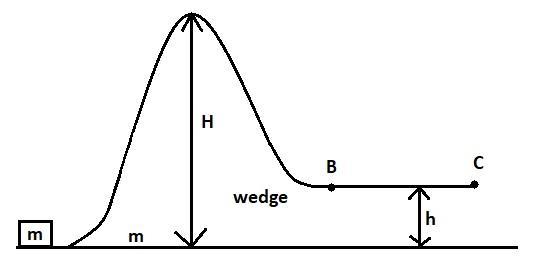
Figure shows an irregular wedge of mass $m$ placed on a smooth horizontal surface. Horizontal part $BC$ is rough. The other part of the wedge is smooth. What minimum velocity should be imparted to a small block of same mass $m$ so that it may reach point $B$ .
A) $2\sqrt {gH} $
B) $\sqrt {2gH} $
C) $2\sqrt {g\left( {H - h} \right)} $
D) $\sqrt {gH} $
Answer
 Verified
233.1k+ views
Hint: For this we use the law of conservation of momentum which is momentum before and after collision is always conserved. And also use the equation of conservation of energy that energy is conserved before and after collision.
Complete step by step solution:
As we have a block of mass m move with initial velocity $\vec u$ and wedge with same mass m and initial velocity $\vec v$ .
Now according to the law of conservation of momentum: For a collision occurring between object 1 and object 2 in an isolated system, the total momentum of the two objects before the collision is equal to the total momentum of the two objects after the collision.
Therefore, $mu = \left( {m + m} \right)v$
Because after collision both the objects are combined so add their mass and they move with the same mass that is $m$ .
$ \Rightarrow mu = 2mv$
After calculating for $v$
$\therefore v = \dfrac{u}{2}$
After that we have an energy equation According to this total energy means potential and kinetic energy is equal before and after collision.
$\dfrac{1}{2}m{u^2} = mgH + \dfrac{1}{2}m{v^2} + \dfrac{1}{2}m{v^2}$
Because in starting only kinetic energy of block is in act whose velocity is $u$ and after that potential energy as well as kinetic energy of block and wedge is in act with common velocity $v$ .
$\dfrac{1}{2}m{u^2} = mgh + \dfrac{1}{2}m{\left( {\dfrac{u}{2}} \right)^2} + \dfrac{1}{2}m{\left( {\dfrac{u}{2}} \right)^2}$ (Insert value of $v$)
$\dfrac{1}{2}m{u^2} = mgh + \dfrac{1}{4}m{u^2}$
Now, like terms should be on same side
$\dfrac{1}{2}m{u^2} - \dfrac{1}{4}m{u^2} = mgh$
After subtraction
$ \Rightarrow \dfrac{1}{4}m{u^2} = mgh$
By cancelling $m$ we have velocity which is equal to
${u^2} = 4gh$
$\therefore u = 2\sqrt {gh} $
So, Option (A) is correct.
Note: Always remember about kinetic energy and potential energy which one is come into action. Otherwise the answer will be wrong and also in momentum conservation law remember that $2\sqrt {gh} $ both objects combined and move with the same velocity.
Complete step by step solution:
As we have a block of mass m move with initial velocity $\vec u$ and wedge with same mass m and initial velocity $\vec v$ .
Now according to the law of conservation of momentum: For a collision occurring between object 1 and object 2 in an isolated system, the total momentum of the two objects before the collision is equal to the total momentum of the two objects after the collision.
Therefore, $mu = \left( {m + m} \right)v$
Because after collision both the objects are combined so add their mass and they move with the same mass that is $m$ .
$ \Rightarrow mu = 2mv$
After calculating for $v$
$\therefore v = \dfrac{u}{2}$
After that we have an energy equation According to this total energy means potential and kinetic energy is equal before and after collision.
$\dfrac{1}{2}m{u^2} = mgH + \dfrac{1}{2}m{v^2} + \dfrac{1}{2}m{v^2}$
Because in starting only kinetic energy of block is in act whose velocity is $u$ and after that potential energy as well as kinetic energy of block and wedge is in act with common velocity $v$ .
$\dfrac{1}{2}m{u^2} = mgh + \dfrac{1}{2}m{\left( {\dfrac{u}{2}} \right)^2} + \dfrac{1}{2}m{\left( {\dfrac{u}{2}} \right)^2}$ (Insert value of $v$)
$\dfrac{1}{2}m{u^2} = mgh + \dfrac{1}{4}m{u^2}$
Now, like terms should be on same side
$\dfrac{1}{2}m{u^2} - \dfrac{1}{4}m{u^2} = mgh$
After subtraction
$ \Rightarrow \dfrac{1}{4}m{u^2} = mgh$
By cancelling $m$ we have velocity which is equal to
${u^2} = 4gh$
$\therefore u = 2\sqrt {gh} $
So, Option (A) is correct.
Note: Always remember about kinetic energy and potential energy which one is come into action. Otherwise the answer will be wrong and also in momentum conservation law remember that $2\sqrt {gh} $ both objects combined and move with the same velocity.
Recently Updated Pages
JEE Main 2023 April 6 Shift 1 Question Paper with Answer Key

JEE Main 2023 April 6 Shift 2 Question Paper with Answer Key
JEE Main 2023 (January 31 Evening Shift) Question Paper with Solutions [PDF]
JEE Main 2023 January 30 Shift 2 Question Paper with Answer Key
JEE Main 2023 January 25 Shift 1 Question Paper with Answer Key
JEE Main 2023 January 24 Shift 2 Question Paper with Answer Key
Trending doubts
JEE Main 2026: Session 2 Registration Open, City Intimation Slip, Exam Dates, Syllabus & Eligibility
JEE Main 2026 Application Login: Direct Link, Registration, Form Fill, and Steps
JEE Main Marking Scheme 2026- Paper-Wise Marks Distribution and Negative Marking Details
Understanding the Angle of Deviation in a Prism
Hybridisation in Chemistry – Concept, Types & Applications
How to Convert a Galvanometer into an Ammeter or Voltmeter
Other Pages
JEE Advanced Marks vs Ranks 2025: Understanding Category-wise Qualifying Marks and Previous Year Cut-offs
Laws of Motion Class 11 Physics Chapter 4 CBSE Notes - 2025-26
Waves Class 11 Physics Chapter 14 CBSE Notes - 2025-26
Mechanical Properties of Fluids Class 11 Physics Chapter 9 CBSE Notes - 2025-26
Thermodynamics Class 11 Physics Chapter 11 CBSE Notes - 2025-26
Units And Measurements Class 11 Physics Chapter 1 CBSE Notes - 2025-26