




Explain the construction and working of a Geiger-Muller counter.
Answer
 Verified
306.9k+ views
Hint A Geiger-Muller counter is a device used for the detection and measurement of ionizing radiation. It is mainly used for applications like the nuclear industry, radiological protection, radiation dosimetry, and experimental physics. It is one of the best devices for the detection of radiation, in the world.
Step by step solution
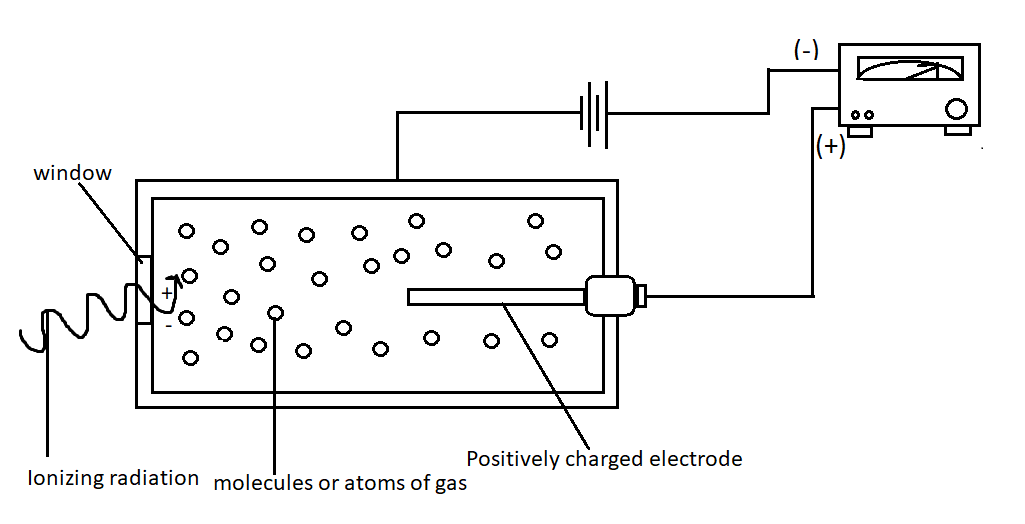
Construction:
The GM counter consists of a hollow metallic chamber as shown in the figure that acts as a cathode.
A thin wire anode is also placed along its axis.
The chamber has a sealed window, through which the radiation enters the chamber.
The chamber is filled with an inert gas at low pressure.
There is a counter connected to this system to measure the radiation.
Working
The chamber is filled with an inert gas (helium, neon, or argon) at low pressure. A high voltage is applied to this chamber. The metallic chamber will conduct electricity. When radiation enters the chamber through the window, the photons in the radiation will ionize the inert gas inside the chamber. This will make the gas conductive. The electrons produced due to ionization are accelerated due to the potential that we applied and these electrons cause even more ionization. The ionized electrons travel towards the anode. The anode is connected to a counter. The counter counts the electrons reaching the anode. This is how we measure radiation.
NoteThe major limitation of the Geiger Muller counter is that it does not have the ability to differentiate different types of radiations. Another major limitation is that it cannot measure high radiation rates. This is because, after each ionization, there will be a 'dead time’. This is an insensitive time during which further incident radiation does not count.
Step by step solution
Construction:
The GM counter consists of a hollow metallic chamber as shown in the figure that acts as a cathode.
A thin wire anode is also placed along its axis.
The chamber has a sealed window, through which the radiation enters the chamber.
The chamber is filled with an inert gas at low pressure.
There is a counter connected to this system to measure the radiation.
Working
The chamber is filled with an inert gas (helium, neon, or argon) at low pressure. A high voltage is applied to this chamber. The metallic chamber will conduct electricity. When radiation enters the chamber through the window, the photons in the radiation will ionize the inert gas inside the chamber. This will make the gas conductive. The electrons produced due to ionization are accelerated due to the potential that we applied and these electrons cause even more ionization. The ionized electrons travel towards the anode. The anode is connected to a counter. The counter counts the electrons reaching the anode. This is how we measure radiation.
NoteThe major limitation of the Geiger Muller counter is that it does not have the ability to differentiate different types of radiations. Another major limitation is that it cannot measure high radiation rates. This is because, after each ionization, there will be a 'dead time’. This is an insensitive time during which further incident radiation does not count.
Recently Updated Pages
If the magnetizing field on a ferromagnetic material class 12 physics JEE_Main

A point charge is placed at the corner of a cube The class 12 physics JEE_Main
What changes occur if the monochromatic light used class 12 physics JEE_Main
The unit of specific conductance is A Ohm B Ohmmetre class 12 physics JEE_Main
Which lens is used in magnifying glass A Concave lens class 12 physics JEE_Main
Sir C V Raman won the Nobel Prize in which year A 1928 class 12 physics JEE_Main
Trending doubts
JEE Main 2026: Exam Dates, Session 2 Updates, City Slip, Admit Card & Latest News
Understanding the Electric Field of a Uniformly Charged Ring
Derivation of Equation of Trajectory Explained for Students
Understanding Atomic Structure for Beginners
How to Convert a Galvanometer into an Ammeter or Voltmeter
Hybridisation in Chemistry – Concept, Types & Applications
Other Pages
CBSE Class 12 Physics Question Paper 2026: Download SET-wise PDF with Answer Key & Analysis
JEE Advanced Percentile vs Marks 2026: JEE Main Cutoff, AIR & IIT Admission Guide
Class 12 Physics Formulas: Complete Chapter-wise PDF Guide
What Are Elastic Collisions in One Dimension?
Isoelectronic Species: Definition, Examples & Importance
Understanding Uniform Acceleration in Physics