



What changes occur if the monochromatic light used in Young’s double-slit experiment is replaced by white light?
\[\left( A \right)\]Only the central fringe is white and all other fringes are observed colored.
\[\left( B \right)\]No fringes are observed.
\[\left( C \right)\]All the bright fringe becomes white.
\[\left( D \right)\]All the bright fringes are colored between violet and red.
Answer
 Verified
602k+ views
Hint: To answer this question we should know Young’s double-slit experiment. Don’t worry if you don’t know about this. We will let you know through this question and will explain the reason behind the central fringe which becomes white.
Answer White light consists of waves of innumerable wavelengths ranging from violet to red color. So if monochromatic light in Young’s double-slit experiment is replaced by white light, then the waves of every wavelength form their separate interference patterns.
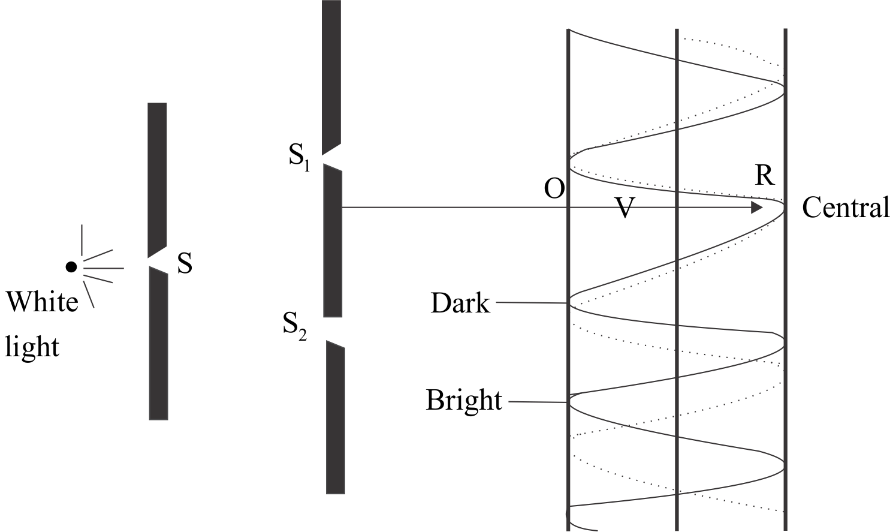
The resultant impact of these patterns is obtained on the screen. The path distinction between waves ranging from \[{S_1}\]and \[{S_2}\]at the location \[R\] of the central fringe is zero that is for the point \[R\] of the screen so the path difference will be zero.
Hence the waves of all colors reach a middle point \[R\] in the same phase. So the central fringe is white. As the fringe dimension that is the wavelength will increase so as colors denoted by VIBGYOR so on either aspect of it some colored fringes are obtained in the order of color VIBGYOR. That's the violet fringe seems first and therefore, the red in the last. When this the fringes of many colors overlap at every purpose of the screen then the screen seems uniformly illuminated. Thus, if we tend to use white light in place of monochromatic light the central fringe is white, containing on either aspect several colored fringes in order VIBGYOR and therefore, the remaining screen seems uniformly illuminated.
Therefore the \[Option{\text{ A}}\]will be the right choice as only the central fringe is white and all other fringes are observed colored.
Notes: Young’s double-slit experiment uses two coherent sources of light placed at a little distance apart, usually, solely orders of magnitude bigger than the wavelength of light is used. Young’s double-slit experiment helped in understanding the wave theory of light.
Answer White light consists of waves of innumerable wavelengths ranging from violet to red color. So if monochromatic light in Young’s double-slit experiment is replaced by white light, then the waves of every wavelength form their separate interference patterns.
The resultant impact of these patterns is obtained on the screen. The path distinction between waves ranging from \[{S_1}\]and \[{S_2}\]at the location \[R\] of the central fringe is zero that is for the point \[R\] of the screen so the path difference will be zero.
Hence the waves of all colors reach a middle point \[R\] in the same phase. So the central fringe is white. As the fringe dimension that is the wavelength will increase so as colors denoted by VIBGYOR so on either aspect of it some colored fringes are obtained in the order of color VIBGYOR. That's the violet fringe seems first and therefore, the red in the last. When this the fringes of many colors overlap at every purpose of the screen then the screen seems uniformly illuminated. Thus, if we tend to use white light in place of monochromatic light the central fringe is white, containing on either aspect several colored fringes in order VIBGYOR and therefore, the remaining screen seems uniformly illuminated.
Therefore the \[Option{\text{ A}}\]will be the right choice as only the central fringe is white and all other fringes are observed colored.
Notes: Young’s double-slit experiment uses two coherent sources of light placed at a little distance apart, usually, solely orders of magnitude bigger than the wavelength of light is used. Young’s double-slit experiment helped in understanding the wave theory of light.
Recently Updated Pages
If the magnetizing field on a ferromagnetic material class 12 physics JEE_Main

A point charge is placed at the corner of a cube The class 12 physics JEE_Main
What changes occur if the monochromatic light used class 12 physics JEE_Main
The unit of specific conductance is A Ohm B Ohmmetre class 12 physics JEE_Main
Which lens is used in magnifying glass A Concave lens class 12 physics JEE_Main
Sir C V Raman won the Nobel Prize in which year A 1928 class 12 physics JEE_Main
Trending doubts
JEE Main 2026: Exam Dates, Session 2 Updates, City Slip, Admit Card & Latest News
Understanding the Electric Field of a Uniformly Charged Ring
Derivation of Equation of Trajectory Explained for Students
Understanding Atomic Structure for Beginners
How to Convert a Galvanometer into an Ammeter or Voltmeter
Hybridisation in Chemistry – Concept, Types & Applications
Other Pages
CBSE Class 12 Physics Question Paper 2026: Download SET-wise PDF with Answer Key & Analysis
JEE Advanced Percentile vs Marks 2026: JEE Main Cutoff, AIR & IIT Admission Guide
Class 12 Physics Formulas: Complete Chapter-wise PDF Guide
What Are Elastic Collisions in One Dimension?
Isoelectronic Species: Definition, Examples & Importance
Understanding Uniform Acceleration in Physics