




Can Sodium borohydride (NaBH4) reduce imine?
Answer
 Verified
233.1k+ views
Hint: Sodium borohydride is a good reducing agent. It can reduce aldehydes and ketones into primary alcohols and secondary alcohols respectively.
Complete Step by Step Solution:
When ammonia is treated with aldehydes or ketones, the ammonia group gets added to the carbonyl group of aldehydes or ketones.
This is a reversible reaction and acid is used as a catalyst.
The product formed is called imine.
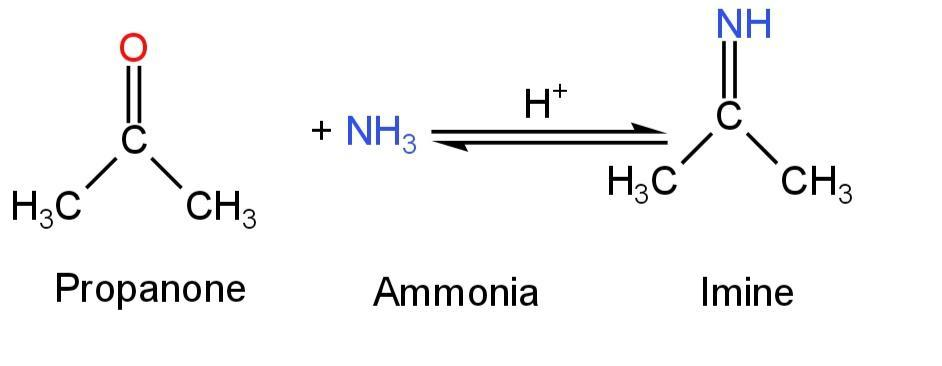
Image: Reaction of propanone with ammonia
Sodium borohydride is a good reducing agent that can reduce imines into secondary amines.
This reaction happens in the presence of alumina.
Here polar metal-hydrogen bond furnishes the hydride anion.
The mechanism of the reaction is of two steps.
Step-1
Nucleophilic attack by the hydride anion.
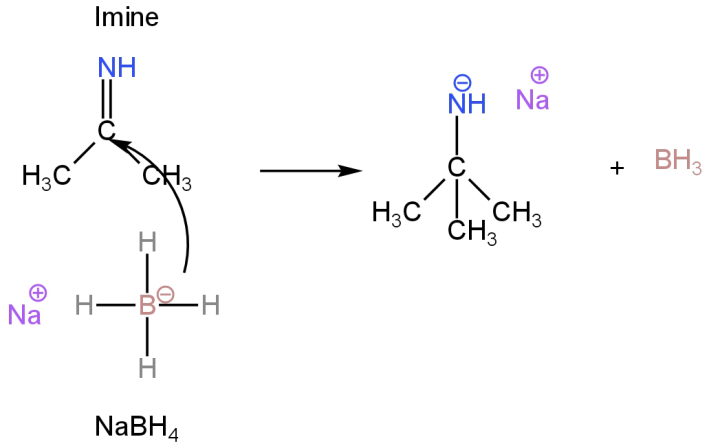
Image: Attack of the nucleophile
Step-2
Protonation leads to the formation of a secondary amine.
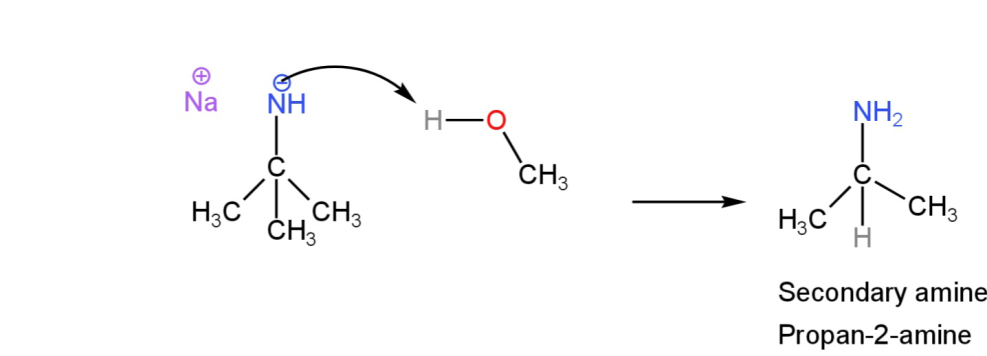
Image: Protonation in the presence of methanol.
Additional Information: Sodium borohydride is a lesser reducing agent than Lithium aluminium hydride. It can reduce aldehydes to primary alcohol and ketones, and acid chlorides to secondary alcohols. It cannot reduce esters, amides, acids, nitriles etc.
Note: Sodium borohydride is an inorganic compound and is a good reducing agent due to the existence of a polar metal-hydrogen bond. The hydrogen atom in the compound acts as a hydride and adds to the carbonyl carbon. The extremely familiar reducing agents in organic chemistry are lithium aluminium hydride and sodium borohydride. It is to be noted that the hydride anion does not directly exist during this reaction, rather a metal-hydrogen bond provides the hydride anion. This anion then acts as a nucleophile.
Complete Step by Step Solution:
When ammonia is treated with aldehydes or ketones, the ammonia group gets added to the carbonyl group of aldehydes or ketones.
This is a reversible reaction and acid is used as a catalyst.
The product formed is called imine.
Image: Reaction of propanone with ammonia
Sodium borohydride is a good reducing agent that can reduce imines into secondary amines.
This reaction happens in the presence of alumina.
Here polar metal-hydrogen bond furnishes the hydride anion.
The mechanism of the reaction is of two steps.
Step-1
Nucleophilic attack by the hydride anion.
Image: Attack of the nucleophile
Step-2
Protonation leads to the formation of a secondary amine.
Image: Protonation in the presence of methanol.
Additional Information: Sodium borohydride is a lesser reducing agent than Lithium aluminium hydride. It can reduce aldehydes to primary alcohol and ketones, and acid chlorides to secondary alcohols. It cannot reduce esters, amides, acids, nitriles etc.
Note: Sodium borohydride is an inorganic compound and is a good reducing agent due to the existence of a polar metal-hydrogen bond. The hydrogen atom in the compound acts as a hydride and adds to the carbonyl carbon. The extremely familiar reducing agents in organic chemistry are lithium aluminium hydride and sodium borohydride. It is to be noted that the hydride anion does not directly exist during this reaction, rather a metal-hydrogen bond provides the hydride anion. This anion then acts as a nucleophile.
Recently Updated Pages
JEE Main 2023 April 6 Shift 1 Question Paper with Answer Key

JEE Main 2023 April 6 Shift 2 Question Paper with Answer Key
JEE Main 2023 (January 31 Evening Shift) Question Paper with Solutions [PDF]
JEE Main 2023 January 30 Shift 2 Question Paper with Answer Key
JEE Main 2023 January 25 Shift 1 Question Paper with Answer Key
JEE Main 2023 January 24 Shift 2 Question Paper with Answer Key
Trending doubts
JEE Main 2026: Session 2 Registration Open, City Intimation Slip, Exam Dates, Syllabus & Eligibility
JEE Main 2026 Application Login: Direct Link, Registration, Form Fill, and Steps
Understanding the Angle of Deviation in a Prism
Hybridisation in Chemistry – Concept, Types & Applications
How to Convert a Galvanometer into an Ammeter or Voltmeter
Understanding the Electric Field of a Uniformly Charged Ring
Other Pages
JEE Advanced Marks vs Ranks 2025: Understanding Category-wise Qualifying Marks and Previous Year Cut-offs
Hydrocarbons Class 11 Chemistry Chapter 9 CBSE Notes - 2025-26
Thermodynamics Class 11 Chemistry Chapter 5 CBSE Notes - 2025-26
Equilibrium Class 11 Chemistry Chapter 6 CBSE Notes - 2025-26
Organic Chemistry Some Basic Principles And Techniques Class 11 Chemistry Chapter 8 CBSE Notes - 2025-26
NCERT Solutions For Class 11 Chemistry Chapter 7 Redox Reactions (2025-26)