




An ideal gas is taken through a process ABCA, as shown in the diagram below. What is the work done in the cycle?
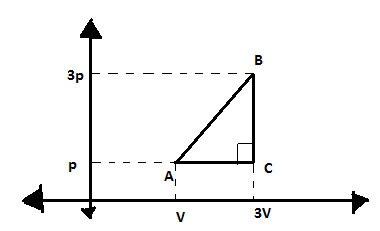
A) $2pV$
B) $pV$
C) $\dfrac{1}{2}pV$
D) zero.
Answer
 Verified
233.1k+ views
Hint: The work done during a thermodynamic process is known as the thermodynamic work for that system. If the process is depicted on a P-V plane the area under the curve representing the process will be the thermodynamic work for that process.
Complete step by step solution:
For any thermodynamic process if there occurs a change in volume then work is done. Thermodynamic work is the product of constant pressure and the change in volume in an isobaric (constant pressure) process. But for any other process where the volume and pressure change with respect to each other the thermodynamic work done in such a process is equal to the integral of pressure as a function of volume. Mathematically we can write the thermodynamic work done as;
\[W = \int\limits_{{V_1}}^{{V_2}} {P(V)dV} \]
Here, the pressure is a function of volume.
The above equation shows the integral of $PdV$ which means it is the area under the curve.
So we conclude that the thermodynamic work is actually the area of a curve on the P-V plane.
What is a cyclic process?
A cyclic process is a thermodynamic process which has the same initial state and final state. The cyclic process undergoes a process in one direction and then another process comes back to its initial state. On the P-V plane a cyclic process is depicted by a closed figure. Also the area of the closed figure is the thermodynamic work done.
So in this question the process is cyclic. So, the area of the triangle ABC will give us thermodynamic work.
So let us see the coordinates of point A are: $(V,p)$
The coordinates of point B are: $(3V,3p)$
The coordinates of point C are: $(3V,p)$
Thus length of side AC is given by;
$AC = \sqrt {{{(3V - V)}^2} + {{(p - p)}^2}} = 2V$
And length of side BC is given by;
$BC = \sqrt {{{(3V - 3V)}^2} + {{(3p - p)}^2}} = 2p$
Thus the area of the triangle is given by;
$A = \dfrac{1}{2}AC \times BC$
$ \Rightarrow A = \dfrac{1}{2} \times 2V \times 2p$
$\therefore A = 2pV$
Thus the work done in the cyclic process is the area so $2pV$ work is done.
Therefore option A is correct.
Note:You solve the question by integrating all the curves and the finding the equivalent integral of the three integrals.
In other words the region below the triangle will be counted twice so we have to subtract it from the total sum of integrals.
Complete step by step solution:
For any thermodynamic process if there occurs a change in volume then work is done. Thermodynamic work is the product of constant pressure and the change in volume in an isobaric (constant pressure) process. But for any other process where the volume and pressure change with respect to each other the thermodynamic work done in such a process is equal to the integral of pressure as a function of volume. Mathematically we can write the thermodynamic work done as;
\[W = \int\limits_{{V_1}}^{{V_2}} {P(V)dV} \]
Here, the pressure is a function of volume.
The above equation shows the integral of $PdV$ which means it is the area under the curve.
So we conclude that the thermodynamic work is actually the area of a curve on the P-V plane.
What is a cyclic process?
A cyclic process is a thermodynamic process which has the same initial state and final state. The cyclic process undergoes a process in one direction and then another process comes back to its initial state. On the P-V plane a cyclic process is depicted by a closed figure. Also the area of the closed figure is the thermodynamic work done.
So in this question the process is cyclic. So, the area of the triangle ABC will give us thermodynamic work.
So let us see the coordinates of point A are: $(V,p)$
The coordinates of point B are: $(3V,3p)$
The coordinates of point C are: $(3V,p)$
Thus length of side AC is given by;
$AC = \sqrt {{{(3V - V)}^2} + {{(p - p)}^2}} = 2V$
And length of side BC is given by;
$BC = \sqrt {{{(3V - 3V)}^2} + {{(3p - p)}^2}} = 2p$
Thus the area of the triangle is given by;
$A = \dfrac{1}{2}AC \times BC$
$ \Rightarrow A = \dfrac{1}{2} \times 2V \times 2p$
$\therefore A = 2pV$
Thus the work done in the cyclic process is the area so $2pV$ work is done.
Therefore option A is correct.
Note:You solve the question by integrating all the curves and the finding the equivalent integral of the three integrals.
In other words the region below the triangle will be counted twice so we have to subtract it from the total sum of integrals.
Recently Updated Pages
JEE Main 2023 April 6 Shift 1 Question Paper with Answer Key

JEE Main 2023 April 6 Shift 2 Question Paper with Answer Key
JEE Main 2023 (January 31 Evening Shift) Question Paper with Solutions [PDF]
JEE Main 2023 January 30 Shift 2 Question Paper with Answer Key
JEE Main 2023 January 25 Shift 1 Question Paper with Answer Key
JEE Main 2023 January 24 Shift 2 Question Paper with Answer Key
Trending doubts
JEE Main 2026: Session 2 Registration Open, City Intimation Slip, Exam Dates, Syllabus & Eligibility
JEE Main 2026 Application Login: Direct Link, Registration, Form Fill, and Steps
Understanding the Angle of Deviation in a Prism
Hybridisation in Chemistry – Concept, Types & Applications
How to Convert a Galvanometer into an Ammeter or Voltmeter
Understanding Uniform Acceleration in Physics
Other Pages
JEE Advanced Marks vs Ranks 2025: Understanding Category-wise Qualifying Marks and Previous Year Cut-offs
Laws of Motion Class 11 Physics Chapter 4 CBSE Notes - 2025-26
Waves Class 11 Physics Chapter 14 CBSE Notes - 2025-26
Mechanical Properties of Fluids Class 11 Physics Chapter 9 CBSE Notes - 2025-26
Thermodynamics Class 11 Physics Chapter 11 CBSE Notes - 2025-26
Units And Measurements Class 11 Physics Chapter 1 CBSE Notes - 2025-26