




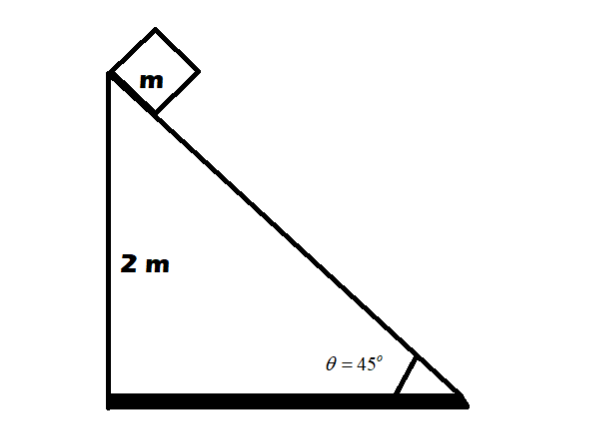
A wedge of mass $2m$ and a cube of mass m are shown in figure. Between the cube and wedge, there is no friction. The minimum coefficient of friction between wedge and ground so that wedge does not move is
(A) $0.10$
(B) $0.20$
(C) $0.25$
(D) $0.50$
Answer
 Verified
233.4k+ views
Hint In these kinds of situations the first thing important is to notice the given problem statement. We can observe that this is a question for the straight approach. In this question we will have to simplify the equation to obtain all the known quantities for the final equation.
Complete step by step answer:
Here, first we have to sort out the given quantities:
Mass of the wedge: $2m$
Mass of the cube:$1m$
And the angle between surface and slope: $\theta = {45^o}$
Now, the equation balancing the forces:
$
\lambda \sin \theta = Fr \\
\lambda \sin \theta = \mu (2mg + mg{\cos ^2}\theta ) \\
mg\sin \theta \cos \theta = \mu (2mg + mg{\cos ^2}\theta ) \\
$
So, after interpreting the final equation with all know quantities we just have to put the values:
$
\dfrac{1}{2} = \mu (2 + \dfrac{1}{2}) \\
\mu = \dfrac{1}{5} \\
$
Note Most important thing here is to notice the given values, then we can easily interpret the equations. In these types of questions using the correct method is necessary unless it will get twisted.
Complete step by step answer:
Here, first we have to sort out the given quantities:
Mass of the wedge: $2m$
Mass of the cube:$1m$
And the angle between surface and slope: $\theta = {45^o}$
Now, the equation balancing the forces:
$
\lambda \sin \theta = Fr \\
\lambda \sin \theta = \mu (2mg + mg{\cos ^2}\theta ) \\
mg\sin \theta \cos \theta = \mu (2mg + mg{\cos ^2}\theta ) \\
$
So, after interpreting the final equation with all know quantities we just have to put the values:
$
\dfrac{1}{2} = \mu (2 + \dfrac{1}{2}) \\
\mu = \dfrac{1}{5} \\
$
Note Most important thing here is to notice the given values, then we can easily interpret the equations. In these types of questions using the correct method is necessary unless it will get twisted.
Recently Updated Pages
JEE Main 2023 April 6 Shift 1 Question Paper with Answer Key

JEE Main 2023 April 6 Shift 2 Question Paper with Answer Key
JEE Main 2023 (January 31 Evening Shift) Question Paper with Solutions [PDF]
JEE Main 2023 January 30 Shift 2 Question Paper with Answer Key
JEE Main 2023 January 25 Shift 1 Question Paper with Answer Key
JEE Main 2023 January 24 Shift 2 Question Paper with Answer Key
Trending doubts
JEE Main 2026: Session 2 Registration Open, City Intimation Slip, Exam Dates, Syllabus & Eligibility
JEE Main 2026 Application Login: Direct Link, Registration, Form Fill, and Steps
JEE Main Marking Scheme 2026- Paper-Wise Marks Distribution and Negative Marking Details
Understanding the Angle of Deviation in a Prism
Hybridisation in Chemistry – Concept, Types & Applications
How to Convert a Galvanometer into an Ammeter or Voltmeter
Other Pages
JEE Advanced Marks vs Ranks 2025: Understanding Category-wise Qualifying Marks and Previous Year Cut-offs
Laws of Motion Class 11 Physics Chapter 4 CBSE Notes - 2025-26
Waves Class 11 Physics Chapter 14 CBSE Notes - 2025-26
Mechanical Properties of Fluids Class 11 Physics Chapter 9 CBSE Notes - 2025-26
Thermodynamics Class 11 Physics Chapter 11 CBSE Notes - 2025-26
Units And Measurements Class 11 Physics Chapter 1 CBSE Notes - 2025-26