




A velocity-time graph of freely falling body is:
A) A straight line with positive slope to the time axis.
B) A straight line with negative slope to the time axis.
C) A straight line parallel to the time axis.
D) A straight line parallel to the acceleration axis.
Answer
 Verified
233.1k+ views
Hint: When we drop a body it will be in free fall motion under gravity. In this motion, a constant acceleration is applied on the body due to Earth’s gravitational force. This acceleration is known as acceleration due to gravity.
Complete step by step answer:
A body can be said to be in free fall when it is dropped from a certain height and is allowed to fall under the effect of gravity. The moment a body is dropped, a force of gravity due to Earth pulls it towards its centre.
We know from Newton's laws that whenever a body is acted upon by a force, there must be a certain value of acceleration with the body. This acceleration in case of gravitation is known to be acceleration due to gravity.
A constant acceleration means that there must be a constant increase in the value of velocity of the object with respect to the time period.
If we plot a velocity-time graph of a body in free fall, due to a constant acceleration on the body, a straight line with positive slope to the time axis would be observed. The slope will be positive as there is a constant acceleration with time.
This can be shown in the given below diagram.
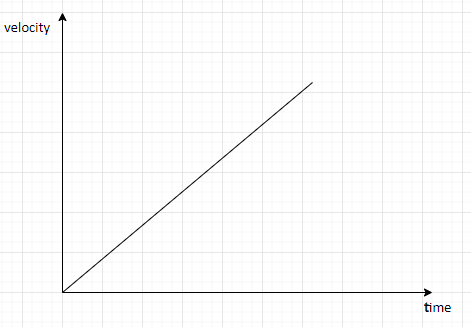
Thus, from the given options, option A is the correct option.
Note: Remember that a constant acceleration acts on the free falling body. The acceleration on the body is constant; this doesn’t mean that the graph will be a straight line parallel to the time axis. A constant acceleration means increase in velocity. Thus, option A and C shouldn’t be confused.
Complete step by step answer:
A body can be said to be in free fall when it is dropped from a certain height and is allowed to fall under the effect of gravity. The moment a body is dropped, a force of gravity due to Earth pulls it towards its centre.
We know from Newton's laws that whenever a body is acted upon by a force, there must be a certain value of acceleration with the body. This acceleration in case of gravitation is known to be acceleration due to gravity.
A constant acceleration means that there must be a constant increase in the value of velocity of the object with respect to the time period.
If we plot a velocity-time graph of a body in free fall, due to a constant acceleration on the body, a straight line with positive slope to the time axis would be observed. The slope will be positive as there is a constant acceleration with time.
This can be shown in the given below diagram.
Thus, from the given options, option A is the correct option.
Note: Remember that a constant acceleration acts on the free falling body. The acceleration on the body is constant; this doesn’t mean that the graph will be a straight line parallel to the time axis. A constant acceleration means increase in velocity. Thus, option A and C shouldn’t be confused.
Recently Updated Pages
JEE Main 2023 April 6 Shift 1 Question Paper with Answer Key

JEE Main 2023 April 6 Shift 2 Question Paper with Answer Key
JEE Main 2023 (January 31 Evening Shift) Question Paper with Solutions [PDF]
JEE Main 2023 January 30 Shift 2 Question Paper with Answer Key
JEE Main 2023 January 25 Shift 1 Question Paper with Answer Key
JEE Main 2023 January 24 Shift 2 Question Paper with Answer Key
Trending doubts
JEE Main 2026: Session 2 Registration Open, City Intimation Slip, Exam Dates, Syllabus & Eligibility
JEE Main 2026 Application Login: Direct Link, Registration, Form Fill, and Steps
JEE Main Marking Scheme 2026- Paper-Wise Marks Distribution and Negative Marking Details
Understanding the Angle of Deviation in a Prism
Hybridisation in Chemistry – Concept, Types & Applications
How to Convert a Galvanometer into an Ammeter or Voltmeter
Other Pages
JEE Advanced Marks vs Ranks 2025: Understanding Category-wise Qualifying Marks and Previous Year Cut-offs
Laws of Motion Class 11 Physics Chapter 4 CBSE Notes - 2025-26
Waves Class 11 Physics Chapter 14 CBSE Notes - 2025-26
Mechanical Properties of Fluids Class 11 Physics Chapter 9 CBSE Notes - 2025-26
Thermodynamics Class 11 Physics Chapter 11 CBSE Notes - 2025-26
Units And Measurements Class 11 Physics Chapter 1 CBSE Notes - 2025-26